6 facts, each with a source below7 questions answered6 verified products
Cleaning a coffee maker is two jobs on two schedules: washing the parts that touch coffee, where oils go rancid within days, and descaling the parts that touch water, where minerals build up over months. Most drip machines can be descaled with diluted white vinegar and two rinse cycles, and Cuisinart's own instruction book says so; some makers say the opposite, Moccamaster and Breville among them, and want a purpose-made descaler. The rules for the carafe, the French press, the moka pot and the espresso machine each differ in one way that matters, and this page takes them one at a time, from the manufacturers' own instructions.
Two jobsWash the coffee-side parts weekly; descale the water side every one to three months, or when the machine asks
VinegarFine where the maker says so (Cuisinart: 1 part vinegar to 2 parts water); not recommended by Moccamaster or Breville
DescalerCitric or lactic acid products such as Urnex Dezcal, dosed per the bottle; odourless and rinse cleaner than vinegar
RinseAt least two full cycles of fresh water after any descale; Moccamaster says three
Moka potWarm water only, no detergent, never the dishwasher, dry before reassembly (Bialetti)
Espresso machinesTwo separate cycles, a tablet backflush and a descale; our Breville guide has the button sequences
The one brewer with the opposite rule: a moka pot is rinsed in warm water and never sees detergent or a dishwasher. Photo: Eric BARBEAU / Unsplash
Two different jobs: washing versus descaling
A coffee maker gets dirty in two ways that have nothing to do with each other. On the coffee side, oils from the grounds coat the basket, the carafe, the shower head and anything the brew touches, and within a few days those oils oxidise and taste rancid; a machine that looks clean and makes coffee that tastes stale, flat or faintly bitter has this problem. On the water side, the minerals in tap water precipitate out as the heater boils it and build up as scale on the element, in the tubing and around valves; a machine that brews slowly, runs cooler than it used to, sputters, or drips after the cycle should have finished has that one. Washing fixes the first and does nothing for the second. Descaling fixes the second and does nothing for the first. Every maker's manual separates them, and Breville's goes so far as to describe its cleaning cycle as a back-flush that is separate from descaling.
The schedules differ too. The coffee side wants attention weekly, and the carafe and basket daily. The water side depends on your water: soft water can go months between descales, hard water can need it monthly, and machines with a scale indicator or a brew counter take the guesswork out. Moccamaster suggests descaling around every hundred brews, which for a daily pot is about every three months; several descaler makers print the same interval on their bottles.
The weekly wash: carafe, basket, lid and shower head
Empty the basket and rinse it after every brew; grounds left sitting are the usual source of a musty machine. Once a week, take the removable parts off and wash them in hot water with a little dish soap: the brew basket, the carafe and its lid, the water reservoir if it lifts out, and the drip tray on machines that have one. Rinse thoroughly, because soap residue tastes worse than the oils did. Wipe the shower head, the perforated plate that water falls from onto the grounds, with a damp cloth; on many drip machines it unscrews or lifts out and can go in the sink. Dry everything before reassembly, and leave the reservoir lid open between brews so it does not stay damp.
Carafes stain. Brown film on the inside of a glass carafe is baked-on coffee oil, and hot soapy water plus a bottle brush removes it if you get to it weekly; a stubborn film comes off with a soak in the same diluted vinegar the descale uses, or with a carafe-cleaning tablet. A thermal carafe is the same job with one caution: check the maker's instructions before submerging it, since some are not sealed against water getting between the walls. Whether a carafe is dishwasher-safe is printed in its manual; many glass ones are top-rack safe and many thermal ones are hand-wash only.
Descaling a drip machine with vinegar, where the maker allows it
White vinegar is a weak acid, cheap, and already in the kitchen, and a great many drip-machine manuals describe descaling with it. Cuisinart's instruction book for its programmable machines is the clearest example we could verify: fill the reservoir with one part white vinegar to two parts water, press the Clean button on models that have it or run a brew cycle on models that do not, then run a full reservoir of fresh cold water to rinse. If the clean indicator lights again afterwards, the book says to repeat the cycle with a fresh solution, and notes that one cycle is usually enough. Mr. Coffee's published guidance for its drip machines is similar in shape, with a vinegar-and-water fill, the machine's clean cycle, and rinse cycles afterwards; its recommended interval is around every ninety brews.
The general method, for any drip machine whose manual endorses vinegar: mix the manufacturer's ratio, fill the reservoir, run the clean cycle or half a brew cycle, pause for twenty to thirty minutes so the acid can work on the heater and lines, run the rest through, discard it, then run at least two full cycles of fresh water. Two rinses is the minimum, and the smell tells you when you are done: if the empty carafe still smells of vinegar, run another. Do not use apple cider or any flavoured vinegar, and do not increase the concentration; a stronger acid is not a faster descale, it is a risk to seals and aluminium parts.
The one thing this section cannot tell you is whether your machine is one of these. That is in your manual, and if the manual says descaler and not vinegar, the next section applies.
When not to use vinegar: Moccamaster, Breville and the descaler makers
Some manufacturers say no, and the reasons they give are worth reading rather than dismissing. Moccamaster's own descaling guide states: "We don't recommend using vinegar to descale; it's not strong enough to break down mineral buildup." It names two products instead, Urnex Dezcal and BioCaf descaling powders, and asks for three rinse cycles afterwards. Breville's instruction books for the Barista Express, Barista Pro and Bambino Plus describe the procedure only with Breville's own descaling agent, and we found no Breville document endorsing vinegar; our Breville descaling guide walks each model's sequence. Espresso machines generally, with their boilers, solenoids and brass parts, are where a purpose-made descaler is the safer default.
The descaler makers, unsurprisingly, agree with the makers who bar vinegar. Urnex describes its Dezcal powder as more effective at removing limescale than vinegar, faster, and odourless, with a stated dose of one ounce of powder per 32 ounces of reservoir capacity; its plant-based Full Circle packets make the same claim in single-use form; Impresa's liquid uses four ounces per session and recommends a cleaning every three to four months. Those are the manufacturers' statements, not our tests, and the honest summary is that a citric- or lactic-acid descaler costs a little more per cycle than vinegar, works on every machine including the ones that bar vinegar, and rinses clean without the smell. If you own more than one coffee machine, one bottle covers all of them.
Descaling with a descaler: the universal method
Dissolve the descaler in fresh water at the dose on its packaging and fill the reservoir. Run the machine's descale or clean cycle if it has one; otherwise run a brew cycle with no coffee in the basket, and on machines that can be paused, stop it halfway and let the solution sit in the heater for the time the product specifies, typically fifteen to thirty minutes. Run the rest through and discard it. Then rinse: fill the reservoir with fresh water and run it through, empty it, and repeat until the water runs clear and tasteless, which is two cycles at minimum and three for a machine that holds a lot of water in its heater block. Wash the carafe and basket afterwards, since descaling solution passes through both.
On machines with a scale indicator, the light going out is the confirmation; on machines with a brew counter, reset it. On machines with neither, mark the calendar. The single most common mistake on any descale is stopping before the rinse is finished, and the symptom is a machine that tastes wrong for a week afterwards; our Breville troubleshooting guide's descaling section was written about exactly that.
French press: the parts, the mesh, and the dishwasher question
A French press has no heater, so there is nothing to descale; the whole job is coffee oils, and the mesh filter collects more of them than any other part. After each use, knock out the grounds, rinse the carafe, and pull the plunger apart: the mesh screen, the cross plate and the spiral usually unscrew from the rod. Wash them in hot soapy water, paying attention to the mesh, where oils and fines lodge, and rinse and dry before reassembling. Do this weekly at least, or the press develops the rancid edge that makes people think they have gone off French press coffee when they have gone off their filter.
The dishwasher question depends on the model, and the answer is on the box or in the manual. Bodum's guidance for its presses, as reported across retailer and owner documentation, places the glass carafe and the plastic or metal frame parts on the top rack and suggests hand-washing the mesh assembly to keep it in shape; the Bodum manual for one of its standard presses lists the glass, plastic, chrome and filter parts as dishwasher-safe. Where the two differ, hand-wash the mesh: a dishwasher does it no harm on a model rated for it, but a warped or clogged mesh is the part that fails first. Our French press guide covers the brewing side.
Moka pot: warm water, no soap, never the dishwasher
The moka pot is the one brewer whose cleaning rule is the opposite of everything above, and the reason is the aluminium most of them are made from. Bialetti's care guidance is explicit on all three points. On detergent: "It's best not to use detergent when washing the aluminum models as it can taint the aluminum and therefore the coffee." On the dishwasher: "Bialetti stovetop espresso makers must not be put in the dishwasher." And on drying: do not reassemble until every part is completely dry, to avoid oxidation. The routine is therefore simple. Let the pot cool, unscrew the chambers, empty the grounds, rinse every part in warm water, and leave them apart to dry; the thin coffee film that builds on the inside is expected and is part of why an old moka pot brews better than a new one, which is also why Bialetti suggests discarding the first two or three brews from a new pot.
Scale does build in a moka pot's lower chamber over years of hard water, and the safe answer is a soak in warm water with a little citric acid or a descaler rated for aluminium, followed by a thorough rinse, never vinegar left to sit, which pits aluminium. Check the rubber gasket and the filter plate periodically and replace them when the gasket hardens or the plate clogs; Bialetti sells both. Stainless-steel moka pots tolerate detergent and, on some models, the dishwasher, but the manual for the specific pot is the authority. The moka pot guide covers brewing.
Espresso machines: two cycles, not one
An espresso machine needs both jobs from the top of this page, and it runs them as two distinct machine cycles. The first is a backflush: a blanking disc and a cleaning tablet in the portafilter, and the machine's cleaning cycle pushes the dissolved tablet back through the shower screen to strip coffee oils from the group head. The second is a descale: descaling solution in the tank, and the machine pushes it through the heater, the group, the hot-water outlet and the steam wand in turn, followed by the same run with fresh water. They answer different alerts and use different products, and confusing them is the most common maintenance mistake on these machines. The full procedures for the Barista Express, Barista Pro and Bambino Plus, from the instruction books, are on our Breville descaling guide; the products those procedures assume are carded below alongside the universal descalers, and the professional backflush tablets that cafe machines use, Urnex Cafiza, are carded for owners of machines that take a generic tablet.
Day to day, an espresso machine also wants what the drip machine wants: the portafilter and basket rinsed after every use, the steam wand purged and wiped immediately after every milk drink so milk does not bake onto it, and the drip tray emptied before it overflows. The water filter, on machines that have one, is the lever on how often the descale alert comes; Breville's books say a filter changed every two months reduces the need to descale.
How often to clean a coffee maker
The honest schedule is three-tiered. Every brew: empty and rinse the basket or portafilter, and rinse the carafe. Every week: wash every removable part in hot soapy water, wipe the shower head, and pull a French press filter apart. Every one to three months: descale, using the machine's indicator or counter if it has one, the manufacturer's interval if it publishes one, and your water hardness otherwise. Moccamaster's hundred-brew guidance and the ninety-brew figure in Mr. Coffee's material both land around three months for a daily pot; hard-water households should halve that, and a water filter in the reservoir stretches it. A machine that has never been descaled and is brewing slowly needs two cycles back to back, with full rinses between them, and may need a third; it will not be cured by a stronger solution.
Verified products for this page
ℹ️
Affiliate disclosure: CoffeeLabAdvisor is an Amazon Associate and may earn a commission from these links, at no extra cost to you. Commissions play no part in what appears here — every product traces to a verified catalog entry or a published review.
Three universal descalers, the Breville agent its manuals assume, and two backflush tablets for espresso machines. Every product fact on a card is the listing's own statement, verified against the live listing on the catalog read date; vinegar needs no card.
Descaler
Urnex
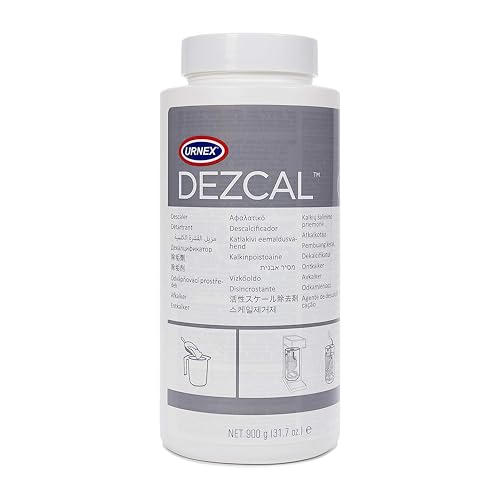
Dezcal Descaler, 900 g
$29.98Live Amazon price · as of 10/26/2026 8:59 PM
The descaler Moccamaster names in its own descaling guide; a bottle covers many cycles. Listing states a universally compatible descaling powder for drip coffee makers, espresso machines, super-automatics and kettles, dosed at 1 oz of powder per 32 oz of reservoir capacity.
$13.49Live Amazon price · as of 10/26/2026 8:27 PM
The liquid option: pre-measured per session, for owners who would rather pour than weigh. Listing states a universal descaling solution, two 8 oz bottles for four sessions at 4 oz each, with a recommended cleaning every 3 to 4 months, compatible with drip, pod, espresso and super-automatic machines and kettles.
$13.10Live Amazon price · as of 10/26/2026 11:10 PM
The single-use, low-waste format: one packet, one descale. Listing states a plant- and mineral-based, biodegradable, phosphate-free descaling powder for coffee and espresso machines and kettles, in two single-use packets.
The descaling agent the instruction books assume you are using; one sachet per descale cycle on the Express. Listing states the official Breville descaler, formulated for Breville espresso machines, coffee makers and kettles, and names the Barista Express BES870 and Bambino Plus BES500 among the machines it is for.
$17.99Live Amazon price · as of 10/26/2026 11:10 PM
For the other job on an espresso machine - the backflush - not for descaling. Listing states professional espresso machine cleaning tablets that remove coffee residue and oils from group heads, valves and lines, recommended as part of a daily backflush regimen, OMRI listed and NSF certified.
$11.98Live Amazon price · as of 10/26/2026 8:02 PM
For the flashing CLEAN light and the FLUSH alert - the backflush cycle, which is not descaling. Listing states official Breville tablets that remove coffee oils and residue from the shower screen and filter baskets, suitable for all Breville espresso machines, with a non-corrosive formulation.
Where the manufacturer allows it, fill the reservoir with the ratio it gives - Cuisinart's instruction book says one part white vinegar to two parts water - run the clean cycle or half a brew cycle, pause twenty to thirty minutes, run the rest through, then run at least two full reservoirs of fresh water to rinse. Check the manual first: Moccamaster and Breville do not recommend vinegar.
How often should I clean my coffee maker?
Rinse the basket and carafe after every brew, wash all removable parts weekly, and descale every one to three months depending on water hardness or when the machine's indicator asks. Moccamaster suggests around every hundred brews and Mr. Coffee's guidance is around ninety, both roughly three months for a daily pot.
Is vinegar or a descaler better?
A descaler works on every machine, including the ones whose makers bar vinegar, rinses without odour, and is stronger against heavy scale; vinegar is cheaper and fine on drip machines whose manuals endorse it. If you own an espresso machine or a Moccamaster, buy the descaler; if you own a drip machine that lists vinegar in its manual, either works.
Can I put my coffee maker parts in the dishwasher?
Only the parts the manual rates for it. Many glass carafes and brew baskets are top-rack safe, many thermal carafes are hand-wash only, French press mesh filters are better hand-washed even where they are rated, and an aluminium moka pot must never go in - Bialetti says so directly.
How do I clean a moka pot?
Let it cool, unscrew it, empty the grounds, rinse every part in warm water without detergent, and leave the parts apart until completely dry before reassembling. Never use the dishwasher on an aluminium pot. Replace the gasket when it hardens and the filter plate when it clogs, and for scale in the base use a citric-acid soak rather than vinegar.
Why does my coffee maker brew slowly or drip after the cycle?
Scale. Minerals from tap water build up on the heater and in the lines until water struggles to pass, so the machine brews slower, runs cooler and sputters or drips at the end. Descaling fixes it, sometimes needing two cycles back to back on a neglected machine, with full rinses between.
Do I need to descale if I use filtered or bottled water?
Less often, not never. Filtered and bottled water still carry some minerals, so scale builds more slowly rather than not at all. Follow the machine's indicator if it has one, and expect the interval to stretch to the long end of the one-to-three-month range.
Sources for this page:
Cuisinart vinegar ratio (1 part white vinegar to 2 parts water), Clean button procedure, repeat-if-indicator-relights and the fresh-water rinse cycle: the Cuisinart DCC-3200 instruction booklet as reproduced on ManualsLib, read 2026-09-07; corroborated by Tom's Guide's and HomeGrounds' Cuisinart cleaning guides, read 2026-09-07 · Mr. Coffee vinegar-and-water fill, clean cycle and ~90-brew interval: Mr. Coffee's published cleaning guidance as reported by Corner Coffee Store, read 2026-09-07 (the manufacturer's page itself served no readable text to our fetch) · Moccamaster: the vinegar sentence quoted above, the Urnex Dezcal / BioCaf recommendation, the ~100-brew interval and the three rinse cycles: Moccamaster USA's descaling guide at us.moccamaster.com, read 2026-09-07 · Bialetti: the detergent and dishwasher sentences quoted above, the drying rule, the first-brews advice and the wear check: Bialetti's Tips and Care page, read 2026-09-07 · Bodum dishwasher guidance (glass, plastic and chrome parts; mesh hand-wash preference): the Bodum 1924 press user instructions and retailer care documentation as reported by manuals.plus and owner guides, read 2026-09-07 · Breville: two separate cycles, the descaling agent, and the two-month filter rule: the BES870, BES878 and BES500 instruction books as read for our Breville descaling guide, 2026-09-07 · Descaler doses and claims (Dezcal 1 oz per 32 oz; Impresa 4 oz per session, every 3–4 months; Full Circle plant-based; Cafiza backflush): each product's own Amazon listing, read 2026-09-07 We have not lab-tested brewers; where a figure is a manufacturer's, the page names the manufacturer, and machine capabilities come from our own published review records.