Home › Guides › Coffee Maker with Grinder
☕ Buying Guide · 2026
Best Coffee Maker with a Built-In Grinder
"Grind and brew" describes two quite different machines, and they suit almost opposite people. Here is the distinction, and the 23 machines in our catalog that have a grinder inside.
23 machines with integrated grinders
9 you operate
14 one-touch
The best coffee maker with a grinder depends on whether you want manual control over espresso or one-touch convenience — because search for one and you get two categories mixed together: espresso machines with an integrated grinder, which grind and dose for you and then hand over control, and bean-to-cup machines, which do the whole drink at one touch. Both are "grind and brew". They suit almost opposite people.
ℹ️
Affiliate disclosure: CoffeeLabAdvisor is an Amazon Associate and may earn a commission from these links, at no extra cost to you. Every machine here is drawn from our catalog by a single specification — whether it has an integrated grinder — not selected by hand for this page.
What is a grind-and-brew coffee maker?
"Grind and brew" is the trade's term for any machine that grinds whole beans and then brews from them without you moving the coffee in between. It is a description of the plumbing, not of a product category — which is precisely why the search results mix two very different machines together, and why the distinction below matters more than any single recommendation.
In this guide the term covers the espresso-oriented grind-and-brew machines in our catalog. Conventional drip coffee makers with a grinder built in are a separate category, and we do not cover them here.
The distinction that decides your purchase
| Espresso machine + integrated grinder | Bean-to-cup |
|---|
| What it automates | Grinding and dosing | The entire drink, often including milk |
| What you do | Prepare the puck and control the extraction; the exact steps vary by machine | Press a button |
| Can you improve results? | Yes — grind, dose and timing are yours to adjust | Within the settings the machine exposes |
| Milk | Usually manual steaming; some models add assistance | Automatic on most models |
| Suits | Someone who wants to make espresso | Someone who wants espresso to appear |
Neither is better. They answer different questions, and the price overlap between them is what makes the category confusing — a well-specified semi-automatic and an entry bean-to-cup can cost the same and deliver completely different mornings.
What integrating the grinder costs you
Two appliances become one, which is genuinely valuable on a small counter and genuinely limiting later.
- Freshness, gained. Ground coffee exposes much more surface area to air than whole beans, which accelerates the loss of volatile compounds. Grinding immediately before brewing minimises the time the coffee spends ground and exposed to air. We have not measured the size of the effect ourselves.
- Counter space, gained. One footprint instead of two, which for many kitchens is the deciding factor. Our dimensions chart has the measurements.
- Grind quality, usually traded. One budget is buying two jobs. At the same total spend, a separate grinder lets you devote a larger share of the money specifically to grinding, which can give you more grinder capability than an integrated system at the same overall price.
- Flexibility, traded. You cannot upgrade the grinder independently, and a failure in either integrated system can mean servicing or replacing the whole appliance.
The honest recommendation: if counter space or simplicity is your constraint, integrate. If cup quality is your constraint and you have room, buy a
separate grinder and a machine without one — you will get more for the same money.
How to read the two lists below. They are not rankings.
Every machine in our catalog with an integrated grinder appears, in price order, split by which of
the two categories above it belongs to. A machine is here because it has a grinder inside, not
because we placed it — and only a machine carrying an award badge has been through a scored
evaluation.
Machines you operate
These grind and dose automatically, then leave the shot to you. They are the better route if you want to learn espresso by controlling the extraction yourself.
Choose this category if control over the shot matters more to you than one-touch convenience.
Choosing within it: these three differ mainly in entry price, how fast they reach temperature, and whether you prefer a dial or a screen. They are not three tiers of cup quality, which is why we have not ranked them.

In our catalog — researched, not scoredSemi-Automatic
Ninja Luxe Café Mini (ES301)
Semi-Automatic · Single heater · integrated grinder
Check price →
A Luxe Café about 30% smaller: grinder with 60 settings and the same grind guidance, a built-in scale, a stored tamper, espresso and hot or iced drip coffee, and a manual steam wand. Its one full hands-on review found drip coffee and crema excellent but espresso volumes inconsistent at identical settings, and it drops the cold brew, cold foam and hot water of the bigger models.
Check price on Amazon → 
In our catalog — researched, not scoredSemi-Automatic
Ninja Luxe Café Mini Plus (ES351)
Semi-Automatic · Single heater · integrated grinder
Check price →
The Mini with an automatic steam wand: a temperature probe in the tip stops the steam for you on three hot presets. The one US hands-on review found its espresso full-bodied and its long drinks accurate, and its wand powerful, but the automatic froth varied a lot from jug to jug; like the Mini it has no cold brew, cold foam or hot water in the US.
Check price on Amazon → 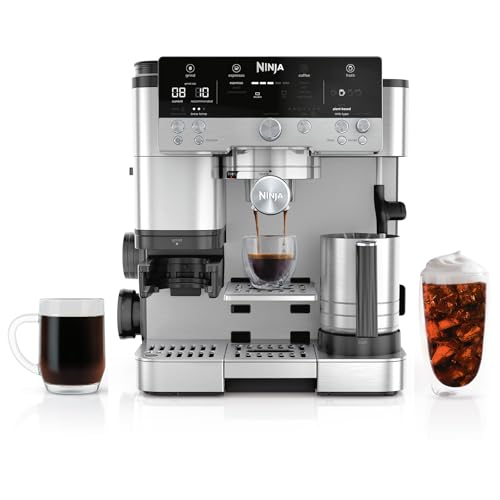
In our catalog — researched, not scoredSemi-Automatic
Ninja Luxe Café Premier (ES601)
Semi-Automatic · Single thermoblock · integrated grinder
Check price →
The machine that made guided espresso mainstream: a conical burr grinder that suggests its own setting, a built-in scale, an assisted tamper, unpressurised 53mm baskets, an automatic whisk-and-steam frother, drip coffee and cold brew. Testers found its dosing very consistent and its shots good with little effort; the guidance can over-correct, the auto milk runs hot, and the US model has no hot water or single basket.
Check price on Amazon → 
In our catalog — researched, not scoredSemi-Automatic
KRUPS Barista Espresso Machine
Semi-Automatic · Single · integrated grinder
Check price →
Check price on Amazon → 
In our catalog — researched, not scoredSemi-Automatic
KitchenAid KES6551 with Burr Grinder
Semi-Automatic · Single thermocoil · integrated grinder
Check price →
KitchenAid's grinder-in-one machine: a conical burr grinder, a 58mm flat-base portafilter, a pressure gauge, a 2.5 L tank with a filter and a separate hot-water spout, on a two-year warranty. Testers rated its milk and its quiet grinder; its dose is timed rather than weighed, and its three temperature steps are coarser than a set temperature.
Check price on Amazon → 
In our catalog — researched, not scoredSemi-Automatic
Breville Barista Express
Semi-Automatic · ThermoCoil · integrated grinder
Check price →
The all-in-one starter package: integrated conical burr grinder, ThermoCoil heating and a steam wand in one footprint, so you do not need a separate grinder to get started. The trade is the one the whole category makes — the grinder cannot be upgraded without replacing the machine.
Check price on Amazon → 
In our catalog — researched, not scoredSemi-Automatic
De'Longhi La Specialista Arte
Semi-Automatic · Single · integrated grinder
Check price →
A compact semi-automatic with an integrated grinder and a built-in tamping lever instead of a loose tamp, which De'Longhi positions as making the dose-and-tamp step more repeatable while you are learning it.
Check price on Amazon → 
In our catalog — researched, not scoredSemi-Automatic
Ninja Luxe Café Pro Series (ES701)
Semi-Automatic · Single thermoblock · integrated grinder
Check price →
The Premier's grinder, scale and guidance with the gaps filled: a lever tamper built into the machine, separate hot water, a single basket, ristretto and lungo presets, a bigger milk jug and a cool-touch wand. Testers measured good, consistent double shots and rated its cold brew and cold foam among the best they had tried; light roasts expose it, auto milk temperature wanders, and several reviewers questioned the premium over the Premier.
Check price on Amazon → 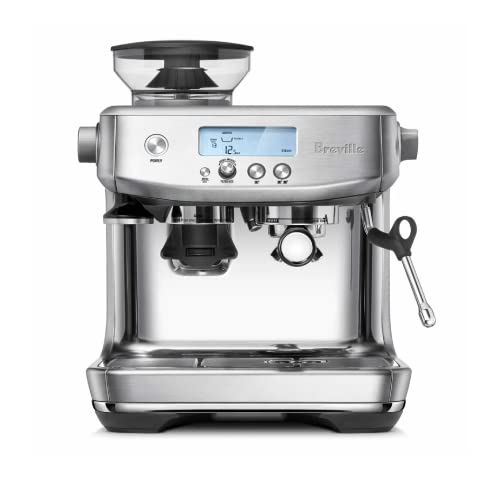
In our catalog — researched, not scoredSemi-Automatic
Breville Barista Pro
Semi-Automatic · ThermoJet · integrated grinder
Check price →
A higher-end integrated-grinder option in Breville's Barista line, with ThermoJet heating and a digital interface in place of the Barista Express's ThermoCoil and dial. Breville states its ThermoJet system reaches extraction temperature in 3 seconds.
Check price on Amazon →
One-touch machines
These complete the drink themselves. Our Best Bean-to-Cup award covers this category on the full scored standard.
Choose this category if convenience and repeatability matter more to you than manual control.
Choosing within it: the money buys breadth of one-touch drinks, milk-system design and how much of the cleaning the machine does for you — not a categorically different espresso. Only the badged machine here has been scored.

In our catalog — researched, not scoredBean-to-Cup
Philips 5400 LatteGo
Bean-to-Cup · Single Thermoblock · integrated grinder
Check price →
A bean-to-cup machine built around the LatteGo milk system, which separates into parts you rinse rather than running milk through internal tubes. That is the practical argument for it: in a household making milk drinks daily, cleaning effort is often what decides whether a machine keeps getting used.
Check price on Amazon → 
In our catalog — researched, not scoredBean-to-Cup
Philips 3300 Series LatteGo
Bean-to-Cup · Single · integrated grinder
Check price →
Check price on Amazon → 
In our catalog — researched, not scoredBean-to-Cup
Philips 2300 Series LatteGo
Bean-to-Cup · Single · integrated grinder
Check price →
Check price on Amazon → 
In our catalog — researched, not scoredBean-to-Cup
De'Longhi Magnifica Evo
Bean-to-Cup · Single Thermoblock · integrated grinder
Check price →
An entry-level bean-to-cup machine with an integrated grinder and automatic milk system. It automates the full drink with a narrower range of configurable specialities than the machines above it — a trade at this level rather than a defect.
Check price on Amazon → 
In our catalog — researched, not scoredBean-to-Cup
Gaggia Anima
Bean-to-Cup · Single · integrated grinder
Check price →
Check price on Amazon → 
In our catalog — researched, not scoredBean-to-Cup
KitchenAid KF2
Bean-to-Cup · Single heater · integrated grinder
Check price →
The only KitchenAid bean-to-cup with a steam wand, and both hands-on testers made better milk with it than with the hose systems on its siblings. It grinds and brews espresso, coffee and an over-ice shot at the press of a button from one of the narrowest bean-to-cup bodies on sale; the over-ice setting is a hot shot poured on ice, and there are no user profiles.
Check price on Amazon → 
In our catalog — researched, not scoredBean-to-Cup
KitchenAid KF3
Bean-to-Cup · Single heater · integrated grinder
Check price →
The KF2's narrow body with an automatic milk hose, a small colour screen and four user profiles, so lattes and cappuccinos are one press. Testers agreed on the slim footprint and split on milk texture; no milk container comes in the box, and the over-ice drinks are hot shots on ice.
Check price on Amazon → 
In our catalog — researched, not scoredBean-to-Cup
Ninja AutoBarista Pro (AE1051)
Bean-to-Cup · Single heater · integrated grinder
Check price →
Ninja's first fully automatic machine: two swappable bean hoppers, a grinder that calibrates itself by pulling test shots, a removable brew unit, drip coffee, iced drinks and a strong steam wand that froths in a jug. Testers split on the espresso, four good, two mixed and two poor; most found shot volumes ran long, calibration used a lot of beans, and you still pour the milk yourself.
Check price on Amazon → 
In our catalog — researched, not scoredBean-to-Cup
De'Longhi Dinamica Plus
Bean-to-Cup · Single Thermoblock · integrated grinder
Check price →
A bean-to-cup machine positioned between De'Longhi's entry machines and the Jura range, with an integrated grinder and the LatteCrema automatic milk system. Its step up from the entry machines is the interface and the milk workflow rather than a different brewing category.
Check price on Amazon → 
In our catalog — researched, not scoredBean-to-Cup
KitchenAid KF6
Bean-to-Cup · Single thermocoil · integrated grinder
Check price →
The entry to KitchenAid's metal-clad full-size range, and the model testers found closest to the KF8 in the cup: rich espresso once the factory settings are adjusted, a removable bean hopper you can swap, and a 2.2 L tank. Milk comes from a hose you put in your own jug, with volume the only setting, and the screen uses buttons rather than touch.
Check price on Amazon → 
In our catalog — researched, not scoredBean-to-Cup
KitchenAid KF7
Bean-to-Cup · Single thermocoil · integrated grinder
Check price →
The KF6 with the parts most buyers miss on it: a touchscreen, a milk container, a dual milk outlet for two drinks at once, named profiles and flat white, cortado and lungo presets. Inside it is the same machine, so the step up buys convenience rather than better espresso.
Check price on Amazon → 
In our catalog — researched, not scoredBean-to-Cup
KitchenAid KF8
Bean-to-Cup · Single thermocoil · integrated grinder
Check price →
KitchenAid's flagship and the most tested machine in its range: a 5-inch touchscreen, six profiles, a plant-milk setting and the longest menu, on the same grinder and brew unit as the KF6 and KF7. The one six-month test reported no drop in extraction after more than 1,400 drinks; several testers still judged the KF7 or KF6 the better value.
Check price on Amazon → 
In our catalog — researched, not scoredBean-to-Cup
Jura E8
Bean-to-Cup · Dual Thermoblock · integrated grinder
Check price →
Jura's mid-range bean-to-cup machine: dual thermoblock heating and one-touch espresso, lungo and milk drinks. It sits below the Z10 in Jura's own range, with a narrower speciality list.
Check price on Amazon → 
🏆 2026 Award Winner — fully scored by usBean-to-Cup
Jura Z10
Bean-to-Cup · Dual Thermoblock · integrated grinder
Check price →
Jura's flagship super-automatic, with Jura's Cold Extraction Process and a servo-driven Product Recognising Grinder. Jura lists its one-touch specialities at 32–40 depending on variant.
Check price on Amazon →
This list is generated from our catalog by the integrated-grinder specification, so it stays in step with the catalog automatically and cannot be quietly curated. Specifications and reference prices come from that catalog and the live Amazon feed. Our build gate rejects any numeric specification in a product verdict that is not backed by a field on that product's own catalog record, or quoted and attributed to the manufacturer — so a spec and a sentence about it cannot drift apart. Badged machines have completed a scored award; the rest are catalog entries that have not. Prices update live; the price on Amazon at purchase applies.
Frequently asked questions
Is a coffee maker with a built-in grinder worth it?
It is worth it for the freshness and the counter space, and it costs you flexibility. Ground coffee exposes much more surface area to air than whole beans, which accelerates the loss of volatile compounds, so grinding immediately before brewing minimises the time it spends ground, and one appliance can take less counter space than a separate machine and grinder. The trade-off is that the grinder and brewer are integrated into the same appliance, so a failure in either system can mean servicing the whole machine, and that one budget is buying two jobs — so at the same total spend, putting a larger share of the budget into a dedicated grinder can give you more grinder capability. That is reasoning from how the cost is divided, not a measurement we have taken.
Is a coffee maker with a built-in grinder better than a separate grinder and machine?
For most people optimising the cup, no — and this is the central point of this page. One budget is buying two jobs, so at the same total spend a dedicated grinder receives a larger share of the money than a grinder built into a machine does. What an integrated machine buys you instead is counter space, one appliance to live with, and a shorter path from beans to drink. If your constraint is space or simplicity, integrate. If your constraint is what is in the cup and you have the room, keep them separate. That is reasoning about how cost is divided, not a measurement we have taken.
What is the difference between a bean-to-cup machine and an espresso machine with a grinder?
They automate different amounts. A semi-automatic with an integrated grinder grinds and doses for you, then you tamp and start the shot yourself — you keep control over the variables and can learn to improve the result. A bean-to-cup machine does the entire sequence at one touch, including milk on many models. Choose the first if you want to make espresso, the second if you want espresso to appear.
Can you use pre-ground coffee in a machine with a built-in grinder?
Most have a bypass or single-dose chute for exactly this, so you can use decaf or a different coffee without emptying the hopper. It is worth checking before you buy if you drink decaf in the evening, because the alternative is emptying and refilling the hopper each time.
Do built-in grinders make good espresso?
Integrated grinders in espresso machines are generally capable of espresso by design — that is what they are there for — and the better ones publish fine adjustment ranges. What they rarely match is a good standalone grinder at the same money, because one budget is buying two jobs. If grind quality is your priority rather than counter space, putting a larger share of the same spend into a dedicated grinder can give you more grinder capability.
How much should I spend on a grind-and-brew machine?
Integrating a grinder adds cost, so these machines start higher than comparable machines without one. Our catalog's grind-and-brew entries run from the mid hundreds to the low thousands. Above that band you are buying automation, milk systems and build rather than a fundamentally better shot.
Sources and methodology
Three terms appear across this site and they mean three different things:
| Term | What it means |
|---|
| In our catalog | A machine we track, with specifications researched and checked against manufacturer documentation rather than copied from retail listings. |
| Recommended catalog pick | An editorial recommendation drawn from that catalog. Researched, not scored, and not an award. |
| Award winner | Completed our full scored evaluation against a published rubric, with its scorecard and known limitations published alongside it. |
What we do not do: we do not physically test these machines, measure shot temperature or pressure, or measure the grind their integrated grinders produce. Product specifications and manufacturer-named technologies are taken from current manufacturer documentation and recorded on our catalog records; they are not findings from our own hands-on testing. Where this page describes what living with a machine is like, that is documented owner and reviewer experience, and it is a weaker class of evidence than a published specification — we keep the two separate rather than blending them into one confident voice. The one machine here that has been scored against a published rubric is our Best Bean-to-Cup winner, and that evaluation is evidence-based rather than hands-on — its methodology and its limits are published with it.
Why the grind-quality comparison is stated the way it is: where we say a separate grinder can give you more grinder capability at the same total spend, that follows from how the budget is divided between two jobs inside one appliance, not from measurements we have taken. It is reasoning from cost, and we would rather say so than imply a test.
Keep going