The question is not which machine is better - both are evaluated on the same published rubric - but whether the things the Breville Barista Pro changes are things you will notice every morning. Both share the same 54 mm portafilter, the same footprint, a built-in conical burr grinder and a manual steam wand. What the Breville Barista Pro changes is the heating system, the number of grind settings, the way the machine talks to you, and how long Breville stands behind it.
ℹ️
Affiliate disclosure: CoffeeLabAdvisor is an Amazon Associate and may earn a commission from the links below, at no extra cost to you. Commissions play no part in anything this page concludes.
The short answer
Buy the Breville Barista Pro if you make more than one drink in a row, or milk drinks daily. Our record marks it as best for home buyers who want fast, convenient espresso; the 3-second ThermoJet removes the brew-to-steam wait that our Breville Barista Express review lists as its documented limitation, and the 30-setting grinder gives you finer control at the espresso end of the range.
Buy the Breville Barista Express if the budget is the constraint. Our record marks it as best for beginners who want a complete all-in-one setup; it makes the same espresso from the same 54 mm basket, and the things it lacks are conveniences, not capabilities.
How we can say this: both machines went through the same published evaluation against the same rubric, and each one's full record is on its review page. That is a repeatable, documented comparison; it is not a tasting, and we say so wherever it matters.
Which one should you buy?
Every row below is resolved from the two catalog records, not from a preference of ours; where the records tie, the row says so.
| If what matters most to you is… | Then | Because |
|---|
| Getting from cold to the first shot fastest |
Breville Barista Pro |
its heating system is recorded as ready in about 3 seconds |
| Fine control over grind size |
Breville Barista Pro |
its review record lists 30 grind settings against 15 on the Express, so each step is a smaller change |
| Paying the least for the all-in-one format |
Breville Barista Express |
it is the lower-priced of the two |
| The longer manufacturer warranty |
Breville Barista Pro |
Breville backs it for longer |
| A screen that shows dose and shot progress |
Breville Barista Pro |
its LCD is recorded in its review as showing dose and extraction feedback |
| Counter footprint |
Either — the records tie |
the two share the same dimensions, so this row is a tie |
Where each one stands
Breville Barista Express
⭐
2026 Best Overall Espresso Machine honorable mention
Beginners who want a complete all-in-one setup
vs
Breville Barista Pro
⭐
2026 Best Overall Espresso Machine honorable mention
Home buyers who want fast, convenient espresso
We publish a score only for award winners, on the award page that justifies it, so this comparison is decided
on what the two machines do rather than on a number. In the words of the two review records: the
Breville Barista Express is A capable all-in-one starter with a built-in grinder and 54mm group. Because the grinder is integrated, moving to a separate grinder changes the workflow rather than replacing a standalone component.
The Breville Barista Pro is The Breville Barista Pro is the best all-in-one espresso machine for most home buyers: 3-second heat-up, a capable built-in grinder, and reliable 54mm extractions. Its ceiling is raised further with a dedicated grinder, which is how our pairing award uses it.
Neither of these is our 2026 award winner. The Best Overall Espresso Machine award went to the Breville Bambino Plus — a different answer to a different question — and its full scorecard is public on the
award page. This page is a comparison of two review records, not an award.
Spec by spec
| Breville Barista Express | Breville Barista Pro |
|---|
| Machine type | Semi-Automatic | Semi-Automatic |
| Model number | BES870XL | BES878 |
| Heating system | ThermoCoil | ThermoJet |
| Heat-up (manufacturer) | Not stated | About 3 seconds |
| PID temperature control | Yes (manufacturer-listed) | Not listed |
| Manufacturer pressure figure | 15 bar pump rating* | 15 bar pump rating* |
| Portafilter | 54 mm | 54 mm |
| Built-in grinder | Yes | Yes |
| Steam wand | Manual | Manual |
| Plant-milk rating (ours) | 4 / 5 | 4 / 5 |
| Water tank | 2.0 L | 2.0 L |
| Dimensions (W×D×H) | 32.5 x 31.0 x 40.6 cm | 32.5 x 31.0 x 40.6 cm |
| Weight | 10.0 kg | 10.2 kg |
| Warranty | 1 year | 2 years |
* Pressure figures are manufacturer-published pump ratings. A pump rating is the pump's maximum, not the pressure at the coffee during a shot, and we have not measured brew pressure on either machine, so the two numbers are shown because the manufacturers publish them, not as comparable measures of extraction. † Marked figures are not confirmed on a manufacturer source for the exact model number listed above; we have left our tracked value in place rather than substitute an unverified one. Plant-milk ratings are our own documented 1–5 scoring, published on each review page.
Portafilter sizes for every machine we cover, with sources, are on our portafilter size chart; footprints are on the dimensions chart.
The price arithmetic
Both machines include their grinder — Built-in grinder: Yes and Yes — so there is no hidden second purchase on either side and the arithmetic is simply the two machine prices.
| Machine | What it is | Live price |
|---|
| Breville Barista Express | Complete setup, grinder built in | $700 |
| Breville Barista Pro | Complete setup, grinder built in | $850 |
At live prices the Breville Barista Pro costs about $150 more than the Breville Barista Express. Prices at retail move, and this figure moves with them; what does not move is what the premium buys, which the sections below take row by row from the two records.
What the extra money changes - and what it does not
Start with what stays the same, because it is most of the machine. Both are semi-automatic espresso machines with a built-in conical burr grinder, a 54 mm portafilter, a manual steam wand, a 2.0 L tank and the same 32.5 × 31.0 × 40.6 cm footprint. The baskets interchange, the accessories interchange, and a shot pulled well on one is not a different kind of espresso from a shot pulled well on the other. If you have read that the Breville Barista Pro makes better espresso, our records do not support that framing: they support faster and more adjustable, which is a different claim.
What changes is four things. First, the heating system: the Breville Barista Express uses a ThermoCoil, the Breville Barista Pro uses Breville's ThermoJet, which Breville states reaches extraction temperature in about 3 seconds. Second, the grinder: our Breville Barista Pro record lists 30 grind settings against 15 on the Breville Barista Express. Third, the interface: the Breville Barista Express has a pressure gauge and indicator lights; the Breville Barista Pro has an LCD with a shot timer and grind feedback. Fourth, the warranty: one year on the Breville Barista Express, two on the Breville Barista Pro, per the catalog records rendered in the spec table below.
Everything else on this page follows from those four rows. Notice what is not on the list: pump pressure (both quote the same 15-bar pump rating, which is a pump maximum rather than a brew pressure), basket size, steam wand type, or plant-milk rating (both carry 4 out of 5 in our records). The premium buys speed, adjustment and information. It does not buy a different category of machine.
ThermoCoil vs ThermoJet: the wait between brewing and steaming
This is the row that decides the comparison for most buyers, and it is the one our Breville Barista Express review records as that machine's limitation: a Thermocoil heating system that requires waiting between brewing and steaming. On a single-heater machine you pull the shot at brew temperature, then the machine has to climb to steam temperature before you can texture milk. On the Breville Barista Express that climb is a pause you stand through; the Breville Barista Pro's ThermoJet is recorded as ready in about 3 seconds from cold and switches between brew and steam faster, which our Breville Barista Pro review lists among its pros.
How much that matters depends entirely on what you drink. If you drink straight espresso or americanos, the difference is the warm-up from cold each morning - real, but seconds rather than minutes. If you make two lattes back to back, you cross the brew-to-steam gap twice every session, and the Breville Barista Pro is the machine that does not make you wait for it. Neither machine has a second boiler: both are single-heater designs and neither can brew and steam at the same moment, which our records list as a con on both sides. The Breville Barista Pro shortens the wait; it does not remove the architecture.
One honest caveat about ThermoJet that applies to the Breville Barista Pro and the Bambino family alike: a heater that reaches temperature in seconds is also a heater with little thermal mass, so temperature stability across a long shot depends on the machine's PID control rather than on a hot block of metal. Breville lists PID temperature control on both of these machines, and neither of our records measures temperature stability - we evaluate from documented evidence, not a bench - so this page does not rank them on it.
15 settings vs 30: what a finer grinder step is worth
Both grinders are conical burr sets built into the machine, and both share the category's structural trade: the grinder cannot be replaced without replacing the machine. Our Breville Barista Express review records its grinder's limited adjustment range at the fine end as a con; our Breville Barista Pro record lists an improved grinder with 30 settings as a pro. The practical difference is the size of each step. Espresso lives in a narrow band of grind sizes, and dialling in means moving one step at a time until a shot runs at the right speed. Twice the settings across a similar range means each step is roughly half the change, so the Breville Barista Pro lets you land between two Breville Barista Express settings that were each slightly wrong.
That is a workflow benefit, not a ceiling benefit. Our Breville Barista Pro record is explicit that the built-in grinder limits ceiling quality versus a dedicated grinder, and the same is true of the Breville Barista Express. If the goal is the best espresso either machine can produce, the answer on both is an external grinder feeding pre-ground coffee into the portafilter - which is exactly why our pairing study for the Breville Barista Express and its sibling for the Breville Barista Pro exist. Buying the Breville Barista Pro for its grinder is buying convenience at the fine end, and that is worth something; it is not buying your way out of the all-in-one compromise.
If the Breville Barista Express's 15 steps ever run out at the fine end, the machine's own manual documents an upper-burr adjustment that extends the range - our Breville Barista Express troubleshooting guide walks through when that is the right fix and when the symptom is something else.
Gauge and lights vs an LCD
The Breville Barista Express shows you a pressure gauge, which reads the pressure the pump is working against and rises when the puck resists, and a row of indicator lights. The Breville Barista Pro replaces the gauge with an LCD that shows grind time, a shot timer and the machine's state, and our Breville Barista Pro review lists that screen among its pros. Neither is more accurate about the espresso itself - the gauge is a proxy for puck resistance, the timer is a clock - but they teach different things. A gauge tells a beginner whether the grind is too coarse before the cup does; a timer tells them how long the shot ran, which is the number every dialling-in guide asks for.
For a first machine the timer is the more useful instrument, because shot time is the variable you will actually change. For an owner who already counts seconds by habit, the gauge is a nice extra and the LCD is a nicer one, and neither should decide a purchase on its own.
One year vs two: the warranty row
Our catalog records a one-year manufacturer warranty on the Breville Barista Express and two years on the Breville Barista Pro. On a machine with a built-in grinder, a pump and a heater, the second year is not a footnote: a warranty is the difference between a support call and a repair bill in the period when a fault is most likely to be a manufacturing one. Read the warranty terms for your own country before you buy - warranty periods differ by market and can change - but on the records we hold, the Breville Barista Pro is backed for twice as long, and that alone recovers part of the price gap for an owner who plans to keep the machine.
Who should buy which
Buy the Breville Barista Express if you want the all-in-one format at the lowest price, you drink mostly espresso or americanos, and a pause before steaming is something you will tolerate rather than resent. Our record marks it as best for beginners who want a complete all-in-one setup, and it is a complete setup in one box. Buy the Breville Barista Pro if you make milk drinks most days, if more than one person in the house drinks coffee at the same time, or if you know from a previous machine that waiting on a heater is what makes you skip the second latte. The four rows above are the reasons.
And consider neither if what you actually want is the best espresso per dollar: a machine without a grinder, paired with a dedicated grinder, is a different architecture that our Bambino comparison and the upgrade advisor cover. The Barista pair is the right answer to one box, one purchase. It is not the right answer to every question.
Where each one wins
| Breville Barista Express | Breville Barista Pro |
|---|
| Built-in conical burr grinder — fresh grinding on demand |
ThermoJet heating — ready in about 3 seconds |
| Adjustable grind size and dose control |
Improved built-in grinder with 30 grind settings |
| PID temperature control (manufacturer-listed) |
LCD screen with dose and extraction feedback |
| Manual steam wand |
54mm portafilter with stable, repeatable extraction |
And where each loses — from the same review records:
| Breville Barista Express | Breville Barista Pro |
|---|
| Grinder has a limited adjustment range for fine espresso settings |
Single boiler — no simultaneous brew and steam |
| Thermocoil heating system — requires waiting between brewing and steaming |
Built-in grinder limits ceiling quality versus a dedicated grinder |
| Takes up significant counter space |
No automatic steam wand option |

Reviewed on our published rubric⭐ Honorable mention
Semi-Automatic · 54 mm portafilter · Built-in grinder · Manual steam
$699.95Live Amazon price · as of 10/26/2026 8:12 PM
A capable all-in-one starter with a built-in grinder and 54mm group. Because the grinder is integrated, moving to a separate grinder changes the workflow rather than replacing a standalone component.
Check price on Amazon → 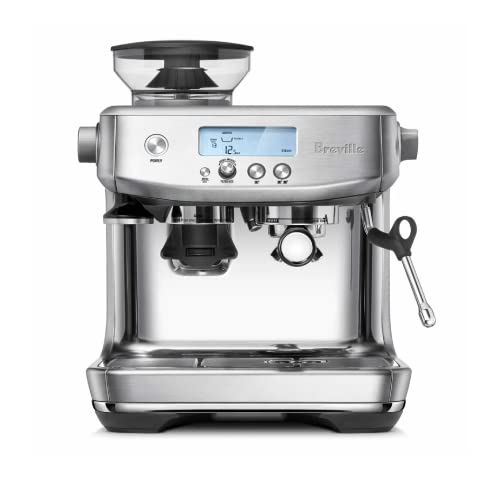
Reviewed on our published rubric⭐ Honorable mention
Semi-Automatic · 54 mm portafilter · Built-in grinder · Manual steam
$849.95Live Amazon price · as of 10/26/2026 8:09 PM
The Breville Barista Pro is the best all-in-one espresso machine for most home buyers: 3-second heat-up, a capable built-in grinder, and reliable 54mm extractions. Its ceiling is raised further with a dedicated grinder, which is how our pairing award uses it.
Check price on Amazon →
Frequently asked questions
Is the Breville Barista Pro worth it over the Barista Express?
For daily milk drinks, our records say yes: the Breville Barista Pro's ThermoJet is recorded as ready in about 3 seconds and switches between brew and steam faster than the Breville Barista Express's ThermoCoil, its grinder carries 30 settings against 15, and it has a two-year warranty against one. For espresso-only drinkers on a tighter budget, the Breville Barista Express makes the same 54 mm espresso for less, and the differences are conveniences you may not use.
Do the Barista Express and Barista Pro make the same espresso?
They share the platform that decides it: a 54 mm portafilter, the same baskets, a built-in conical burr grinder and a manual steam wand. Both are evaluated on the same rubric, and what separates them is heating speed, grind adjustment, the interface and the warranty rather than a different quality of extraction. A well-pulled shot on either is the same kind of drink.
What is the difference between ThermoCoil and ThermoJet?
Both are single-heater systems, so neither machine can brew and steam at the same moment. The Breville Barista Express's ThermoCoil takes longer to reach temperature and to climb from brew to steam temperature, which our review records as its documented limitation. The Breville Barista Pro's ThermoJet is recorded as reaching extraction temperature in about 3 seconds and moving between brew and steam faster. Breville lists PID temperature control on both.
Is the Barista Pro grinder better than the Barista Express grinder?
It is more adjustable: 30 settings against 15 in our records, so each step is a smaller change and dialling in espresso is easier. Both are built-in conical burr grinders with the same structural limit - our Breville Barista Pro record is explicit that the built-in grinder limits ceiling quality versus a dedicated grinder - so neither replaces a separate espresso grinder for someone chasing the best possible shot.
Do they take the same accessories?
Yes. Both use a 54 mm portafilter, so single-wall and dual-wall baskets, bottomless portafilters, dosing funnels and tampers sized for Breville's 54 mm range fit either machine. Our portafilter size chart lists every machine we cover with its basket size and the accessories verified against live listings for each.
Which one is better for a beginner?
Either is a complete beginner setup, because the grinder is included. The Breville Barista Pro's shot timer on the LCD is the more useful teaching instrument, since shot time is the first variable a beginner learns to change, and its faster heating removes a pause that makes new owners skip the milk. Our record marks the Breville Barista Express as best for beginners who want a complete all-in-one setup - the budget-first version of the same recommendation.
Sources for this page: every score, spec, pro and con is rendered from the same two records that produce the Breville Barista Express review and the Breville Barista Pro review; manufacturer figures carry the spec source recorded on each catalog entry (Breville Barista Express: Breville BES870XL product page structured data, read 2026-08-31). We have not physically tested either machine.
Keep going