If you have ever seen an eight-ounce bag of Yemeni coffee priced like a bottle of wine and wondered whether that can possibly be justified, the answer is genuinely interesting. Yemen grows very little coffee, on terrain that resists every labour-saving method the rest of the industry depends on, in a country under enormous strain. The scarcity is real. The romance around it is often not. Much of what circulates about Yemeni coffee — including the story about how "mocha" came to mean chocolate — is folklore that hardened into fact through repetition, so this guide marks the difference as it goes.
Where coffee actually started
There is a distinction worth getting right, because almost every article flattens it. The plant is not Yemeni. Kew's Plants of the World Online gives the native range of Coffea arabica as eastern South Sudan, south-western Ethiopia and northern Kenya (Mount Marsabit) — north-east Africa, not the Arabian Peninsula. What began in Yemen is coffee as a crop: deliberately planted, harvested, traded, and brewed into a drink people organise their day around.
Both halves of that sentence matter. Yemen did not discover the plant, and the popular claim that Yemen "gave the world coffee" is too broad. What it did was turn a wild African tree into an agricultural commodity and a drinking culture, and then supply the world with it for roughly two hundred years.
By the 15th century, coffee was established in Yemeni Sufi communities, drunk to stay alert through long night prayers and dhikr. That is the practical origin of coffee as a beverage culture: not a café, but a devotional aid. Early Arabic accounts attribute its introduction to particular figures and dates, but they differ from one another, and none amounts to evidence that cultivation began in a specific year. From the monasteries it spread to Mecca, Cairo, Damascus, and Istanbul, and the coffeehouse — that specific institution where people sit, talk, and stay too long — followed it.
15th century
Coffee becomes established among Yemeni Sufi communities as a devotional stimulant — the earliest well-documented coffee-drinking culture. Traditional accounts place this around the middle of the century; the precise date is not settled.
1500s
Coffee spreads through the Ottoman world, and Yemen becomes its dominant commercial source. Its terraces expand to meet the demand.
1500s–1700s
Yemen is the principal commercial source of coffee for the Middle East and an important source for Europe, with the Red Sea port of Mokha as its principal export hub. Yemeni merchants and authorities restrict the export of living plants and viable seed to protect the trade. Later accounts also describe beans being treated to stop them germinating; that detail is repeated far more confidently than the surviving evidence supports.
1600s–1700s
The monopoly ends. Viable plants and seed leave Yemen by several routes over several decades — including to India and to Dutch-controlled Java — and once colonial plantations are established elsewhere, Yemen can no longer control supply.
Today
Yemen produces a fraction of a percent of world coffee — and commands some of the highest prices per pound in the specialty market.
Where we have deliberately hedged. The early history of coffee is unusually myth-prone, and several of its best stories are not securely evidenced. We give the 15th century rather than a specific year, and "roughly two centuries" as an approximation, because the accounts differ and none is decisive. We say Yemen was the dominant source rather than the only one, and that Mokha was the principal hub rather than claiming every bean passed through it. We report the bean-sterilising story as a later account rather than as fact. If you see those claims stated more precisely elsewhere, the extra precision is usually not coming from better evidence.
Native range of Coffea arabica from Plants of the World Online (Royal Botanic Gardens, Kew), which gives it as "E. South Sudan, SW. Ethiopia, N. Kenya". Trade history cross-checked against the Port of Mokha record and documentation of early Arabic coffeehouse culture. Dates are given as approximations rather than false precision.
The port that named your mocha
Mokha (al-Makha) is a small, hot, now-quiet town on Yemen's Red Sea coast. For roughly two hundred years it was one of the most important trading posts on the planet — the principal hub through which Yemeni coffee reached Europe, Persia and the Ottoman world. It was an export port, not a growing region: the coffee itself came down from the mountains inland.
The English word derives from the name of the port. Mocha enters English in 1773 meaning fine coffee — specifically coffee produced in Yemen — from the name of the port it shipped from. The sense everyone knows today, a mixture of coffee and chocolate, is not recorded until 1849, some seventy-six years later.
A story worth not repeating. You will very often read that "mocha" came to mean chocolate because Yemeni beans of that era tasted chocolatey. It is a tidy explanation and we cannot find evidence for it. What the record actually shows is a two-step drift: the port's name came to mean Yemeni coffee, and decades later it was attached to a coffee-and-chocolate drink. Yemeni coffees genuinely can carry cocoa-like notes — but that is a tasting observation, not a documented cause of the word's modern meaning, and this page will not present it as one.
The Mocha-Java connection: often described as the world's oldest recorded coffee blend, pairing Yemeni Mocha with Indonesian Java — heavy, fruity, spiced against earthy and low-acid. Who first combined them, and when, is not securely established. What matters to a buyer is simpler: much of what is sold today as "Mocha Java" contains no Yemeni coffee at all. It is a style name, not an origin claim.
Dates for both senses of mocha from the Online Etymology Dictionary, which records 1773 for "fine coffee," properly that produced in Yemen, from the Red Sea port "from which coffee was exported (the beans themselves grew further inland)," and 1849 for the coffee-and-chocolate sense.
Why Yemeni coffee costs so much
The price is not marketing. Four compounding factors make Yemeni coffee genuinely expensive to produce.
1. There is almost none of it
The FAO's assessment of the Yemeni coffee value chain reports national production of 20,812 tonnes in 2019, from 34,981 hectares. That is well under 1% of world output — a rounding error next to Brazil's or Vietnam's harvests. Treat it as a dated benchmark rather than a current annual figure: Yemeni production has fluctuated considerably, the data is incomplete, and no one is publishing a reliable live number.
The number that makes the scarcity concrete is smaller. The same assessment puts average land ownership at around 0.3 hectares — roughly 394 coffee trees — producing an average of about 114 kg of coffee per farmer. Yemeni coffee is not produced by estates. It is produced by very large numbers of people each growing a very small amount.
2. Mechanisation is unusually difficult
Yemeni coffee grows on terraces cut into steep mountainsides; many of the best-known growing areas sit between roughly 1,500 and 2,700 metres. Many terraces were built by hand centuries ago, cannot be widened, and are reached by gradients that rule out the tractors and mechanical harvesters used at scale elsewhere. Production is correspondingly labour-intensive: cherries are typically hand-picked and processed on the farm, often dried on the flat rooftops of farmhouses. This is a constraint of terrain and plot size rather than an absolute — the FAO assessment discusses drying centres, milling and other infrastructure as upgrade opportunities — but it is why the labour cost per kilo is so high.
3. The yield is unusually poor
Yemen's coffee is largely rain-fed in an arid climate, and the trees are genuinely water-stressed. Some Yemeni producers and importers report cherry-to-green conversion ratios as poor as 10:1 — meaning ten kilos of picked cherry yielding one kilo of green coffee. Treat that as an industry-reported, origin-specific figure rather than a constant: conversion varies substantially with variety, ripeness, cherry quality, processing, moisture and exactly what is being weighed at each stage.
Water stress is frequently said to concentrate flavour. It is more accurate to say that altitude, climate, genetics, traditional farming and dry processing together produce the character associated with Yemeni coffee; singling out one variable as the cause is tidier than the agronomy supports.
4. Everything else is harder too
Conflict has, in the FAO's words, "severely increased the cost structure for all players along the coffee value chain, making Yemeni coffee less competitive". Governance is divided, leaving exporters dealing with two administrations and two taxation systems whose rules frequently conflict. Financing is hard to obtain, particularly for smallholders. Water scarcity is severe. And coffee competes directly for land with qat, a water-intensive cash crop that sells locally, pays faster, and needs no export infrastructure at all.
What that adds up to: specialty Yemeni coffee sells at a large premium to mainstream coffee, with retail prices varying widely by lot, roaster, bag size and sourcing model — which is why any "$X per bag" figure is close to meaningless unless the weight is stated. Compare by price per pound, not per bag. The premium has real production and supply-chain drivers behind it, but a high retail price does not by itself tell you how much of it reaches the farmer.
Production, farm-size, cost-structure and qat figures from the FAO assessment report on the coffee value chain in Yemen (2019 production year). Trade context cross-checked against MTPak Coffee's roaster-facing analysis. Where the FAO and secondary coffee-trade sources disagree, we follow the FAO.
What it tastes like
Yemeni coffee has predominantly been dry-processed — whole cherries dried before hulling, the fruit fermenting around the bean as it dries. That, combined with altitude, heirloom varieties and traditional farming, produces a profile that is distinctive next to a modern washed coffee. "Predominantly" is doing real work in that sentence: newer specialty producers also use controlled fermentation and experimental drying. In the Alliance for Coffee Excellence's Best of Yemen 2022 auction, lots were listed as natural, "slow dried" and "Alchemy" — the last a proprietary process involving controlled fermentation rather than a synonym for sun-drying. Even among top Yemeni specialty lots, processing is no longer limited to conventional natural drying.
| Attribute | Common Yemeni characteristics | Compared to a washed Ethiopian or Colombian |
|---|
| Body | Medium to heavy; often syrupy and coating | Often perceived as fuller |
| Acidity | Variable — often wine-like, ranging from soft to pronounced | Less citric in character, but not reliably lower |
| Flavour notes | Dried fruit (raisin, date, fig), cocoa, warm spice, cardamom, winey or fermented notes | Often denser, fruitier and more ferment-forward than a washed lot |
| Finish | Often long and sweet, sometimes savoury or rustic | Often perceived as longer |
Two cautions on that table. These are tendencies, not guarantees — Yemeni coffees vary enormously by lot, and the widespread claim that they are uniformly low-acid is not reliable; some, including well-known Bani Matar lots, can be markedly acidic. And it divides people, as it should: if your ideal cup is a crisp, floral, tea-like pour-over, Yemeni coffee will feel dense and old-world. If you enjoy intense natural-process coffees, it is one of the most distinctive origins to explore.
The regions worth knowing
Yemeni coffee is sold under regional and trade names, and a named region is among the most useful things a label can give you. Common Yemeni trade and regional names include those below. We describe them geographically and by trade history rather than by flavour — and note that Yemeni coffee nomenclature mixes localities, historic trade labels and bean types, so a name does not always map neatly onto an administrative area.
- Haraaz — high mountain terraces west of Sana'a; among the most consistently exported Yemeni coffees, and the region you will most often see named on a bag.
- Bani Matar — west of Sana'a, and the historical source of much of what was traded as "Mocha Mattari".
- Yafe' — southern highlands, in the Lahij and Abyan uplands.
- Ismaili / Bani Ismail — a traditional Yemeni designation associated with both local geography and a historically recognised coffee type, rather than with a single administrative area.
- Sana'ani — a broad designation covering coffees from the areas around the capital, rather than a single locality.
Do not treat a region as a tasting note. Cup profiles vary considerably within any of these regions — by farm, altitude, variety, harvest and processing. A region name tells you something real about provenance. It does not promise you a flavour.
Yemeni vs Ethiopian coffee
These two origins are constantly confused, partly because the history genuinely entangles them: the plant is native to north-east Africa, and Yemen is where it became a crop.
| Yemeni | Ethiopian |
|---|
| Relationship to the plant | Cultivated from Arabica originating in north-east Africa | Within the native range of Coffea arabica |
| Historical role | Early centre of coffee cultivation, and the centre of the early international coffee trade | Native genetic home of the species |
| Usual processing | Predominantly natural/dry | Both washed and natural, at scale |
| Typical character | Dried fruit, cocoa, spice, winey notes; often heavier | Frequently floral, citric, tea-like — especially washed lots |
| Production scale | Tiny — around 20,000 tonnes | Very large — a top-five global producer |
| Typical price | Among the highest at retail | Wide range, from commodity to top specialty |
How to read a Yemeni coffee label
"Mocha" on a label means nothing on its own — it is far more often a flavour descriptor or a blend name than an origin claim. What a label can tell you is how much the seller knows about their own supply chain, and how much of it they are willing to put in writing.
First, a caution about the word "authentic". Nothing printed on a bag proves origin. A well-documented label is a seller being specific and accountable, which correlates with a real supply chain — but a genuine Yemeni coffee can carry a poor label, and a bag can be beautifully packaged and still not be what it says. Treat the list below as provenance signals ranked by how hard they are to assert casually, not as a test that returns "real" or "fake".
Stronger signals — specific, checkable, and awkward to fake:
- Country of origin stated explicitly as Yemen
- A named growing region (Haraaz, Bani Matar, Yafe', Ismaili)
- A named producer, farm, cooperative or sourcing partner
- The importer or exporter identified
- Harvest year or season, and lot or traceability information
- A stated processing method
- A seller who will answer sourcing questions and show documentation if asked
Weaker signals — useful, but not evidence of origin: altitude; roast date (that is freshness, which matters, but says nothing about where the coffee came from); detailed tasting notes; and price.
Not signals at all: the words "Arabian", "Mocha", "heritage", "artisan" or "authentic"; a chocolate-flavoured coffee using the word mocha; vague "Middle Eastern blend" language.
Price is not proof, in either direction. This page previously listed "a price that reflects production reality" as an authenticity check, and that was wrong. A legitimate Yemeni coffee can sell cheaply — small bag, promotion, direct sourcing, a roaster clearing stock. An expensive coffee can still be poorly documented or mislabelled. An unusually low price on a bag claiming Yemeni origin is a reason to look harder at the rest of the label. It is not a verdict.
Yemeni coffee remains a specialist purchase, sold mainly by importers and roasters working directly with Yemeni exporters rather than by mass-market brands. Buying from a seller who provides specific origin and traceability information — region, season, producer, sourcing partner — is among the most useful things a consumer can actually do.
Where to buy Yemeni coffee beans
Yemeni coffee beans are sold mainly by specialist importers and roasters, with a smaller number of listings on Amazon. If you are shopping for Yemeni coffee online, the most useful starting point is not the cheapest bag or the word "Mocha" on the label, but the amount of origin and sourcing information the seller is willing to put in writing.
ℹ️
Affiliate disclosure: CoffeeLabAdvisor is an Amazon Associate and may earn a commission from the links below, at no extra cost to you. That commission plays no part in which coffees we list — the vague "Arabian Mocha" listings that carry no provenance information are deliberately absent, even though several of them outsell everything here.
Important — what these listings are, and what they are not. CoffeeLabAdvisor has not cupped these coffees, inspected the lots, visited the farms, or audited the supply chains. Everything in the table below is what the seller's listing states, recorded so you can see exactly how much provenance each one offers. We present them as purchase options that clear a stated minimum, not as CoffeeLabAdvisor-verified Yemeni coffees. We are not in a position to certify any coffee as genuine, and neither is any other website that has not tested it.
Our minimum bar for inclusion: origin stated explicitly as Yemen, plus at least one provenance detail beyond the processing method — a named growing region, producer, cooperative, importer or exporter, lot, or harvest. Processing information alone does not qualify a listing, because a seller typing "natural" tells you nothing about where the coffee came from. That is still a lower bar than the full provenance list above — most Amazon listings will not carry a harvest year or a named cooperative — so the table records what each listing is missing as well as what it shows.
| Coffee | Region stated | Process stated | Also shows | Not shown |
|---|
| Al-Aqeeq | Haraaz | Natural | Organic, medium roast, whole bean | Harvest year; named producer |
| Red Sea Coast Hiwari Heritage | Hiwar Valley, Ibb Al-Gafr | Natural | Tasting notes | Harvest year; named producer |
| Harazi Coffee Ancient Typica | Haraz | Natural | Seller-stated variety; roasted in Yemen; 380 g | Harvest year; independent variety verification |
| Al Mokha Medium Roast | Yemen (company publishes sourcing regions) | Dry | Yemen-specialist company | Per-lot region on the listing itself |
No "best overall" is named here, and none of these is presented as a winner. We rank coffees only where we have applied our full evidence standard — see the scored Best Coffee Beans award for what that involves.

Region namedAl-Aqeeq
Whole Bean Yemen Coffee, Haraaz Region
Listing shows: Yemen; Haraaz region; natural
Check price →
The listing names Haraaz, one of the growing regions this page lists, on the front of the bag, and describes the coffee as specialty-grade organic Arabica, medium roast, whole bean.
Check price on Amazon → 
Region + processRed Sea Coast
Hiwari Heritage Yemeni Coffee
Listing shows: Yemen; Hiwar Valley, Ibb Al-Gafr; natural
Check price →
The listing names both a growing area (Hiwar Valley, Ibb Al-Gafr) and the processing method (natural) — the combination this page tells you to look for. Its stated tasting notes run to apple, berry and nut.
Check price on Amazon → 
Region + process + stated varietyHarazi Coffee
Ancient Typica, Roasted at the Source
Listing shows: Yemen; Haraz; natural; seller-stated “Ancient Typica”; roasted in Yemen
Check price →
The most detailed listing here: it names the Haraz region and the natural process, says the coffee is roasted in Yemen rather than after export, and identifies the variety as “Ancient Typica” — a seller designation we have not genetically verified. A 380 g bag.
Check price on Amazon → 
Yemen-specialist sellerAl Mokha
Yemen Medium Roast, Whole Bean
Listing shows: Yemen; company publishes its sourcing regions
Check price →
From a company built specifically around Yemeni coffee and named for the port this page is about, which publishes sourcing information for its Yemeni lots.
Check price on Amazon → 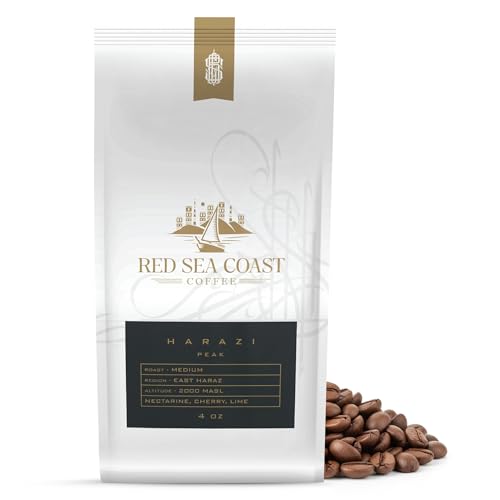
Region + process + stated altitudeRed Sea Coast
Harazi Peak, East Haraz Micro-Lot
Listing shows: Yemen; East Haraz – Mathabiha; Anaerobic Process; 2000 MASL; light roast
Check price →
Names the growing area down to the village (East Haraz – Mathabiha), calls the lot a micro-lot, states an altitude, and names the processing method as anaerobic, a sealed-tank fermentation. The smallest bag here at 4 oz, which is exactly why the per-pound comparison below matters.
Check price on Amazon →
A note on price: these are small bags — some as little as 4 oz — so compare them per pound, not per bag, and do the same with any Yemeni coffee you see elsewhere. Bag size is the single most common reason two Yemeni coffees look wildly differently priced when they are not. Prices update live from Amazon and are accurate as of the time shown on each card; the price displayed on Amazon at purchase applies.
Buying Yemeni coffee responsibly
This page has treated Yemen's situation mainly as a cost driver, which is how a buying guide naturally frames it and is not the whole picture.
Yemen's coffee sector operates inside a severe and prolonged humanitarian crisis. The UN's Humanitarian Needs and Response Plan for 2026 reports that more than 22 million people in Yemen require humanitarian assistance and protection, and that 18.3 million people are acutely food insecure. The FAO's assessment of the coffee value chain describes conflict severely increasing costs at every stage, divided governance leaving exporters facing two administrations and two tax systems, and smallholders struggling to obtain finance.
The practical consequence for a buyer is worth stating plainly: a high retail price does not mean the money reaches the farmer. Long chains, currency instability and multiple intermediaries sit between a bag on Amazon and a smallholder with 0.3 hectares. If farmer benefit matters to you, look for roasters that disclose their sourcing relationships, name their partners, or give meaningful information about producer payments and premiums — and treat that disclosure, not the price tag, as the thing worth paying for. The absence of such disclosure is not proof that a roaster pays badly; it simply means you cannot tell.
Humanitarian figures from the OCHA Yemen Humanitarian Needs and Response Plan 2026, published 29 March 2026. Value-chain constraints from the FAO coffee value chain assessment. We include this context because it affects the coffee supply chain and the people producing it.
How to brew it
Expensive coffee deserves measured brewing, not guesswork.
- Weigh your dose. At this price, a 20% scooping error is real money. Start at 1:16 and adjust — our coffee-to-water ratio calculator does the arithmetic for any batch size.
- Pour-over or drip keeps the fruit clear and the body intact. French press pushes the heavy body further, if that is what you want from it.
- Water just off the boil — start around 200°F / 93°C. If the cup tastes bitter or drying, adjust grind and temperature together rather than blaming the temperature alone; extraction depends on roast level, grind and contact time as much as on heat.
- Grind fresh, and match the grind to the method — medium is a reasonable starting point for pour-over. Dried-fruit aromatics are the first thing to disappear from pre-ground coffee; if you do not own a burr grinder yet, our Best Overall Burr Grinder award covers the evidence-led pick.
- Try qishr once. This traditional Yemeni drink brews the dried coffee husks rather than the roasted beans, commonly with ginger and sometimes other spices — lighter, spiced, and closer to a tea. It sits alongside brewed coffee in Yemen rather than replacing it.
The gear it deserves
Nothing here is Yemen-specific — it is simply the kit that suits an expensive natural-process coffee, and each item matches a recommendation made above rather than being added to fill a grid.

Pour-overHario
V60 Ceramic Dripper
Check price →
Keeps the dried-fruit notes clear and separated — the method this page recommends first for Yemeni naturals.
Check price on Amazon → 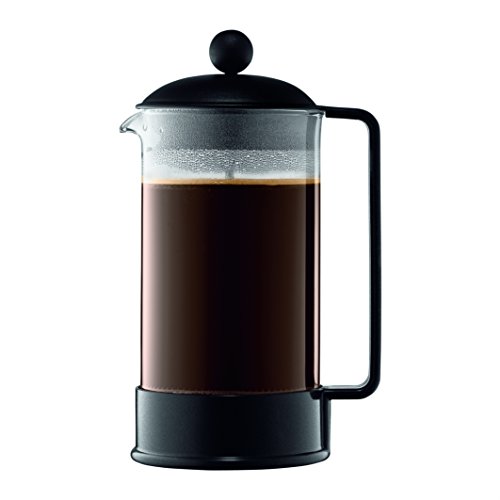
For maximum bodyBodum
Chambord French Press
Check price →
No paper filter, so the oils stay in the cup. Pushes the heavy, syrupy body of a natural-process coffee even further.
Check price on Amazon → 
Stop scoopingGreater Goods
Coffee Scale with Timer
Check price →
The cheapest way to stop wasting expensive coffee: brew to a weight you can repeat, instead of to a scoop that varies.
Check price on Amazon → 
Water controlCosori
Gooseneck Kettle, Temperature Control
Check price →
Lets you hold a repeatable brew temperature around 200°F / 93°C instead of guessing, and pour slowly enough to control the bed.
Check price on Amazon →
Affiliate links — CoffeeLabAdvisor may earn a commission at no extra cost to you. For grinders evaluated on our full evidence standard rather than picked for a guide, see the Best Overall Burr Grinder award.
Frequently asked questions
Why is Yemeni coffee so expensive?
Several factors compound. Volume: the FAO recorded 20,812 tonnes in 2019, well under 1% of world output, and average production of about 114 kg per farmer. Terrain: most of it grows on hand-built mountain terraces, where steep gradients and tiny plots make the mechanisation used elsewhere impractical, so production stays labour-intensive. Yield: the trees are largely rain-fed and water-stressed, and some producers report cherry-to-green ratios as poor as 10:1, though conversion varies with variety, ripeness, processing and how the weights are taken. On top of that, conflict has sharply increased costs across the value chain, governance is divided, finance is hard to obtain, and coffee competes for land with qat. Compare prices per pound rather than per bag — bag sizes vary so much that per-bag figures mislead.
Is Yemeni coffee the origin of all coffee?
No, and the distinction matters. Kew gives the native range of Coffea arabica as eastern South Sudan, south-western Ethiopia and northern Kenya — the plant is north-east African, not Arabian. What Yemen did was turn it into a crop: by the 15th century, Sufi communities there were cultivating coffee and drinking it to stay alert through night prayers, which is the earliest well-documented coffee-drinking culture. Traditional accounts place this around the middle of the century, though the precise date is not settled. Yemen then became the dominant commercial source for the Middle East and Europe for roughly two centuries, exporting principally through the Red Sea port of Mokha.
What does "mocha" have to do with Yemen?
The name comes from Mokha (al-Makha), the Yemeni Red Sea port that exported the coffee — though the beans themselves grew inland. "Mocha" is recorded in English from 1773 meaning fine coffee, specifically coffee produced in Yemen. The coffee-and-chocolate sense everyone knows today is not recorded until 1849, some seventy-six years later. You will often read that the word came to mean chocolate because Yemeni beans tasted chocolatey; that is a popular explanation we could not find evidence for, and the gap between the two dates does not support it.
What does Yemeni coffee taste like?
Yemeni coffee is predominantly natural (dry) processed, which tends to give it a medium-to-heavy, often syrupy body and deep dried-fruit and spice notes — raisin, date, cocoa, cardamom, frequently a winey or fermented edge. Acidity is variable rather than uniformly low: some lots are soft, others markedly acidic. It tastes noticeably different from the bright, clean washed coffees that dominate specialty menus, which is why people either love it immediately or need a cup or two to adjust. Treat all of that as tendencies, not guarantees — lot-to-lot variation is large.
How should I brew Yemeni coffee?
Treat it gently and let the body show. A pour-over or drip brew at a standard 1:16 to 1:17 ratio works well; a French press flatters the heavy body even more. Because these coffees are expensive, weigh your dose rather than scooping — our coffee-to-water ratio calculator handles the maths. Traditional Yemeni preparation, qishr, actually brews the dried coffee husks with ginger rather than the beans.
Where can I buy real Yemeni coffee?
Mostly from importers and roasters who specialise in it rather than from supermarket shelves, though a number of Yemeni coffees are now listed on Amazon — we list the ones above whose listings state a Yemeni origin plus a named region or a stated process. We have not verified any of them ourselves, and we say so on the page. Whatever the channel, apply the same reading: a seller with a real supply chain will name the region (Haraaz, Bani Matar, Yafe, Ismaili), the process, and often the harvest year and their sourcing partner. A bag that says only "Arabian Mocha" is giving you a flavour description, not an origin claim.
How do I know Yemeni coffee is genuine?
Strictly speaking you cannot, from a label alone — nothing printed on a bag proves origin, and no website that has not tested a coffee can certify it either. What you can do is read the provenance. Stronger signals are specific and awkward to assert casually: origin given explicitly as Yemen, a named growing region, a named producer or cooperative, the importer or exporter identified, a harvest year, and a seller who will answer sourcing questions. Weaker signals include altitude, roast date and tasting notes. Price is not a signal at all — a genuine Yemeni coffee can be cheap and an expensive one can be poorly documented. Vague "Mocha Java" or "Arabian Mocha" labelling is usually a blend or flavour name rather than an origin claim.
Keep going