8 facts, each with a source below6 questions answered5 verified products
Fill the kettle with an acid — equal parts white vinegar and water, or 500 mL of water with 2 spoonfuls of citric acid — boil it, then let it stand at least 30 minutes before emptying, rinsing, and boiling a full kettle of clean water away. That is Fellow's published routine. OXO's differs in the detail and adds the part most owners never read: “The warranty is voided if descaling is not carried out in accordance with these instructions.” How often depends on your water, not your habits — Fellow says about once a month in hard water, every two to three months in soft; OXO says every 60 uses.
The agentAn acid: white vinegar, citric acid, or a bought descaler
Fellow's vinegar recipeEqual parts white vinegar and water
Fellow's citric recipe500 mL water with 2 spoonfuls of citric acid
SoakAt least 30 minutes — both makers agree
OXO's intervalEvery 60 uses
Fellow's intervalMonthly in hard water, every 2–3 months in soft
The warranty catchOXO voids it if you descale outside its instructions
NeverSteel wool or an abrasive brush — it scratches the surface
The two routines we could verify, in the makers' own numbers. They agree on the acid and the half-hour soak, and disagree on almost everything else.
What you are actually removing
OXO puts it plainly in its instruction booklet: Scale is a naturally occurring buildup of mineral deposits. It is not dirt, it is not mould, and no amount of scrubbing will shift it, because it is not stuck on — it is precipitated out of the water onto the element and the walls. That is why every published routine uses an acid rather than a detergent. The acid dissolves the carbonate; soap does nothing to it.
It matters beyond appearance. OXO's own argument for doing it is performance, not looks: Regular descaling can also increase the service life of the Kettle, allowing it to boil water faster with less energy. Scale sits between the element and the water as an insulator, so a scaled kettle works harder for the same cup.
The two routines we could verify, in full
We looked for manufacturer instructions we could read in the makers' own words rather than a recipe passed between blogs. Two were readable in full, and they do not match.
OXO, in the booklet for its cordless glass kettle, numbers the steps: fill with descaling solution and water to the MAX marking; Bring solution to a boil.; Turn Kettle OFF, unplug from outlet and let stand for at least 30 minutes.; Empty Kettle and rinse out any remaining solution.; then Fill Kettle with water to ‘MAX’ marking, boil, and discard water before next use. On the solution itself OXO is deliberately open-ended — it notes only that descaler is Available where household cleaning products are sold; follow solution’s recommended use.
Fellow publishes two recipes instead of pointing at a bought product. For vinegar: Fill the kettle with equal parts white vinegar and water. For citric acid: combine 500 mL of water with 2 spoonfuls of citric acid. Either way, Leave the solution in the kettle for at least 30 minutes, so it has time to loosen the mineral buildup.
The half-hour soak is the one number both land on. Everything else — what you put in, whether you boil before or after adding it, how often — differs by maker.
How often, and why the answer is about your water
Neither maker gives a calendar date, because the right interval is set by water hardness rather than by time. OXO offers a count: Descale the Kettle every 60 uses. For a two-cups-a-morning household that is roughly monthly; for an office kettle it might be a fortnight.
Fellow splits it by water instead: Descale your kettle about once a month in hard-water areas or every two to three months if you have soft water. Both framings point the same way — if your water leaves white marks on taps and glassware, you are at the frequent end of the range, and if it does not, you are not.
The honest version is that you should descale when you can see it or feel it in the performance, and use these numbers as the outer bound rather than a schedule to keep.
The sentence most owners never read
Buried in OXO's troubleshooting and descaling section is a line with real consequences: The warranty is voided if descaling is not carried out in accordance with these instructions.
Read that carefully, because it cuts two ways. Not descaling can cost you the warranty — and so can descaling the wrong way. If your kettle is still in warranty and its booklet names a specific product or procedure, a vinegar recipe you found elsewhere is a departure from those instructions, whatever it does to the scale.
This is the one place where we would not generalise across makers. Find your own model's booklet before the first descale, and follow it over anything on this page.
What not to do
Do not scrub it off. Fellow is explicit: Avoid steel wool and other abrasive cleaning tools, which can scratch the surface. A scratched interior gives new scale more to hold onto, so abrasion makes the next descale worse rather than better. If a soak has not cleared it, the answer is another soak.
Do not skip the rinse. Both routines end with a full kettle of fresh water boiled and thrown away. Vinegar in particular leaves a smell that will carry into tea, and the point of the final boil is to clear it.
Do not descale a hot or plugged-in kettle. OXO's sequence has you turn it off and unplug it before the stand time, which is also when the kettle is full of hot acid.
Vinegar, citric acid, or a bought descaler
All three are acids and all three dissolve carbonate scale. The practical differences are smell, strength and whether your warranty names one.
White vinegar is in the cupboard already and Fellow publishes a ratio for it. Its drawback is the smell, which can need a second rinse to clear.
Citric acid is the same chemistry without the smell, and Fellow's ratio — 500 mL of water to two spoonfuls — is a stronger solution than a 1:1 vinegar mix. It is sold as a powder and keeps indefinitely.
A bought descaler is what OXO's instructions assume, and it is the safest choice while a kettle is in warranty because follow solution’s recommended use is then the instruction you are complying with. It is also the most expensive way to buy an acid.
Verified products for this page
ℹ️
Affiliate disclosure: CoffeeLabAdvisor is an Amazon Associate and may earn a commission from these links, at no extra cost to you. Commissions play no part in what appears here — every product traces to a verified catalog entry or a published review.
The two kettles whose published instructions this page quotes, and the descalers the makers point to. Kettle cleaner is sold wherever household cleaning products are; a bought descaler and citric acid do the same chemical job.
Kettle
OXO
Brew adjustable temperature kettle
$119.95Live Amazon price · as of 10/09/2026 11:05 AM
Adjustable temperature in a glass body - a standard spout, not a gooseneck, so it suits tea and drip more than V60. Listing states a borosilicate glass body with measuring marks, temperature control from 104°F to 212°F that holds the selected temperature for up to 30 minutes, a single-dial control with a digital screen, and a cordless 360-degree swivel base.
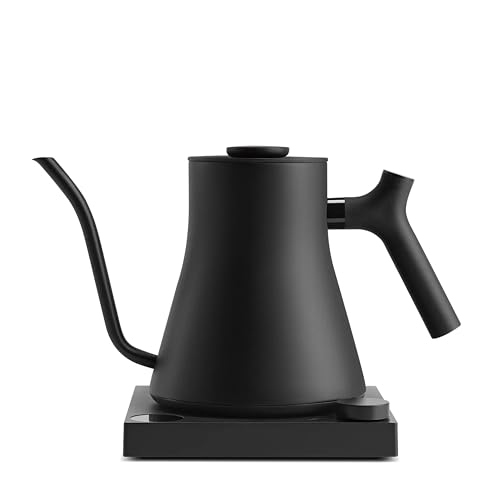
The reference electric gooseneck - to-the-degree control and the spout the pour-over guides are written around. Listing states a 0.9 L electric gooseneck kettle with a precision spout, to-the-degree temperature control, a high-resolution LCD screen and a brew timer.
$29.98Live Amazon price · as of 10/09/2026 11:05 AM
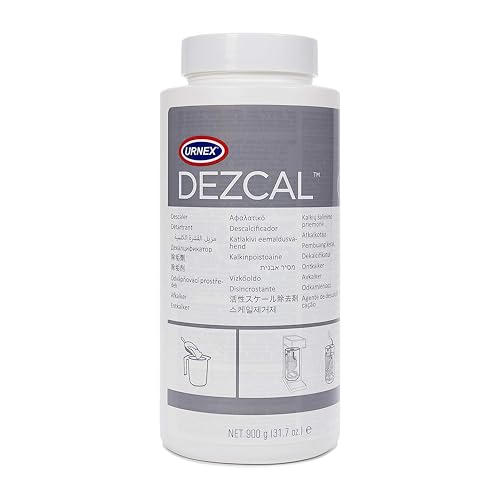
The descaler Moccamaster names in its own descaling guide; a bottle covers many cycles. Listing states a universally compatible descaling powder for drip coffee makers, espresso machines, super-automatics and kettles, dosed at 1 oz of powder per 32 oz of reservoir capacity.
$13.10Live Amazon price · as of 10/09/2026 11:05 AM
The single-use, low-waste format: one packet, one descale. Listing states a plant- and mineral-based, biodegradable, phosphate-free descaling powder for coffee and espresso machines and kettles, in two single-use packets.
$39.97Live Amazon price · as of 10/09/2026 11:05 AM
A gooseneck spout, without the temperature control premium. Listing states a 27 oz gooseneck electric water kettle intended for pour over coffee and tea.
It depends on your water, not the calendar. OXO says <q>Descale the Kettle every 60 uses.</q> Fellow says <q>about once a month in hard-water areas or every two to three months if you have soft water.</q> If your water marks taps and glassware, assume the frequent end.
Can I use white vinegar in an electric kettle?
Fellow publishes a vinegar recipe — <q>Fill the kettle with equal parts white vinegar and water.</q> — so at least one maker endorses it. But check your own booklet first: OXO states that its warranty is voided if descaling is not carried out in accordance with its instructions, and a substituted agent is a departure from them.
How long do I leave the solution in?
At least 30 minutes. This is the one figure OXO and Fellow agree on: OXO says <q>let stand for at least 30 minutes</q>, Fellow says <q>Leave the solution in the kettle for at least 30 minutes</q>.
Is citric acid better than vinegar?
It is the same chemistry without the lingering smell, and Fellow's published citric ratio — 500 mL of water to two spoonfuls — is the stronger of its two recipes. Neither is more correct; pick on smell and on what your booklet allows.
Why is my kettle noisier than it used to be?
Scale is an insulator sitting between the element and the water, so a scaled kettle both takes longer to boil and tends to get louder as bubbles form under the deposit. Descaling usually quietens it.
Can I scrub the limescale off instead?
No. Fellow warns to <q>Avoid steel wool and other abrasive cleaning tools, which can scratch the surface.</q> Scratches give the next round of scale more to grip, so abrasion makes the problem worse. Repeat the soak instead.
Sources for this page:
Descaling procedure, the “MAX” fill, the boil, the at-least-30-minute stand, the rinse-and-discard finish, the every-60-uses interval, the “warranty is voided” sentence and the “Scale is a naturally occurring buildup of mineral deposits” definition: OXO's Cordless Glass Electric Kettle instruction booklet (On_8710300_Booklet.pdf), Troubleshooting & Descaling section, read 2026-10-09 · The equal-parts vinegar recipe, the 500 mL / 2 spoonfuls citric acid recipe, the at-least-30-minute soak, the once-a-month hard water and two-to-three-month soft water intervals, and the steel wool warning: Fellow's published guide “Is Descaling Necessary? How Often to Descale a Kettle”, fellowproducts.com, read 2026-10-09 · Kettle and descaler specifications on the cards below: each product's own Amazon listing copy, read 2026-10-09 We have not lab-tested brewers; where a figure is a manufacturer's, the page names the manufacturer, and machine capabilities come from our own published review records.