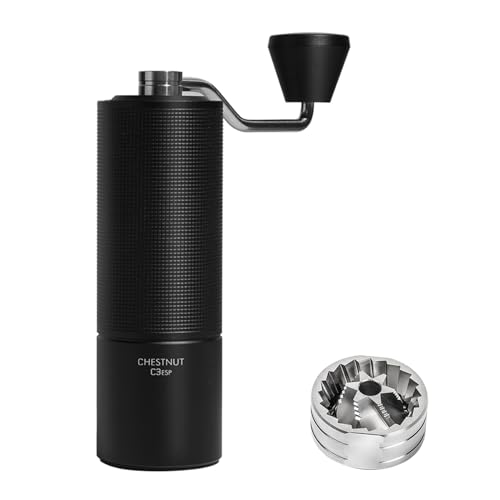
A hand coffee grinder gives you burr grinding without a motor. It is not a cheaper version of an electric grinder — it applies the same burr-grinding principle with you supplying the power, which changes where the money goes and what the grinder asks of you.
4 manual grinders in our catalog31% cheaper than the cheapest 48 mm electric grinder in our catalog0 we have physically tested
A manual coffee grinder can devote a larger share of a small product budget to grinding hardware, because there is no motor or electrical system to pay for. That does not mean every dollar saved on the motor reaches the burrs: bearings, the adjustment mechanism, machining and the body still account for much of what a hand grinder costs. As one illustration, in our own catalog the cheapest 48 mm manual grinder is about 31% cheaper than the cheapest electric we hold at the same burr diameter — an observation from four grinders, not a market-wide rule. What you pay on top is effort, and that cost is real and worth being specific about.
ℹ️Affiliate disclosure: CoffeeLabAdvisor is an Amazon Associate and may earn a commission from the links below, at no extra cost to you. Commissions play no part in which grinders appear here.
Why choose a manual coffee grinder over an electric one?
An electric grinder has to pay for a motor, a gearbox or speed reduction, a housing stiff enough to hold the burrs in alignment under load, and a power supply. A hand grinder does not. That frees budget, but it does not follow that all of it reaches the burrs — a hand grinder still spends on bearings, the adjustment mechanism, machining and the body, and manufacturing volume affects the price as much as the parts list does.
That is not a claim that manual beats electric. Above the mid range, electric grinders buy things no amount of cranking delivers: speed, workflow, and a rigid powered chassis that does not depend on how steadily you hold it. The honest summary is that manual grinding can stretch a small budget further at the bottom of the market, and is a deliberate preference at the top.
How much effort does a hand coffee grinder take?
Most guides quote a single grinding time. We are not going to, for two reasons: the figure varies enormously by grinder, burr set, bean and — above all — grind size, and we have not measured these grinders under a common protocol. Effort rises steeply as you go finer, which is why the same grinder can feel effortless for French press and genuinely hard for espresso.
So the table below is a decision framework built from dose size, grind size and how often you brew — the things that actually predict whether hand grinding will suit you. It is not test data, and we have not presented it as any.
Your routine
Hand grinder?
Why
One or two drinks a day
Yes
The effort is unremarkable at this volume, and more of the price goes into the burrs
Filter and pour-over
Yes
Coarser settings generally take less effort, which makes filter brewing a natural fit for manual grinding
Travel, office, camping
Yes
No power needed and no electronics to depend on, which suits travel, an office drawer or a campsite
Daily espresso
Only if you want to
Espresso settings generally take substantially more effort than coarse brewing on the same grinder; capable, but you will feel it every morning
Several milk drinks each morning
No
Volume plus a busy routine is exactly where hand grinding stops being charming
Wrist or grip problems
No
This is a physical task, and the fine end is demanding
Four parts separate a budget hand grinder from one costing four times as much. The bearings are the one you cannot see, and most of what a higher price buys.
What to look for in a manual coffee grinder
Adjustment resolution, if you want espresso. Not whether it grinds fine, but how small a step it makes at the fine end. Manufacturers targeting espresso often publish burr movement per click. That is useful for comparing adjustment granularity between models; it is not on its own a measure of grind quality or espresso performance.
External vs internal adjustment. External adjustment lets you change the setting without disassembling anything, which matters if you switch between brew methods.
Burr diameter, with a caveat. Bigger burrs can reduce the cranking needed for a dose, but diameter alone does not determine how fast or easy a grinder feels, and it does not determine particle distribution either — burr geometry, alignment and the design as a whole all matter. Not every maker publishes a diameter.
The axle and bearings. These help keep the burrs stable and aligned while you grind, alongside the body and the adjustment mechanism. It is one of the less visible parts of a hand grinder and an important part of its mechanical design — but not something a specification sheet lets you compare, and not something we have inspected.
Our picks
What these are, and what they are not. These four are in our catalog, chosen to cover distinct use cases rather than ranked against each other. None of them has been through our scored award process, and we have not physically tested any of them — the 2026 burr grinder award went to an electric grinder, and no manual grinder has been entered.
Specification provenance differs by model and we say so on each card: 1Zpresso publishes full figures on its own site; Comandante publishes burr material but not a diameter, so we quote none; and the TIMEMORE specification comes from its retail listing rather than a manufacturer datasheet.
One limit on all of these figures: manufacturers sell several variants under one product name, and a specification published for one variant does not necessarily hold for another. Where a maker publishes figures per variant we have taken the one matching the model we link to; where we could not establish which variant a figure describes, we have left the figure out rather than guess.
If your priority is…
Our catalog pick
The lowest-cost way into burr grinding
TIMEMORE Chestnut C3 ESP
General filter and pour-over use
1Zpresso J
Fine adjustment for espresso
1Zpresso J-Ultra
German manufacture, at the top of this group's price range
Comandante C40 MK4
These are editorial picks from published specifications, not test winners. We have not ground coffee with any of them.
Catalog pick — selected from published specifications
Budget pick
TIMEMORE Chestnut C3 ESP
Stainless steel (S2C, per listing) · Manual
Check price →
The lowest-priced of the four here, and a burr grinder rather than a blade. Its retail listing describes a stainless steel conical burr set of TIMEMORE's S2C design — S2C names the burr family rather than the material, and this is a listing claim we have not verified against a manufacturer datasheet. At this price the meaningful comparison is often against a blade grinder, and moving to a burr grinder is the more consequential change in grinding method.
Catalog pick — selected from published specifications
All-rounder pick
1Zpresso J
48 mm · Stainless steel · Manual
Check price →
1Zpresso publishes a 48 mm conical burr, a 30-click system per rotation, a 30–35 g capacity and a 705 g body. That burr diameter is part of what a manual grinder can offer at this price; what it is worth in the cup depends on geometry and alignment, which we do not measure.
Catalog pick — selected from published specifications
Espresso-focused pick
1Zpresso J-Ultra
Coated (per 1Zpresso) · Manual
Check price →
1Zpresso publishes 8 microns per click, a 35–40 g capacity and a 670 g body, and positions it for espresso. It does not give a burr diameter on the page we take these from, so we do not quote one. Its 8-micron increment is designed for fine control at espresso settings; adjustment resolution alone does not establish grind quality, and we have not measured any of it.
Catalog pick — selected from published specifications
German-made pick
Comandante C40 MK4
Nitro Blade (high-nitrogen steel) · Manual
Check price →
Comandante's own page describes a Nitro Blade burr made from its Nitro Rex steel, a jar holding 40 grams, and manufacture in Germany. It does not publish a burr diameter, so we do not quote one. It is the highest-priced of the four here, and Comandante's own material emphasises durable construction and long-term ownership.
Specifications from manufacturer pages read on 28 August 2026: 1Zpresso J (48 mm conical burr, 30-click system per rotation, 30–35 g capacity, 705 g), 1Zpresso J-Ultra (8 microns per click, 35–40 g capacity, 670 g — this page publishes no burr diameter, so we quote none for it), and Comandante C40 MK4 (Nitro Blade burr in Nitro Rex steel, 40 g jar, made in Germany — no burr diameter published). The TIMEMORE figure is from its Amazon listing and is labelled on the card as a listing claim. Prices update live; the price on Amazon at purchase applies.
Frequently asked questions
Are hand coffee grinders as good as electric ones?
Sometimes, and the reason is where the money goes: with no motor, gearbox, housing or power supply to pay for, more of the price can reach the burrs and the adjustment mechanism. How much that buys you varies by model, and our own catalog shows both outcomes at the same burr diameter: our cheapest 48 mm manual grinder is about 31% less than the cheapest 48 mm electric we hold, while our espresso-focused manual costs within a few dollars of that same electric. A tendency, then, not a rule. What you give up is throughput and convenience. The comparison changes at the top of the market, where electric grinders add speed and workflow that manual grinders cannot match at any effort level.
Are manual coffee grinders worth it?
They are worth it if you brew one or two drinks at a time, want burr grinding on a small budget, or need something that works without power — travel, an office, a campsite. They are not worth it if you make several drinks each morning, pull espresso daily and would rather not work for it, or have wrist or grip problems. Decide it on the effort rather than the specification sheet — the effort is the part you live with every morning.
How long does it take to grind coffee by hand?
It depends on the grinder, the burr set, the bean and above all the grind size — effort rises sharply as you go finer. A coarse French press dose is quick; an espresso dose from the same grinder takes noticeably longer and is physically harder. Rather than quote a single figure, we would say this: grinding for one or two drinks is unremarkable, and grinding for four is a chore you will feel every morning.
Can a hand grinder make espresso?
Good ones can. What matters is not whether the grinder reaches espresso fineness but whether it adjusts finely enough at that end of its range to let you land on the setting you want. Grinders sold as espresso-capable usually publish that resolution — 1Zpresso lists the J-Ultra at 8 microns per click, which indicates fine mechanical adjustment, though adjustment resolution alone does not establish grind quality. Many inexpensive hand grinders are filter-only in practice even when they physically grind fine.
What size burr should a hand grinder have?
Larger burrs can reduce the amount of cranking a dose takes, but diameter alone does not determine how fast or easy a grinder feels, and it does not determine particle distribution either — burr geometry, alignment and the design as a whole all matter. Note also that not every manufacturer publishes a diameter; Comandante does not publish one for the C40, which is why we do not quote a figure for it.
Are hand grinders good for travel?
They are particularly well suited to it, because they need no power and have no electronics to depend on, and the things an electric grinder does better all need a power socket. Their compact form also makes them easier to pack than most electric grinders, though size varies by model and we have not compared dimensions across the four here.