
🏆 2026 Best Bean-to-Cup Machine winner
Jura Z10
Bean-to-Cup · Automatic milk · Plant milk 5/5
$4,151.40Live Amazon price · as of 09/25/2026 12:32 AM
Buy on Amazon →Home › Coffee Drinks › Breve
☕ Coffee Drinks · 2026A breve is an espresso made with steamed half-and-half instead of milk. What half-and-half is, why it steams differently, how it compares with a latte, and how to make one.
Written and reviewed by the CoffeeLabAdvisor editorial team · Published 24 September 2026
A breve is an espresso made with a steamed mixture of half milk and half cream — half-and-half — in place of the milk in a latte. That is the whole definition. Same espresso, same steam wand, different dairy. The substitution changes the drink more than it sounds like it should: half-and-half carries far more fat than milk, so it steams denser and heavier, tastes markedly richer, and does not aerate into the light microfoam a latte is built on. It is also why the drink is normally served small, often around 6–8 oz where a latte would be 12. The name refers to the use of cream and milk rather than to the size of the drink, and you will see it written breve or caffè breve.
A breve is a latte with the milk swapped for half-and-half. Nothing else about the build changes: espresso in the cup, steamed dairy poured over it. If you can make a latte, you can make a breve on your first attempt.
The substitution is the interesting part, because half-and-half is not a kind of milk. It is, as the name says, equal parts milk and cream, sold ready-mixed. Cream carries substantially more fat than milk, so half-and-half sits well above milk in fat content and well below pure cream. That single compositional fact explains every difference in the sections below: how it tastes, how it behaves under the steam wand, and why nobody serves it in a 16 oz cup.
Outside North America, half-and-half is not a standard product on supermarket shelves, which is why the drink is largely an American one. Mixing equal parts whole milk and single or light cream gets you close enough to make the drink at home anywhere.
The name is worth a note, because it invites a wrong guess. Breve means short in Italian, and people reasonably assume it describes the size of the drink. In coffee it does not: it refers to the use of cream and milk. A breve is usually small, but that is a consequence of how rich it is, not what the word means.
Put the three next to each other and the breve's position is clear: same technique, progressively richer dairy and progressively smaller cups.
| Breve | Latte | Flat white | |
|---|---|---|---|
| Dairy | Half-and-half — half milk, half cream | Milk | Milk, textured to microfoam |
| Espresso | Commonly a double | One or two shots | Commonly a double |
| Dairy volume | About 4–6 oz | Enough to fill 8–12 oz | About 130 ml |
| Foam | Dense and thin — it does not whip light | A thin layer | A thin microfoam layer, ~5 mm |
| Reads as | Rich, heavy, dessert-adjacent | Milky and mild | Coffee-forward and silky |
A breve tastes like a latte made luxurious: the coffee is still there but it arrives wrapped in something much closer to cream. People often describe it as the richest of the standard espresso-and-dairy drinks, and that is a fair description rather than marketing.
If you want the coffee more prominent, the flat white is the better drink, and our flat white vs cappuccino comparison covers that end of the range.
This is the practical heart of the drink, and the reason a first attempt often disappoints someone who steams milk well.
Foam in steamed milk is built by protein: air is folded in and milk proteins stabilise the bubbles into microfoam. Fat works against that structure. Half-and-half carries much more fat than milk, so it simply will not whip up into the light, glossy, voluminous microfoam you can build with whole milk. Push it harder and you get large, unstable bubbles rather than more foam, and the texture breaks.
The technique that works is therefore the opposite of the one people reach for:
Done properly the result is dense and velvety rather than airy — a thin, heavy layer on top rather than a cap. That is the correct outcome, not a failed latte. Our frothing guide covers the underlying technique.
A breve is normally poured into a 6–8 oz cup, and a 16 oz breve is rare even where the chains will sell you one. There are two straightforward reasons.
The first is balance. Half-and-half coats the palate far more than milk does, and it mutes espresso more thoroughly. Stretch a double shot across twelve or sixteen ounces of it and the coffee stops registering: you are drinking warm cream with a suggestion of coffee. Keeping the drink small is what lets the espresso stay in the conversation.
The second is simply that it is a lot. Richness that is pleasant for six ounces becomes heavy at twelve, which is why the drink sits naturally in the same size bracket as a cortado or a small flat white rather than in latte territory.
If you want a larger drink and still want the character, the usual move is to use half-and-half for part of the dairy and milk for the rest, rather than scaling the cream up with the cup.
In a café that knows the drink, asking for a breve is enough. Elsewhere, the reliable phrasing is to order a latte made with half-and-half, which is exactly what it is and leaves no room for confusion. Many cafés will do this whether or not the word is on the menu, because half-and-half is usually already behind the counter for drip coffee.
Common variations you will meet:
One honest note: this is a dairy drink by definition. Oat, almond and soy alternatives make a perfectly good latte, but a breve made with them is not a breve — the drink is named for the cream.
A breve is not the only way cream reaches an espresso, and the drinks around it are easy to mix up on a menu. The distinction that matters is whether the cream is steamed into the drink or floated on top of it.
Breve — half-and-half, steamed and poured through the drink. The dairy is integrated; the drink is uniformly rich from the first sip to the last.
Espresso con panna — literally espresso with cream: a shot with a spoon of whipped cream on top. Nothing is steamed and nothing is mixed. You drink the espresso through the cream, so the first mouthful is sweet and cold-edged and the last is straight coffee. It is far closer to a macchiato in construction than to a breve, with whipped cream in place of foam.
Café au lait — the opposite end: brewed coffee with hot milk, no espresso and no cream. It shares nothing with a breve except that both are dairy-forward. Our café au lait guide covers it.
Irish coffee and its relatives — cream floated on coffee, usually unwhipped and poured over the back of a spoon so it sits as a distinct layer. Again, floated rather than steamed.
Two useful rules of thumb follow. If the cream is steamed, it is a breve and it will taste uniform. If the cream is floated or whipped, the drink is layered and it will change as you drink it. And if you like the idea of a breve but find it too heavy, con panna is often the better order, because the cream stays out of the coffee until you choose to mix it.
A working recipe, at the ratios published for the drink:
If you have no half-and-half, mix equal parts whole milk and single or light cream. That is what the product is.
If your first one tastes cooked, you steamed it too hot. This is the single most common fault, because the temperature at which milk is merely hot is the temperature at which half-and-half has already gone too far.
If it will not foam, it is not supposed to. Dense and glossy with a thin heavy layer on top is the finished texture.
Any machine with a steam wand will make this drink; the cards below are our reviewed machines with steam systems.
A breve is steamed like a latte, so any machine below with a steam system will make one — each has a published review, and the steam type is named on its card. Half-and-half needs a wand you can control rather than an automatic frother aiming for stiff foam.
Bean-to-Cup · Automatic milk · Plant milk 5/5

Semi-Automatic · Automatic milk · Plant milk 5/5

Bean-to-Cup · Automatic milk · Plant milk 4/5
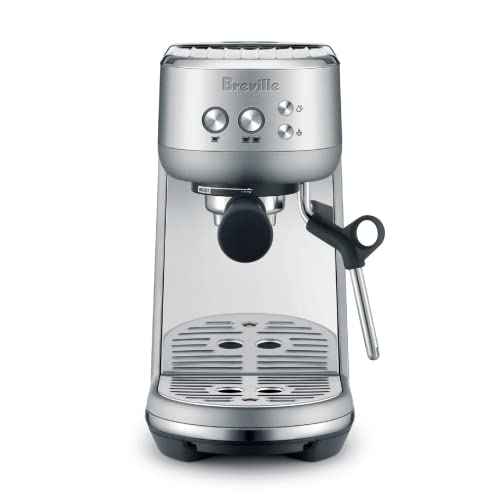
Semi-Automatic · Manual milk · Plant milk 4/5
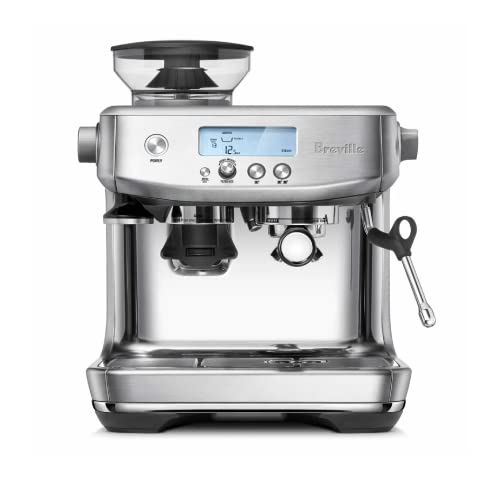
Semi-Automatic · Manual milk · Plant milk 4/5

Bean-to-Cup · Automatic milk · Plant milk 4/5
An espresso made with a steamed mixture of half milk and half cream, known as half-and-half, in place of the milk in a latte. Same espresso and same technique, different dairy, which makes the drink noticeably richer and heavier.
Only the dairy. A latte uses milk; a breve uses half-and-half, which is equal parts milk and cream. Because half-and-half carries far more fat, a breve is richer, denser and usually served in a smaller cup.
Not in coffee. Breve means short in Italian, but in this drink the name refers to the use of cream and milk rather than the size. Breves are usually small, but that is because of how rich they are.
You can steam and texture it, but it will not whip into light microfoam the way milk does, because fat works against the protein structure that holds foam. The correct result is dense and glossy with a thin heavy layer, not an airy cap.
Cooler than milk. Published guidance for the drink puts the target around 135 to 145 F, roughly 57 to 63 C. Higher-fat dairy scorches more readily, and once it does the drink tastes cooked and flat.
Commonly 6 to 8 oz, with about 4 to 6 oz of half-and-half over a double shot. Larger sizes tend to lose the coffee entirely, because half-and-half mutes espresso more than milk does.
Yes. Half-and-half is equal parts milk and cream, so mixing whole milk and single or light cream in equal amounts gives you the same thing. This is the usual approach outside North America, where the product is not commonly sold.
You can make the same drink with a dairy alternative, but it is then a latte rather than a breve, since the drink is defined by the cream in half-and-half. Some barista-formulated alternatives are richer than others, but none is half-and-half.
Whether the cream is steamed in or floated on. A breve steams half-and-half and pours it through the drink, so it tastes uniformly rich. An espresso con panna is a shot with whipped cream spooned on top, so it stays layered and changes as you drink it.
Almost always because it was steamed too hot. Higher-fat dairy scorches more readily than milk, and the published target for half-and-half is around 135 to 145 F, roughly 57 to 63 C, which is noticeably cooler than milk. Stop while it still looks glossy.
It usually tastes sweeter without any sugar being added, because fat carries flavour and softens the perception of bitterness and acidity in the espresso. That is a taste effect of the dairy rather than added sweetness.
Sources for this page: Breve defined as an espresso made with a steamed mixture of half milk and half cream, that its size can vary, and that the name relates to the use of cream and milk: Wikipedia's Milk coffee entry, read 2026-09-24 · Working ratios and steaming guidance for half-and-half - 18 g of coffee in for about 36-45 g out, 4-6 oz (120-180 ml) of half-and-half in a 6-8 oz cup, a rolling vortex stopped around 135-145 F (57-63 C), only a small amount of air, and the note that a breve is richer and heavier than a latte so it takes less aeration: Espresso Outlet's cafe breve recipe, read 2026-09-24 · Fat working against the protein structure that stabilises milk foam, and the texturing technique that follows: our own published frothing guide and review records · Steam-wand types, single-boiler brew and steam sequencing, and plant-milk ratings: our own published review records We have not measured drinks in a lab; where volumes differ between authorities, the page names each authority rather than averaging them, and machine capabilities come from our own published review records.