Shot Quality
The Oracle Jet doses 22 grams into the double basket and 12 into the single, and the reviewers who measured it found that consistent: Coffeeness, which bought its machine, said it dosed 22 grams every time. Taste notes are strong across the evidence. Home Coffee Expert called the espresso as good as you will get from any home espresso machine and dialled a light-roast Yirgacheffe at grind 22, 22 grams in and 45 out, at the highest temperature. TechRadar, testing in Sydney, found shots smooth and consistent even with inexpensive supermarket beans, and Tom's Guide described them as creamy, rich and evenly extracted. Tom's Coffee Corner set the brew temperature to 95 degrees Celsius for a lighter roast and got a fruity shot without sourness; the PID range it reports is 86 to 96 degrees. Two cautions recur. WIRED found the first shot of the morning less consistent than the second or third, and advises running a blank shot through the portafilter first; Coffeeness likewise recommends flushing the group before brewing. WIRED also notes there is no pressure gauge, so you judge a shot by its flow and time.
Grinder, Dosing and Barista Guidance
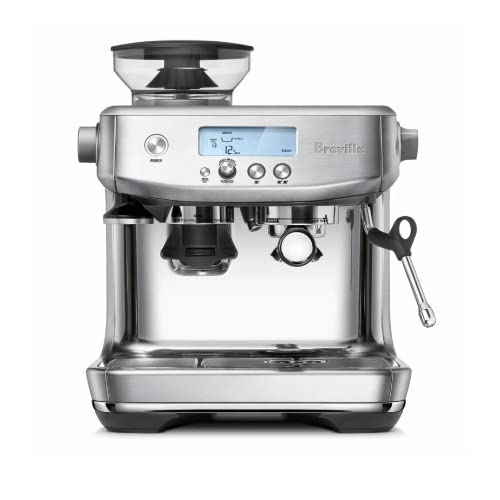
The grinder uses Baratza burrs, which Breville owns, with 45 numbered settings on a side dial; Tom's Coffee Corner, which opened its unit, describes them as the same stainless steel burr found in the Baratza ESP grinders and the dial as stepless. You place the portafilter in the cradle, and grounds fill the basket until they reach a spinning tamper fan, which then levels and tamps the puck. Breville's Barista Guidance times each shot and suggests a finer or coarser setting. Home Coffee Expert and Coffeeness found its suggestions reliably right, while WIRED found it unsophisticated and expects most owners to turn it off after a week or so. The fixed dose is the main limitation: Home Coffee Expert would like an easy way to change it, and Tom's Coffee Corner got from 22 to 20 grams only by adjusting the tamper fan's depth, then needed an aftermarket basket for 18. TechRadar and Tom's Guide both report a sprinkle of stray grounds on the puck or around the machine, and Tom's Coffee Corner noted occasional clogging of the grinder chute and some retention.
Heating: ThermoJet, Not a Dual Boiler
This is the change that separates the Jet from the Oracle Touch. Breville's specification lists a ThermoJet heating system and a ThermoJet heated group head that you can adjust in one-degree Fahrenheit steps under PID control. In practice that means two fast heaters, one for the water and steam and a small one in the group head, rather than two boilers. The benefit is speed: TechRadar found it ready to pull a shot about 30 seconds after power-on, against several minutes for the Oracle Touch. Coffeeness was sceptical of the switch but found its espresso always arrived at the right temperature, and WIRED found water temperature stable over long manual pulls. The cost is that one heater serves both brewing and steaming, so the Jet cannot do both at once. TechRadar named this as its main drawback for anyone making several milk drinks, and Home Coffee Expert said four or more drinks take a while. Auto Queue softens it by starting the milk automatically after the shot, and WIRED and Coffeeness judged the wait small for one or two drinks.
Steam, Auto MilQ and Plant Milk
Auto MilQ steams milk hands-free to a set temperature and one of eight texture levels, with settings for dairy, soy, almond and oat, and the temperature probe now sits in the wand tip, so it reads the milk directly in manual mode too. Results divide the testers more than anything else on this machine. TechRadar found the automatic milk always silky and good enough for latte art, CNET was satisfied with almond and oat, and Home Coffee Expert rated whole milk and Oatly Barista Edition close to professional after firmware updates. Against that, Tom's Coffee Corner got no microfoam from whole, skim, oat or soy in automatic mode, WIRED found the automatic frothing not as silky as manual steaming, and Tom's Guide got more precise results steaming by hand. Coffeeness found the plant-milk presets made little difference and that the regular setting worked best for every milk. The manual wand is the constant: Tom's Coffee Corner and WIRED both rate it powerful. Because barista oat milk works and manual steaming suits every milk, we rate it four of five for plant milk.
Cold Brew, Daily Use and Cleaning
Cold Brew and Cold Espresso extract with cooler water, in under three minutes and just over one minute according to Breville, and Coffeeness reports slightly reduced pressure and an unheated group. None of the testers treat it as true overnight cold brew. TechRadar, Tom's Guide and CNET liked both drinks, and CNET used the cold espresso for espresso martinis, while WIRED preferred the cold espresso and found the three-minute cold brew a bit astringent. Day to day, several details help: the tank fills from a flap at the front, a lever lowers the machine onto wheels so you can slide it out, and Wi-Fi updates have added drinks such as the shakerato and espresso martini since launch, which Home Coffee Expert and WIRED both describe. Smaller irritations recur too. Tom's Guide, WIRED and Home Coffee Expert all found the dedicated hot water spout splashy, and WIRED found the machine thirsty. Cleaning is prompted on screen: the manual describes separate backflush and descale cycles, and Home Coffee Expert puts a descale at about 20 minutes, every four to eight weeks depending on water and filter use.
Who It's For, Build and Warranty
The Oracle Jet suits someone who wants café-style espresso and milk drinks from fresh beans with very little technique, and who values a standard 58mm portafilter, so that baskets, tampers and a bottomless portafilter from the wider market fit. It is less suited to households making four or more milk drinks back to back, to anyone who wants to set their own dose without modifying the machine, or to someone who switches beans daily, since CNET notes there is no bypass for a second bean. Coffeeness concluded it is not for true espresso nerds, and WIRED expects geeks to want more control and a separate grinder. Build is stainless steel over a large chassis: Breville lists 16.6 inches wide and 27.78 pounds, and TechRadar and Tom's Coffee Corner list it at about 19 inches tall, which appears to include the bean hopper. Tom's Coffee Corner judged the build on par with other Breville machines and noted some single-use crimped fittings inside. Breville's US warranty is a two-year limited warranty covering repair or replacement for faults in materials, workmanship or function.
What This Review Is Based On
This review is a synthesis of published evidence, not a test of our own unit. Specifications come from Breville's US product page for the BES985, its Oracle Jet Instruction Book and the Amazon listing, all read in October 2026. Where Breville's own figures disagree, as with power (1400 to 1600 watts on the web page, 1780 watts on the manual's rating label), we use the manual. Breville publishes no pump pressure for the Oracle Jet, so we do not print one. Hands-on evidence comes from Coffeeness, TechRadar, Home Coffee Expert, Tom's Coffee Corner, Tom's Guide, WIRED and CNET. Coffeeness bought its machine; TechRadar says its unit was sent to it for review, which we treat as supplied; the other five do not say how they obtained theirs. TechRadar tested the Australian model and Tom's Coffee Corner the UK Sage-branded version, which is the same machine under another name. No reviewer has multi-year data yet, so long-term reliability is unknown, and we found no safety recall for the Oracle Jet in the US Consumer Product Safety Commission recall database, checked in October 2026.
As an Amazon Associate, CoffeeLabAdvisor earns from qualifying purchases. Prices are live from Amazon and may change. Product details are drawn from the manufacturer and specialist review consensus at review time; always confirm specifications before purchase.