6 facts, each with a source below7 questions answered4 verified products
An 8 fl oz cup of brewed coffee carries about 95 mg of caffeine, per USDA FoodData Central. That single figure answers most versions of this question, because almost every other number on this page is that one scaled by volume: a 12 oz travel mug is nearer 140 mg, a 16 oz is nearer 190 mg, and the FDA's own range for a 12 oz cup of regular brewed coffee is wider still at 113 to 247 mg, because dose and grind vary between kitchens. Espresso is the exception, concentrating about 63 mg into a single ounce. Decaf is not zero: the FDA puts it at 2 to 15 mg in an 8 oz cup.
Espresso, 1 fl ozAbout 63 mg (USDA); a double is about 126 mg
Regular brewed, 12 fl oz113 to 247 mg (FDA's published range)
Decaf, 8 fl oz2 to 15 mg (FDA); the USDA entry is about 2 mg
Instant, 8 fl ozAbout 62 mg (USDA)
Roast levelChanges caffeine very little; how you dose changes it more
About 95 mg, if the cup is 8 fl oz. Most mugs are not, which is where every disagreement about this number begins. Photo: Nathan Lemon / Unsplash
The one figure, and why every chart you find disagrees
USDA FoodData Central, the reference database behind most nutrition labelling in the United States, puts an 8 fl oz cup of brewed coffee at about 95 mg of caffeine. That is the number to carry around. Every other figure on this page is either that number scaled to a different volume, a different extraction, or a manufacturer's published measurement of its own product.
So why does every chart on the internet give a different answer? Three reasons, and none of them is that somebody is lying. First, cup size: a nutritional cup is 8 fl oz, a coffee-maker cup is 5 or 6 oz, and the mug in your cupboard is probably 12 or 14. Second, dose: the same 8 oz of water carries more caffeine if you brewed it with 15 g of coffee than with 10 g, and no chart knows your dose. Third, the coffee itself: arabica and robusta differ substantially, and robusta carries roughly twice the caffeine of arabica by weight, which is why a blend containing it lands higher. The FDA's own published figure for a 12 fl oz cup of regular brewed non-specialty coffee is a range rather than a point: 113 to 247 mg. A regulator publishing a range with a factor of more than two in it is the honest version of this answer.
What this means practically: treat 95 mg per 8 oz as the centre of a distribution, not a measurement of your cup. If you need the number to be precise, the only thing that gets you there is knowing the dose and the coffee, and even then it is an estimate.
Caffeine by drink
Drink
Serving
Caffeine
Where the figure comes from
Brewed / drip coffee
8 fl oz
~95 mg
USDA FoodData Central
Brewed / drip coffee
12 fl oz
113 to 247 mg
FDA, regular brewed non-specialty
Espresso
1 fl oz (single)
~63 mg
USDA FoodData Central
Espresso
2 fl oz (double)
~126 mg
Twice the USDA figure (arithmetic)
Latte, cappuccino, flat white, macchiato
Any size
Same as the shots inside
Milk contributes none; shot count sets the number
Americano
Any size
Same as the shots inside
Water contributes none
Instant coffee
8 fl oz
~62 mg
USDA FoodData Central
Decaf, brewed
8 fl oz
2 to 15 mg
FDA; the USDA entry is about 2 mg
Cold brew
Varies
Set by concentrate strength and dilution
No single reference figure; see below
The row that surprises people most is the milk drinks. A 16 oz latte and a 6 oz cappuccino built on the same double shot carry the same caffeine, because milk has none. Ordering a bigger milk drink adds milk, not caffeine, unless the shop also adds a shot. Our shot sizes guide covers what those shots actually are, and the espresso caffeine page does the shot-by-shot arithmetic in detail.
Caffeine by cup size, and the mug problem
Nothing on this page causes more confusion than the word cup. A nutritional cup is 8 fl oz. A coffee maker's cup is 5 oz on most machines and 6 on some, which is why a 12-cup carafe holds about 60 oz rather than 96. A mug is whatever the potter decided, usually 11 to 15 oz. Chain sizes are larger again. So the useful table is by volume, holding the brew strength constant at the USDA figure of roughly 12 mg per fluid ounce.
Volume
What it usually is
Caffeine at the USDA rate
5 fl oz
One carafe cup on most drip machines
~60 mg
8 fl oz
The nutritional cup; a small mug
~95 mg
12 fl oz
A standard mug or small travel cup
~140 mg
16 fl oz
A large mug or travel flask
~190 mg
20 fl oz
A large takeaway cup
~235 mg
60 fl oz
A full 12-cup carafe
~710 mg across the whole pot
Two caveats keep this table honest. It assumes every cup was brewed at the same strength, which is the assumption the FDA's wide range exists to reject: brew stronger and the whole column moves up. And the last row is a pot, not a serving; half a 12-cup carafe is around 355 mg. The ratio calculator tells you what you actually dosed.
Does brewing method change the caffeine?
Less than people expect, once you compare like with like. Caffeine is highly water-soluble and comes out of the grounds readily, so any method that uses a normal dose of coffee and a normal volume of water extracts most of what is there. What actually moves the number is dose and volume, not the machine. A drip machine and a French press dosed identically for the same volume land close together. A pour-over at 1:17 lands close to both.
The apparent exceptions all resolve into dose and volume. Espresso looks like a caffeine bomb per ounce and is, at about 63 mg in one ounce, roughly five times the per-ounce concentration of drip coffee, but a single shot is one ounce, so a mug of drip coffee usually carries more caffeine in total than a single espresso. Cold brew is brewed as a concentrate at a much heavier dose, often somewhere between 1:5 and 1:8 rather than 1:17, so the concentrate is strong; what you drink depends entirely on how far you dilute it, which is why no honest chart gives cold brew a single figure. Our cold brew versus espresso page takes that comparison apart properly. Instant lands slightly below brewed at about 62 mg per 8 oz on the USDA entry, because the serving is defined by how much powder the label tells you to use. Moka pot and AeroPress sit between drip and espresso for the same reason: they concentrate a normal dose into a smaller volume. The brewing methods guide sets all of them side by side.
Light roast or dark roast: does roast level change caffeine?
Barely, and not in the direction folklore claims. Roasting does not meaningfully destroy caffeine, so a bean's caffeine content is nearly the same light or dark. What changes is density. Roasting drives off moisture and expands the bean, so a dark-roasted bean is lighter and larger than the same bean roasted light. That means a scoop by volume of dark roast holds fewer beans and therefore slightly less coffee and slightly less caffeine, while a dose by weight of dark roast contains slightly more beans and evens the difference out.
So the honest answer to whether light roast has more caffeine is this: only if you measure by scoop, and only slightly. Anyone dosing on a scale will find the difference disappears into the noise of bean variety and extraction. If you want more caffeine, the levers that actually work are a bigger dose, a bigger cup, or a blend containing robusta, which carries roughly twice the caffeine of arabica by weight. Our light roast guide covers the rest of what roast level does change, and the arabica guide covers the species difference.
Decaf is not zero
Decaffeinated coffee is decaffeinated, not caffeine-free, and the regulator says so plainly: the FDA puts a typical 8 fl oz cup of decaf at 2 to 15 mg of caffeine, and the USDA entry sits at the bottom of that range at about 2 mg. For scale, that means a cup of decaf carries somewhere between one fiftieth and one sixth of a regular cup. Several cups of decaf in a day can add up to roughly one regular cup, which matters to anyone who is counting carefully and to nobody else.
The removal process is worth knowing because listings advertise it. Swiss Water Process is a solvent-free method using water and carbon filtration, and it is what the Kicking Horse and Subtle Earth bags below state; the Subtle Earth listing puts its result at 99.9% caffeine free. Other decafs use carbon dioxide or solvent-based methods: Lavazza's DEK listing describes a natural process without naming it, and Peet's describes its decafs as water processed. All are regulated, and all leave a trace. If the numbers matter to you medically, they are the ones to take to whoever advises you; this page is not that adviser.
What the FDA publishes about daily amounts
The FDA cites 400 mg a day as an amount not generally associated with dangerous, negative effects for healthy adults, and describes that as roughly two to three 12 fl oz cups of coffee. It also notes that toxic effects such as seizures have been observed with rapid consumption of around 1,200 mg, and, importantly, that there is wide variation in both how sensitive people are to caffeine and how quickly they clear it from the body. Body weight, medication, and individual sensitivity all move the line.
What this page is not. These are population-level reference figures published by regulators, reproduced here so the arithmetic on this page has a scale to sit against. They are not advice, and they do not apply uniformly: pregnancy, medical conditions, medications and individual sensitivity all change what is appropriate, and only a clinician who knows your situation can say what that is. We publish the sourced numbers and stop there.
Against those figures, the arithmetic from the table above is straightforward. A 12 oz mug of drip coffee at the FDA's own range is 113 to 247 mg, so two of them can land anywhere from a quarter to well past the whole of the 400 mg reference depending on how strong you brew. A double espresso is about 126 mg. A full 12-cup carafe is around 710 mg spread across whoever drinks it.
How to drink less caffeine without giving up coffee
Four levers, in order of how little they cost you. Use a smaller cup. The single biggest variable on this page is volume, and a 12 oz mug swapped for an 8 oz one removes about 45 mg without changing anything about the coffee. Dose less. Dropping from a heavy dose to the standard 55 g per litre in our ratio calculator cuts caffeine proportionally, and usually improves the cup, because most over-caffeinated coffee is also over-dosed and unbalanced. Go half-caf. Blending regular and decaf beans in the same grinder halves the number and is invisible in the cup; it is the least disruptive change available and needs no new equipment. Switch to decaf for the second or third cup rather than the first, which keeps the morning intact and removes most of the daily total.
What does not work: choosing dark roast, which the roast section shows is a rounding error, and switching from drip to espresso, which lowers caffeine per drink only because the drink is smaller. The four bags below are the decafs in our verified catalog, two of them from roasters already on our beans roster.
Verified products for this page
ℹ️
Affiliate disclosure: CoffeeLabAdvisor is an Amazon Associate and may earn a commission from these links, at no extra cost to you. Commissions play no part in what appears here — every product traces to a verified catalog entry or a published review.
Four verified decaf bags: two Swiss Water Process, one for espresso machines and one pre-ground for drip. Every product fact is the listing's own statement. No bag here is presented as low-caffeine beyond what its own listing states.
Swiss Water decaf, whole bean
Kicking Horse Coffee
Decaf, Swiss Water Process
$11.99Live Amazon price · as of 10/26/2026 10:14 PM
A decaf processed without solvents, from a roaster whose regular bags are already on our roster. Listing states a dark roast decaf, whole bean, Swiss Water Process, certified organic, Fairtrade and kosher, in a 10 oz bag.
$41.99Live Amazon price · as of 10/26/2026 8:55 PM
The bulk option, and the one whose listing puts a figure on how much caffeine is removed. Listing states Swiss Water Process decaffeinated and 99.9% caffeine free, USDA organic certified, medium-dark roast, whole bean, 100% arabica from Honduras, in a 2 lb bag.
$17.99Live Amazon price · as of 10/26/2026 9:09 PM
The decaf to put in an espresso machine, from the blend house whose Super Crema is on our roster. Listing states a 1.1 lb bag of decaffeinated Italian whole beans, an arabica and robusta blend, decaffeinated using a natural process, blended and roasted in Italy, and best used with an espresso machine.
$9.98Live Amazon price · as of 10/26/2026 10:14 PM
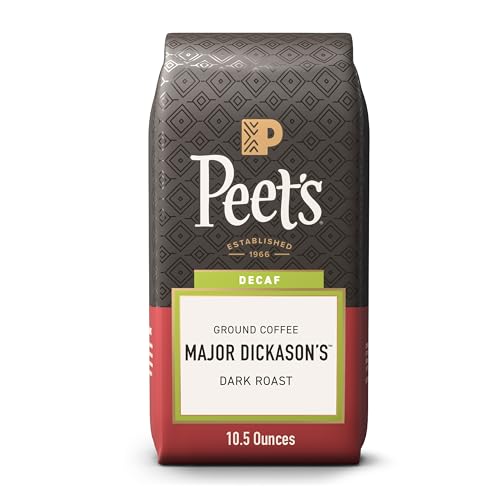
The decaf version of a blend already on our roster, ground for drip and pour-over. Listing states a 10.5 oz bag of decaf Major Dickason's Blend, dark roast, 100% arabica, ground and suited to drip or pour-over, and that every Peet's decaf is water processed to remove the caffeine.
About 95 mg in an 8 fl oz cup of brewed coffee, per USDA FoodData Central. A 12 oz mug is nearer 140 mg at the same strength, and the FDA publishes a range of 113 to 247 mg for a 12 oz cup of regular brewed coffee because dose and coffee vary between kitchens.
How much caffeine is in a 12 oz cup of coffee?
Around 140 mg if it is brewed at the strength behind the USDA's 8 oz figure. The FDA's own published range for a 12 fl oz cup of regular brewed non-specialty coffee is wider, at 113 to 247 mg, which reflects how much dose and bean choice move the number.
Does espresso have more caffeine than coffee?
Per ounce, yes, by roughly five times: about 63 mg in one ounce of espresso against about 12 mg per ounce of brewed coffee. Per serving, usually no, because a single shot is one ounce and a mug of drip coffee is eight or more. A double espresso at about 126 mg beats an 8 oz cup.
Does dark roast have more caffeine than light roast?
Not meaningfully. Roasting changes caffeine very little. Dark-roasted beans are less dense, so a scoop measured by volume holds slightly less coffee and slightly less caffeine, while dosing by weight nearly equalises the two. Bean species matters far more: robusta carries roughly twice the caffeine of arabica.
How much caffeine is in decaf coffee?
Not zero. The FDA puts a typical 8 fl oz cup of decaf at 2 to 15 mg, and the USDA entry is about 2 mg. That is between one fiftieth and one sixth of a regular cup, so several cups of decaf can add up to roughly one regular one.
Which brewing method has the most caffeine?
Dose and volume decide it, not the method. Espresso is the most concentrated per ounce; a large mug of drip or a heavily dosed cold brew carries the most per serving. Two brewers dosed the same for the same volume land close together, because caffeine dissolves readily in any of them.
Is 400 mg of caffeine a limit?
It is a reference figure, not a limit set for you. The FDA cites 400 mg a day as an amount not generally associated with negative effects for healthy adults, which it describes as about two to three 12 oz cups, and notes wide individual variation in sensitivity and clearance. Pregnancy, medications and medical conditions change it, and that conversation belongs with a clinician.
Sources for this page:
Brewed coffee ~95 mg per 8 fl oz, espresso ~63 mg per 1 fl oz, instant ~62 mg per 8 fl oz and decaf ~2 mg per 8 fl oz: USDA FoodData Central entries, read 2026-09-02 for our espresso caffeine guide and re-checked 2026-09-08 · Regular brewed non-specialty coffee 113 to 247 mg per 12 fl oz; decaf 2 to 15 mg per 8 fl oz; 400 mg a day cited for healthy adults and described as about two to three 12 oz cups; toxic effects observed around 1,200 mg consumed rapidly; wide individual variation in sensitivity and clearance: FDA, Spilling the Beans: How Much Caffeine is Too Much, read 2026-09-08 · Robusta carrying roughly twice the caffeine of arabica by weight, and the roast-density explanation: our 100% arabica guide and light roast guide and the sources cited there · Decaffeination methods and the 99.9% caffeine-free figure: each bag's own Amazon listing, read 2026-09-08 We have not lab-tested brewers; where a figure is a manufacturer's, the page names the manufacturer, and machine capabilities come from our own published review records.