8 facts, each with a source below6 questions answered4 verified products
USDA FoodData Central measures decaffeinated espresso at 1 mg of caffeine per 100 g, against 212 mg for regular espresso. A 1 fl oz shot is roughly 30 g, so a decaf shot carries about 0.3 mg — against about 63 mg for a normal one. That is not zero, and decaf is not caffeine-free, but it is in the region of one two-hundredth of the caffeine. The trade body puts a decaf cup at 2–15 mg, which brackets the measured figure for a mug of decaf drip.
Decaf espresso1 mg per 100 g — about 0.3 mg in a 1 fl oz shot
Regular espresso212 mg per 100 g — about 63 mg in a shot
Decaf brewed coffee1 mg per 100 g — about 2.4 mg in an 8 fl oz mug
Regular brewed coffee40 mg per 100 g — about 95 mg in a mug
Trade body's range2–15 mg of caffeine in a decaf cup
Typical removalAround 97%, described as what the process achieves
Caffeine-free?No. Close, but not zero
The trapDecaf instant powder measures 122 mg per 100 g — it is dry
Decaf against regular, on the same scale. The bar for decaf is not missing from the chart; it is there, and it is this small.
The measured figure
USDA FoodData Central lists decaffeinated espresso as a food in its own right, and measures it at 1 mg of caffeine per 100 g. Regular espresso, from the same database and the same preparation description, measures 212 mg per 100 g.
Converting to a drink: a single espresso is about 1 fl oz, which is roughly 30 g, so a decaf shot carries about 0.3 mg and a regular one about 63 mg. A double decaf is about 0.6 mg.
For scale, that is less caffeine than you would get from a cup of decaffeinated tea, and roughly a two-hundredth of a normal shot. If you are avoiding caffeine for sleep, this is not the thing keeping you awake.
But it is not zero, and that matters to some people
Decaf is not caffeine-free, and nobody in the industry claims it is. The National Coffee Association describes the process as one that typically removes around 97% of the caffeine naturally found in coffee beans, leaving approximately 2–15 mg of caffeine in your cup.
Its own comparison puts an 8 ounce cup at Decaf coffee 2–15 mg caffeine against Caffeinated coffee 95 mg caffeine.
That bracket is worth keeping, because it is wider than the measured average. USDA's figure for decaf brewed coffee works out at about 2.4 mg for an 8 fl oz mug — the bottom of the trade body's range. The top of it, 15 mg, is roughly six times as much. Which end you land on depends on the beans and the process, and no roaster publishes the number for a given bag.
For most people that spread is irrelevant. If you are caffeine-sensitive enough that 15 mg matters, or are avoiding it on medical advice, decaf is a reduction rather than an elimination and should be treated as one.
About that 97%, and who actually says it
The figure you will see everywhere is that decaf must have 97% of its caffeine removed, usually attributed to the FDA as a legal requirement.
We went looking for that rule and could not stand it up. What we can source is the trade body's own description, which is a statement about what the process does rather than what the law demands: decaffeination typically removes around 97% of the caffeine naturally found in coffee beans. The words are typically and around, and they are doing work.
Sources disagree on whether a US numeric threshold exists at all, with some pointing instead at rules governing solvent residues. The European standard is specific and different in kind — a cap on residual caffeine by weight in the roasted bean.
So we are reporting 97% as an industry norm for what decaffeination achieves, which is what the industry itself calls it, and not as a legal guarantee. If the distinction matters to you, the measured values above are the firmer ground.
The number that makes decaf look caffeinated
Search for this and you may run into a figure of 122 mg per 100 g for decaf, which would be alarming if it meant what it appears to.
It is on the same USDA database, and it is real: decaffeinated instant coffee powder measures 122 mg per 100 g. But that is 100 g of dry granules, which is something like fifty servings, not a cup. Prepared as a drink, decaf instant sits with everything else down at about 1 mg per 100 g.
The same trap exists on the caffeinated side, where instant powder measures 3,140 mg per 100 g. Any time a caffeine figure looks implausible, check whether it describes the drink or the dry ingredient.
How much decaf would equal one real coffee
A useful way to hold the scale.
Taking the measured figures at face value: one regular espresso at about 63 mg is matched by roughly 200 decaf shots. An 8 oz mug of regular coffee at about 95 mg is matched by about 40 mugs of decaf.
Using the trade body's less favourable end instead — 15 mg per decaf cup — the answer becomes about six mugs, which is a very different number and the reason we quote both.
Either way, the practical reading is the same: ordinary decaf consumption is not meaningfully caffeinated, and the people for whom this arithmetic matters already know who they are.
Verified products for this page
ℹ️
Affiliate disclosure: CoffeeLabAdvisor is an Amazon Associate and may earn a commission from these links, at no extra cost to you. Commissions play no part in what appears here — every product traces to a verified catalog entry or a published review.
Decaf for espresso and for drip, including two processed by the Swiss Water method. Roasters do not publish per-bag caffeine figures, so nothing here carries a caffeine claim of its own.
Decaf for espresso
Lavazza
DEK Decaffeinated
$17.27Live Amazon price · as of 10/09/2026 7:11 PM
The decaf to put in an espresso machine, from the blend house whose Super Crema is on our roster. Listing states a 1.1 lb bag of decaffeinated Italian whole beans, an arabica and robusta blend, decaffeinated using a natural process, blended and roasted in Italy, and best used with an espresso machine.
$14.99Live Amazon price · as of 10/09/2026 7:11 PM
A decaf processed without solvents, from a roaster whose regular bags are already on our roster. Listing states a dark roast decaf, whole bean, Swiss Water Process, certified organic, Fairtrade and kosher, in a 10 oz bag.
$41.99Live Amazon price · as of 10/09/2026 7:11 PM
The bulk option, and the one whose listing puts a figure on how much caffeine is removed. Listing states Swiss Water Process decaffeinated and 99.9% caffeine free, USDA organic certified, medium-dark roast, whole bean, 100% arabica from Honduras, in a 2 lb bag.
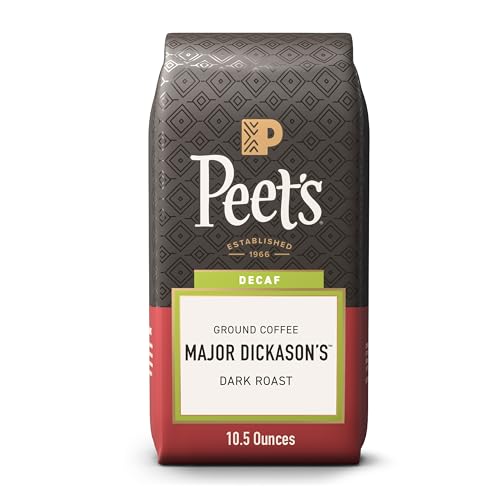
The decaf version of a blend already on our roster, ground for drip and pour-over. Listing states a 10.5 oz bag of decaf Major Dickason's Blend, dark roast, 100% arabica, ground and suited to drip or pour-over, and that every Peet's decaf is water processed to remove the caffeine.
About 0.3 mg. USDA FoodData Central measures decaffeinated espresso at 1 mg per 100 g, and a 1 fl oz shot is roughly 30 g. Regular espresso measures 212 mg per 100 g, or about 63 mg a shot.
Is decaf coffee completely caffeine-free?
No. The trade body describes decaffeination as typically removing <q>around 97%</q> of the caffeine, <q>leaving approximately 2–15 mg of caffeine in your cup.</q> It is a large reduction, not an elimination.
Does the FDA require 97% of caffeine to be removed?
We could not verify that as a US legal requirement. The 97% figure is what the trade body says decaffeination <q>typically</q> achieves — a description of the process, not a stated legal threshold. Sources disagree on whether a numeric US rule exists.
How much caffeine is in a decaf coffee compared to regular?
USDA puts both decaf espresso and decaf brewed coffee at 1 mg per 100 g, against 212 for regular espresso and 40 for regular brewed. In a cup, that is roughly 2.4 mg of decaf drip against about 95 mg of regular.
Why do some sources say decaf has 122 mg of caffeine?
Because that figure is for decaffeinated instant coffee <em>powder</em> per 100 g — dry granules, not a drink. Prepared, decaf instant measures about 1 mg per 100 g like the rest.
Will decaf espresso keep me awake?
At roughly 0.3 mg a shot, it is very unlikely on caffeine grounds alone. If decaf noticeably affects your sleep, the more probable explanations are the temperature, the volume of liquid, or the habit rather than the caffeine.
Sources for this page:
Caffeine values per 100 g for decaffeinated espresso (1 mg, FDC 174125), espresso (212 mg, FDC 171891), decaffeinated brewed coffee (1 mg, FDC 171889), brewed coffee (40 mg, FDC 171890), decaffeinated instant coffee powder (122 mg, FDC 174133) and regular instant coffee powder (3,140 mg, FDC 171893): USDA FoodData Central, SR Legacy, queried 2026-10-09, fdc.nal.usda.gov · The “typically removes around 97% of the caffeine naturally found in coffee beans” description, the “leaving approximately 2–15 mg of caffeine in your cup” figure and the 8 ounce comparison of “Decaf coffee 2–15 mg caffeine” against “Caffeinated coffee 95 mg caffeine”: the National Coffee Association's decaf page, aboutcoffee.org, read 2026-10-09 · Serving conversions are arithmetic on the USDA per-100 g figures at 1 fl oz ≈ 30 g and 8 fl oz ≈ 237 g, and are approximate · The regulatory section reports what we could and could not verify: no US numeric threshold was confirmed, and the 97% is presented as the industry's own description of the process We have not lab-tested brewers; where a figure is a manufacturer's, the page names the manufacturer, and machine capabilities come from our own published review records.