6 facts, each with a source below7 questions answered8 verified products
Pour-over is a category where the shortlist wrote itself years ago: the Hario V60 and the Chemex are the two reference designs, and the honest question is not which is better but which job you are hiring for. The V60 is the precision instrument for one or two cups; the Chemex brews into its own serving carafe for a table. Under fifty dollars either way - and the quiet truth of the category is that the gooseneck kettle matters as much as the brewer, because the pour is the method.
What we did not doTaste-test them - the reasoning below is documented, not cupped
The four things every pour-over setup shares: a dripper, its filter, a gooseneck kettle and a scale. Photo: Najib Kalil / Unsplash
Why the shortlist is three designs, not thirty
Search for pour-over coffee makers and the results run to hundreds of drippers. Almost all of them are variations on three geometries, and the three originals are still the ones specialty cafes use and every published recipe is written for. The cone, which Hario's V60 defines: a 60-degree funnel with a single large hole and spiral ribs, where flow rate is entirely in your hands. The flat bed, which Kalita's Wave defines: three small holes under a flat floor and a fluted filter that holds the bed level, where the geometry does more of the work. And the brewer-carafe, which Chemex defines: a glass hourglass with thick bonded filters that brews and serves in one vessel. Everything below is one of those, and this page keeps to the reference version of each, verified against its own listing, rather than pretending to have compared thirty look-alikes.
What all three share matters more than what separates them. A pour-over is a paper-filtered, gravity-drained brew with no pressure, so the cup is clean and the variables are grind, water temperature, ratio and the pour itself. That last variable is why the kettle section further down is not an accessory afterthought: a dripper without a gooseneck kettle is a funnel you cannot control.
The V60: maximum control, one cup at a time
The V60 is the cone every pour-over guide from Stumptown to Counter Culture writes its recipe for, and the reason is control. The single large hole means the paper filter, not the dripper, sets the drain rate, so grind size and pour speed decide everything: pour fast and coarse for a light, quick cup, slow and finer for more body. That makes it the most rewarding dripper to learn on and the least forgiving on a bad morning, because the same freedom that lets you dial in lets you stall the bed or rush it. The 02 size brews one to four cups and is the one to buy; the 01 is for a single small cup only.
It comes in three materials, and the difference is practical rather than acoustic. Ceramic is the classic: heavy, holds heat once warmed, and wants a rinse of hot water before the brew so it does not steal temperature from the first pour. Glass is lighter, lets you watch the bed drain, and rinses the same way. Metal is unbreakable and heats fastest, which makes it the travel and camp V60 and a good choice for a kitchen where things get knocked over. Our how-to-make-pour-over guide gives the 1:17 recipe two benchmark roasters publish for it, and the grind chart gives the medium-fine to medium starting band.
The Kalita Wave: the flat bed that forgives the pour
If the V60 rewards technique, the Wave reduces the need for it. Its flat floor and three small holes hold the coffee in an even, shallow bed, and the fluted wave filter stands away from the dripper wall so water drains through the coffee rather than around it. The listing's own description of the filter puts it plainly: the flat bottom maintains a wide, even coffee bed, where a cone filter demands a perfect grind and pour to avoid stalling. The result is a brew that is less sensitive to how you pour and more consistent from cup to cup, which is exactly what a beginner wants and what a cafe wants at volume, which is why the listing can point to the Wave in top specialty cafes and competitions.
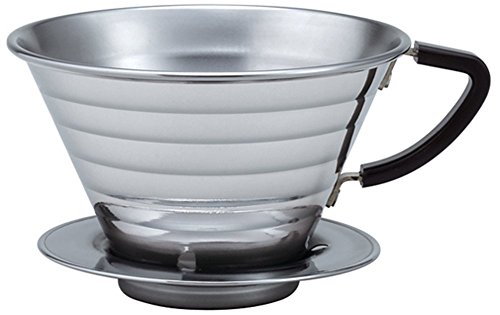
The 185 is the two-to-four-cup size and the one carded below; it is made in Japan of polished stainless steel, heats faster than ceramic or glass, and goes in the dishwasher. The trade is that the Wave takes only its own wave filters, which cost more than cone filters and are sold in fewer shops, so the filters are carded beside it. Choose the Wave over the V60 if you would rather have a repeatable good cup than the option of a great one that depends on your morning.
The Chemex: brewer and carafe in one
The Chemex answers a different question: not how do I make one excellent cup, but how do I make coffee for the table without a second vessel. The 6-cup model, carded below, brews into its own hourglass of borosilicate glass, which the listing describes as non-porous and unable to absorb odours or residues, and it goes straight to the table with its wood collar as the handle. Its bonded filters are thicker than any cone paper, which is why Chemex sits one band coarser than a V60 on the grind chart, and why the cup is the cleanest of the three: almost no oil, almost no fines, and a lighter body that shows a light roast's clarity well. Note the cup convention: a Chemex cup is 5 oz, so a 6-cup makes about 30 oz, which is three mugs.
The Chemex is also the one pour-over brewer with no plastic anywhere in it, which has made it the default answer on our plastic-free coffee makers guide. Choose it if you brew for more than one person at a time, or if the object itself matters to you; choose a V60 or Wave if you mostly brew one cup and want the dripper to sit on the mug.
The kettle is half the purchase
Every pour-over recipe on this site describes a pour: a slow spiral for the bloom, a steady centre pour, a controlled rate to a target weight and time. None of that is possible from a standard kettle, whose wide spout dumps water in a rush that digs a crater in the bed and drains the cone unevenly. A gooseneck kettle's thin, curved spout lets you pour a thread of water exactly where you want it at exactly the rate you want, and it is the single accessory that turns a dripper into a method. The Hario Buono, carded below, is the reference stovetop version: stainless, 1.2 L, works on gas, electric and induction, and the listing suggests filling to about 800 ml for the best pour.
Electric gooseneck kettles with temperature control add the second variable, and they are worth it if you brew light roasts, which want water near 96 C (205 F), or tea, which wants less. The ones our Amazon search surfaced are third-party brands we have not verified, so none is carded; the rule for choosing one is a gooseneck spout first, a hold-temperature function second, and a capacity around a litre. Whatever kettle you use, weigh the water rather than eyeballing it: a basic scale is the other half of repeatability, and the ratio calculator tells you what the numbers should be.
Filters: three shapes, none interchangeable
The dripper decides the filter. V60 cones take a 60-degree cone paper (the 02 size for the 02 dripper); the Wave takes its fluted wave filter, sized 155 or 185 to match; the Chemex takes its own square or circle bonded filters, which are markedly thicker. None substitutes for another: a cone filter collapses in a Wave, a wave filter does not seal in a cone, and a standard cone paper in a Chemex drains too fast for the recipe. Budget for the filters when you choose the brewer: V60 filters are the cheapest and most widely stocked, at roughly seven dollars per hundred brews on the listing we track; Wave filters cost more and are found in fewer shops; Chemex filters cost the most per brew and are the least substitutable. Bleached or unbleached is taste and rinse preference rather than quality; rinse either with hot water before the coffee goes in, both to remove any paper taste and to warm the dripper.
Which one should you buy?
One cup at a time, and you enjoy the craft: a V60 02, in ceramic for the kitchen or metal if it travels. One cup at a time, and you want it to come out the same every day: a Kalita Wave 185 and a box of its filters. Coffee for two or more, or an object you want on the table: a Chemex 6-cup. All of them: a gooseneck kettle first, a scale second, and the dripper third, because the kettle and the scale are the parts that make any of the three work. If you already own a drip machine and are choosing whether pour-over is worth the ritual, the brewing methods guide sets pour-over beside every other method, and the drip coffee maker guide covers the machines that automate the same brew.
Verified products for this page
ℹ️
Affiliate disclosure: CoffeeLabAdvisor is an Amazon Associate and may earn a commission from these links, at no extra cost to you. Commissions play no part in what appears here — every product traces to a verified catalog entry or a published review.
Eight verified listings: the V60 in three materials, the Kalita Wave 185, the Chemex 6-cup, the Buono gooseneck kettle, and the two filters the cone and the wave take. Every product fact is the listing's own statement.
Pour-over
Hario
V60 Ceramic Dripper, 02
$25.00Live Amazon price · as of 10/26/2026 8:22 PM
The reference cone: one large opening, spiral ribs, and total control handed to your kettle. Listing states the Hario V60 Dripper 02 in white ceramic.
$26.00Live Amazon price · as of 10/26/2026 10:49 PM
The travel and drop-proof V60, in metal. Listing states a cone dripper designed and manufactured in Japan with spiral ribs and a large single hole, in sizes 01 (1 to 2 cups), 02 (1 to 4) and 03 (1 to 6).
$39.80Live Amazon price · as of 10/26/2026 9:49 PM
The flat-bed alternative to the cone: more forgiving of pour technique, and steel rather than ceramic. Listing states a flat-bottomed wave dripper made in Japan of polished stainless steel, dishwasher safe, with a 2-inch dripping area that fits most cups and carafes.
$47.03Live Amazon price · as of 10/26/2026 9:27 PM
Brewer and serving carafe in one piece - the table-service answer to the V60's single cup. Listing states a pour-over glass coffeemaker in non-porous borosilicate glass, using bonded filters, sediment-free.
$53.95Live Amazon price · as of 10/26/2026 8:47 PM
Half the method is the pour, and the pour is the kettle. Listing states a slender gooseneck spout for a slow, steady and controlled pour, stainless steel, 1.2 L, for gas, electric and induction stoves.
The Wave takes its own filter; a cone filter does not fit it. Listing states oxygen-bleached Japanese paper filters sized for the Wave 185 dripper, whose flat bottom keeps a wide, even coffee bed.
For one precise cup, the Hario V60 02, the cone every published recipe is written for; for a more forgiving daily cup, the Kalita Wave 185, whose flat bed evens out the pour; for coffee for the table, the Chemex 6-cup, which brews into its own glass carafe. All three need a gooseneck kettle to work as intended.
Hario V60 or Kalita Wave?
The V60's single hole hands control of the drain to your grind and pour, so it rewards technique and punishes a rushed one. The Wave's flat bed and three small holes hold an even bed that drains the same way whatever the pour, so it is more consistent and more forgiving. Choose V60 for ceiling, Wave for repeatability.
Is a Chemex better than a V60?
It is different. The Chemex brews into its own carafe, uses thicker bonded filters that give the cleanest cup of any pour-over, and makes about 30 oz in the 6-cup size. The V60 makes one cup on the mug with more control over the brew. Choose by how many people you brew for, not by quality.
Do I need a gooseneck kettle for pour-over?
Yes, if you want the method rather than a funnel. Every pour-over recipe describes a slow, controlled pour that a wide-spouted kettle cannot deliver. A stovetop gooseneck such as the Hario Buono is enough; an electric one with temperature control adds the water-temperature variable, which light roasts in particular reward.
Ceramic, glass or metal V60?
Same geometry, different handling. Ceramic holds heat once warmed and wants a hot rinse first; glass is lighter and shows the drain; metal is unbreakable and heats fastest, which makes it the travel choice. None brews a different cup once the dripper is warm and the recipe is the same.
What filters does each dripper use?
V60 cones take 60-degree cone papers sized to the dripper; the Kalita Wave takes its own fluted wave filter in 155 or 185; the Chemex takes its thick bonded square or circle filters. They are not interchangeable, and Chemex filters cost the most per brew, V60 filters the least.
What grind and ratio should I use for pour-over?
Medium-fine to medium for a V60 or Wave and one band coarser for a Chemex, per our grind chart, at about 1:17 coffee to water with water near 200 to 205 F. The how-to-make-pour-over guide carries the full recipe from two benchmark roasters, and the ratio calculator scales it to any cup.
Sources for this page:
Product facts (V60 02 in ceramic, glass and metal; Kalita Wave 185 stainless, dishwasher safe, 2-inch drip area, and its wave filters; Chemex 6-cup borosilicate, 5 oz cups, bonded filters; Buono 1.2 L stainless gooseneck, fill to about 800 ml): each item's own Amazon listing, read 2026-09-02 and 2026-09-08 · Method context (V60 as the guide-published reference; pour cadence; 1:17 ratio): Stumptown and Counter Culture published V60 recipes as documented on our how-to page, read 2026-09-02 · Grind bands per dripper: our grind size chart and its sources We have not lab-tested brewers; where a figure is a manufacturer's, the page names the manufacturer, and machine capabilities come from our own published review records.