Keurig Cleaning and Rinse Pods: What They Remove, and What Still Needs Descaling
Keurig lists rinse pods weekly for flavour carryover, descaling every 3 months for scale, and hand-washing periodically. Three jobs, three products — and a rinse pod will not clear a blocked needle.
8 facts, each with a source below6 questions answered3 verified products
A Keurig rinse pod is a weekly flavour job. Keurig's maintenance schedule lists Keurig® Rinse Pods against Weekly, with the stated benefit A simple, fast, and convenient way to reduce flavor carryover between brews. It runs through the brewer like a pod of coffee. It does not descale — that is a separate product on a 3-month cycle — and it does not clear a clogged needle, which is a manual job with a straightened paper clip. If your cup is weak or partial, the needle is the thing to look at, not the rinse pod.
The distinction that decides whether a rinse pod is the right purchase: it is a flavour job, not a mineral job and not a blockage job.
What a rinse pod is for, in Keurig's own words
A rinse pod is a single-use pod with cleaning solution instead of coffee. You run it through the brewer exactly as you would a K-Cup, and the point of it is taste rather than hygiene theatre.
Keurig's maintenance schedule gives it a line of its own. The K-Duo Essentials Gen 2 guide lists Keurig® Rinse Pods at Weekly, and states the benefit as A simple, fast, and convenient way to reduce flavor carryover between brews. The K-Express guide says the same thing in its own words: Weekly cleaning with Keurig® Rinse Pods helps reduce flavor carryover between brews.
Flavour carryover is the real complaint behind most searches for this product. You brew a chai or a dark roast, and the next cup carries a ghost of it. That is what the pod addresses.
Three cleaning jobs people merge into one
Almost every confused Keurig cleaning question comes from treating cleaning as one activity. In Keurig's own schedule it is three, each with its own product and interval.
Weekly is the rinse pod, for flavour. Every 3 months is descaling solution, for the mineral scale that builds up inside. And periodically the removable parts get hand-washed — the guides say to Periodically hand-wash the water reservoir and lid and drip tray with warm soapy water and rinse clean.
One instruction applies to all of it, and it is the one most likely to cost you a part: CAUTION: Parts are not dishwasher safe. That includes the water reservoir.
Where the three overlap is a sweetened pod. The K-Duo guide is specific: We recommend using a Keurig® Rinse Pod or running a cleansing brew immediately after brewing hot cocoa or other sweetened pods to keep the needles clean. Note what that sentence is really about — sugar reaching the needles.
How to run one, including the step people skip
The procedure is short, and the third step is the one that gets missed.
Put the rinse pod in the holder as if it were coffee and brew the largest size into a mug. Tip that away and bin the pod. Then — and this is the step — run one more brew at the largest size with no pod in the holder at all, to flush the cleaning solution out of the machine.
Skip the second brew and the next coffee tastes faintly of the thing you were trying to remove, which is the most common reason owners decide rinse pods made the problem worse. The brewer has no way of knowing the last thing through it was cleaner rather than coffee.
If you have no rinse pod to hand, the guides' own fallback is a cleansing brew: no pod, hot water, largest size. The K-Elite guide describes it plainly — Do not insert a K-Cup® pod. Press the HOT WATER button.
If the cup is weak or partial, it is the needle, not the pod
This is the point at which a rinse pod stops being the answer. A Keurig punctures each pod twice — an entrance needle in the lid and an exit needle in the bottom of the pod holder — and either can block with grounds or sugar. Blocked needles give you a weak cup, a partial cup, or grounds in the drink. No amount of rinse solution reaches a blockage inside a needle.
The guides give a manual procedure for both. For the exit needle: Insert a straightened paper clip into the exit needle to loosen any coffee grounds. For the other one: Lift the brewer handle and locate the entrance needle on the underside of the lid.
There is a safety line that belongs here rather than in small print, because the needles are not obvious until you are reaching past them: CAUTION: There are sharp needles that puncture the K-Cup® pod above the K-Cup® pod holder and in the bottom of the K-Cup® pod holder. To avoid risk of injury, do not put your fingers in the K-Cup® pod holder. A straightened paper clip goes in. Fingers do not.
Are they worth buying, or is a cleansing brew enough?
Honest answer: for most owners a weekly cleansing brew with plain hot water does most of the work, and rinse pods are a convenience rather than a necessity. Keurig itself offers them as alternatives in the same sentence — a Keurig® Rinse Pod or running a cleansing brew — which is a fair indication of how it rates the gap.
Where a rinse pod earns its cost is sweetened drinks. Hot cocoa, chai and sweetened lattes leave residue that plain water moves slowly, and that residue is what reaches the needles. If those are a regular part of your brewing, the pods are doing something water alone does less well.
What they will not do, to be explicit: they will not turn off a descale notification, they will not extend the descaling interval, and they will not rescue a brewer that has stopped working. Those are a different product and a different page.
A routine that actually gets followed
The reason these three jobs get forgotten is that they never fall on the same day. Laid out over twelve weeks, the rinse pod lands weekly, the filter at week eight, and the descale at week twelve — three rhythms that never quite line up.
The practical fix is to anchor the two slow jobs to something you already do rather than trusting memory, because the brewer only warns you about one of the three. There is no rinse-pod light and no filter light. There is only a descale notification, and by the time it appears the scale is already there.
Verified products for this page
ℹ️Affiliate disclosure: CoffeeLabAdvisor is an Amazon Associate and may earn a commission from these links, at no extra cost to you. Commissions play no part in what appears here — every product traces to a verified catalog entry or a published review.
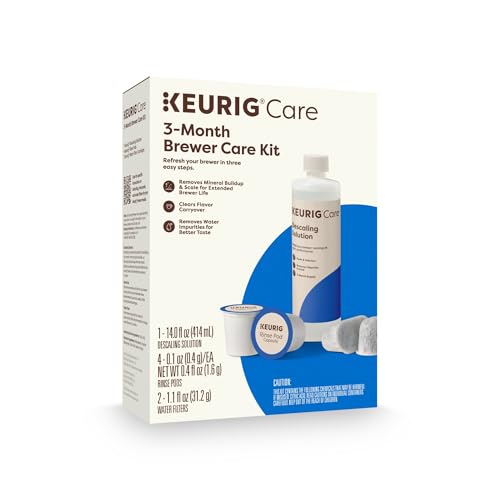
The consumables this page refers to. Keurig's own maintenance kit bundles rinse pods, descaling solution and filters together; the cleaning pods are also sold separately. Every product fact is the listing's own statement, read on the date shown on the card.
Cleaning tablets
Quick & Clean
Keurig Cleaning Pods, 6 pack
$9.99Live Amazon price · as of 10/08/2026 10:23 AM
Runs through the pod holder and exit needle; not a descaler. Listing states a non-toxic, biodegradable cleaning pod compatible with Keurig 1.0 and 2.0 brewers, used by brewing one large cycle with the pod and then one large water-only cycle, and states plainly that it is an aftermarket product with no affiliation with or endorsement from the manufacturers named.
$12.99Live Amazon price · as of 10/08/2026 10:23 AM
Keurig's own bundle of the three things this page asks for. Listing states the kit contains 4 Keurig rinse pods, 1 descaling solution and 2 water filter cartridge refills, is compatible with Classic/1.0 and 2.0 K-Cup coffee makers, and says to use the descaling solution every 3 months to remove mineral deposits.
$12.94Live Amazon price · as of 10/08/2026 10:23 AM
The consumable most owners forget exists. Listing states 12 charcoal filters each lasting about 2 months, compatible with K-Mini, K-Supreme, K-Slim, K-Express, K-Classic, K-Duo, K-Duo Hot & Iced, K-Elite, K-Select, K-Cafe, K-Compact and all Keurig 1.0 and 2.0 brewers, and not compatible with Cuisinart machines.
Weekly. Keurig's maintenance schedule lists <q>Keurig® Rinse Pods</q> against a <q>Weekly</q> frequency, and the same interval appears in more than one model's guide.
Do rinse pods descale a Keurig?
No. Descaling is a separate product on a separate line of the same schedule, at every 3 months or when the descale notification turns on. A rinse pod addresses flavour carryover; it does not remove mineral scale and will not turn the notification off.
Can I just run water instead of buying rinse pods?
Largely, yes. Keurig offers the two as alternatives in the same sentence — <q>a Keurig® Rinse Pod or running a cleansing brew</q>. Rinse pods pull ahead mainly after sweetened drinks, where residue is stickier than plain water shifts easily.
Why does my coffee still taste of the last pod?
Either the rinse cycle was not followed by a pod-free brew to flush the solution through, or the residue is on the needles rather than in the water path. Sweetened pods are the usual cause, and the needles are cleaned by hand.
My Keurig brews a partial cup. Will a cleaning pod fix it?
Probably not. A partial cup usually points at a clogged exit needle, which Keurig's guides clear with a straightened paper clip rather than with solution. The rinse pod cannot reach inside the needle.
Can Keurig parts go in the dishwasher?
No. The guides carry the instruction <q>CAUTION: Parts are not dishwasher safe.</q> That includes the water reservoir. Warm soapy water by hand is the stated method.
Sources for this page:
Keurig K-Duo Essentials Gen 2 Use & Care Guide, 8pp, PDF, maintenance schedule and care sections read 2026-10-07, dam.keurig.com/content/dam/public-assets/kcom_support/K-Duo Essentials Gen 2 UCG.pdf · Keurig K-Express Use & Care Guide, 7pp, PDF, maintenance schedule read 2026-10-07, dam.keurig.com/content/dam/public-assets/kcom_support/K-Express Use and Care Guide.pdf · Keurig K-Elite Use & Care Guide, 7pp, PDF, care, needle and cleansing-brew sections read 2026-10-07, dam.keurig.com/content/dam/public-assets/kcom_support/7297_KEUR_KElite_UCG_Digital.pdf · Keurig K-Slim Use & Care Guide, 6pp, PDF, read 2026-10-07, dam.keurig.com/content/dam/public-assets/kcom_support/J10690_KGM_KSlim_UCGuide_401.pdf We have not lab-tested brewers; where a figure is a manufacturer's, the page names the manufacturer, and machine capabilities come from our own published review records.