Keurig Water Filter: What It Does, Which Brewers Take One, and How Often Keurig Says to Change It
Keurig's own maintenance schedule lists the water filter every 2 months and descaling every 3 — two clocks, two jobs. Which brewers take a filter, how to change one, and why a filter will never stop the descale light.
8 facts, each with a source below6 questions answered3 verified products
Keurig's Use & Care Guides list Keurig Water Filters on a 2-month cycle, and Keurig Descaling Solution on a separate 3-month cycle or when the descale notification turns on. The filter takes impurities out of the water going in; descaling removes scale already inside the brewer. A filter does not delay or replace a descale — and Keurig tells you to remove the filter before you descale. Only brewers with a multi-cup removable reservoir can take one, because the cartridge sits in a handle that stands inside the reservoir.
The single most useful thing on this page: the filter and the descale are different jobs on different clocks, and one will never do the other's work.
How often, in Keurig's own words
Keurig publishes a maintenance schedule in the back of its Use & Care Guides, and the water filter has its own line in it. The K-Duo Essentials Gen 2 guide lists Every 2 months against Keurig® Water Filters, with the stated benefit Keep your water fresh and clean for a great-tasting cup of coffee every time. The K-Express guide prints the same interval in the same table.
Two months is the calendar answer, and it is the one to set a reminder for, because nothing on the brewer tells you a cartridge is spent. There is no filter light. The descale light you may have seen is a different warning for a different job, and the next section is about why that distinction matters more than the interval itself.
If you brew rarely, the cartridge is still ageing in standing water. Treat two months as a ceiling rather than a target to stretch.
A filter is not a descaler, and Keurig says so twice
This is the misunderstanding that sends people looking for a filter in the first place: the descale light came on, and a filter sounds like it should stop that happening. It will not.
The two sit on separate lines of the same Keurig table. Filters are every 2 months, Keurig® Descaling Solution is Every 3 months or when the Descale notification turns on, and the benefit Keurig states for descaling is to Remove calcium deposits, or scale, that can build up inside a brewer over time. Different cadence, different consequence.
The clearest proof is procedural rather than promotional. In the K-Elite guide, the descaling procedure opens by telling you to take the filter out: Water Filter, remove and set aside. The cleaning section repeats it — NOTE: If you are using a water filter inside the water reservoir, remove it before cleaning. A component you must remove before descaling is not a component that prevents descaling.
What a filter does do is upstream work: it reduces what goes in. The K-Elite guide frames it exactly that way — You can also install a Keurig® Water Filter to help remove water impurities and improve beverage taste. Taste, not scale.
Which brewers can take one
The filter is not a universal part, and the reason is physical rather than commercial. The charcoal cartridge clips into a reusable filter handle, and that handle has to stand upright in water. A brewer with a multi-cup removable reservoir has somewhere to put it. A brewer you fill cup by cup before each brew does not.
So the question to ask of your own machine is not which model name is on the front, but whether it has a reservoir you lift off and fill once for several brews. If it does, a filter handle fits it. If you pour a single cup of water in before each brew, there is nowhere for the handle to go.
Keurig's setup instructions treat the filter as an optional extra rather than part of the box. The K-Elite guide puts it in the setup sequence conditionally: If you have a Keurig® Water Filter, install it now. Refer to your Water Filter Starter Kit for instructions.
Changing the cartridge
The brewer guides deliberately do not print the cartridge procedure. They refer you to the Water Filter Starter Kit's own instructions, which is where the soak time and any model-specific detail live. That is worth saying plainly rather than inventing a number: the step sequence below is the shape of the job, and the packaging in your hand is the authority on the timing.
The shape is consistent: soak the new cartridge in fresh water, rinse it, clip it into the handle, and stand the handle back in the reservoir before refilling. Soaking matters because a dry charcoal cartridge carries air, and air in the cartridge is the usual reason a newly fitted filter seems to do nothing.
One more line from the same guides that belongs here, because it is about the water rather than the filter: NOTE: Do not use distilled water. Distilled water is not a substitute for filtering, and Keurig rules it out for its brewers.
Is it worth fitting one at all?
Honest answer: it depends on what your tap water is like, and this page cannot measure that for you. The claim Keurig makes is about taste and impurities, not about machine longevity — longevity is the descaling claim, and descaling stays on its own schedule whether or not a filter is fitted.
If your water already tastes good from the tap, a filter is a small refinement and a recurring cost. If it tastes of chlorine, that is exactly the sort of thing activated charcoal addresses, and it will reach the cup otherwise. Neither case changes the descaling interval.
What a filter will not do, to close the loop: it will not extend the time between descales, it will not turn off a descale notification, and it will not rescue a brewer that already has scale inside it. Those are jobs for the descaling solution, on its own three-month clock.
The questions that actually get asked
Below are the ones that come up most, answered from the same guides rather than from forum consensus. Where Keurig's documentation hands a question to the Starter Kit instructions, this page says so instead of filling the gap with a plausible number — a specific figure we cannot cite is worth less than an honest pointer.
Verified products for this page
ℹ️Affiliate disclosure: CoffeeLabAdvisor is an Amazon Associate and may earn a commission from these links, at no extra cost to you. Commissions play no part in what appears here — every product traces to a verified catalog entry or a published review.
The consumables this page refers to. Keurig's own maintenance kit bundles filters, cleaning pods and descaling solution; the filters are also sold on their own. Every product fact is the listing's own statement, read on the date shown on the card.
Water filter
GoodCups
Keurig Water Filter Replacements, 12 pack
$12.94Live Amazon price · as of 10/08/2026 10:23 AM
The consumable most owners forget exists. Listing states 12 charcoal filters each lasting about 2 months, compatible with K-Mini, K-Supreme, K-Slim, K-Express, K-Classic, K-Duo, K-Duo Hot & Iced, K-Elite, K-Select, K-Cafe, K-Compact and all Keurig 1.0 and 2.0 brewers, and not compatible with Cuisinart machines.
$12.99Live Amazon price · as of 10/08/2026 10:23 AM
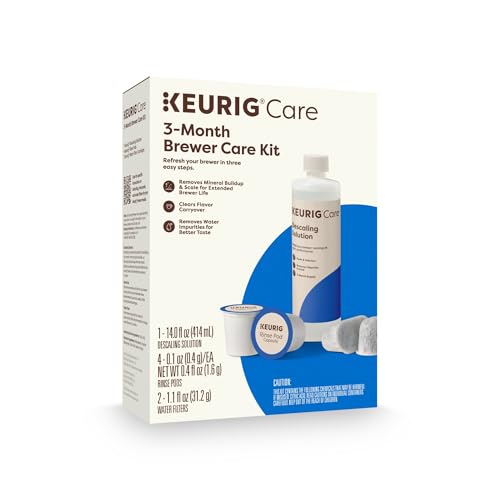
Keurig's own bundle of the three things this page asks for. Listing states the kit contains 4 Keurig rinse pods, 1 descaling solution and 2 water filter cartridge refills, is compatible with Classic/1.0 and 2.0 K-Cup coffee makers, and says to use the descaling solution every 3 months to remove mineral deposits.
$9.99Live Amazon price · as of 10/08/2026 10:23 AM
Runs through the pod holder and exit needle; not a descaler. Listing states a non-toxic, biodegradable cleaning pod compatible with Keurig 1.0 and 2.0 brewers, used by brewing one large cycle with the pod and then one large water-only cycle, and states plainly that it is an aftermarket product with no affiliation with or endorsement from the manufacturers named.
Every 2 months. Keurig's Use & Care Guides list <q>Keurig® Water Filters</q> on an <q>Every 2 months</q> line in the recommended maintenance schedule, and the same interval appears in more than one model's guide.
Does a water filter mean I do not have to descale?
No. Descaling sits on its own line at every 3 months or when the descale notification turns on, and Keurig's descaling procedure begins by telling you to remove the filter — <q>Water Filter, remove and set aside.</q> The filter treats water going in; descaling removes scale already inside.
Which Keurig brewers take a water filter?
The ones with a multi-cup removable reservoir. The cartridge clips into a filter handle that has to stand in standing water, so brewers you fill a cup at a time before each brew have nowhere to fit one.
Do I need to soak a new cartridge first?
Yes, and the packaging is the authority on how long. Keurig's brewer guides refer the owner to the Water Filter Starter Kit instructions for the cartridge procedure rather than printing a time themselves.
Can I use distilled water instead of a filter?
Not in a Keurig. The guides carry the instruction <q>NOTE: Do not use distilled water.</q> Filtering and choosing a different water are not interchangeable here.
Is there a light that tells me the filter is spent?
No. The descale notification is about scale, not the cartridge. Nothing on the brewer reports filter life, which is why the two-month interval is a calendar reminder rather than something the machine prompts.
Sources for this page:
Keurig K-Duo Essentials Gen 2 Use & Care Guide, 8pp, PDF, maintenance schedule read 2026-10-07, dam.keurig.com/content/dam/public-assets/kcom_support/K-Duo Essentials Gen 2 UCG.pdf · Keurig K-Express Use & Care Guide, 7pp, PDF, maintenance schedule read 2026-10-07, dam.keurig.com/content/dam/public-assets/kcom_support/K-Express Use and Care Guide.pdf · Keurig K-Elite Use & Care Guide, 7pp, PDF, setup, maintenance and descale sections read 2026-10-07, dam.keurig.com/content/dam/public-assets/kcom_support/7297_KEUR_KElite_UCG_Digital.pdf · Keurig K-Slim Use & Care Guide, 6pp, PDF, read 2026-10-07, dam.keurig.com/content/dam/public-assets/kcom_support/J10690_KGM_KSlim_UCGuide_401.pdf We have not lab-tested brewers; where a figure is a manufacturer's, the page names the manufacturer, and machine capabilities come from our own published review records.