Flat vs Conical Burrs: What Actually Changes in the Grind
Flat burrs grind between two rings; conical burrs grind between a cone and a ring. What that does to particle size, fines and the cup, and which one is actually worth paying for.
8 facts, each with a source below10 questions answered6 verified products
Flat burrs grind between two facing rings; conical burrs grind between a cone and the ring around it. Both are real burr grinders and both are enormously better than a blade grinder — that is the jump that matters. Between the two, the documented difference is in particle size distribution. Flat burrs tend toward a uniform, single-peaked spread. Conical burrs tend toward a bimodal one: a population of larger particles plus a second population of fines. Those fines are not a defect. They add body and sweetness, which is why conical grinders have a long association with espresso, while the cleaner flat-burr grind is generally lower in astringency and separates individual flavours more distinctly. Neither is better. The makers who sell both say so, and this page explains what each is actually good for.
Flat burrsTwo rings lying flat on each other, with angled teeth
Conical burrsOne burr sits inside another; the grinding happens vertically
Flat producesA more even, single-peaked particle distribution
Conical producesA bimodal distribution — larger particles plus more fines
Fines doAdd body and sweetness, and raise astringency if there are too many
Flat tends toSeparate flavours more distinctly, with lower astringency
Conical tends toGive a more traditional, blended body
Which is betterNeither. The makers who sell both say so
Flat burrs: two rings facing each other, the coffee thrown outward between them. Conical burrs: a cone inside a ring, the coffee falling down through the gap.
The geometry, and why it is the whole story
Both designs do the same job — draw beans through a gap between two abrasive surfaces until they are small enough to pass — and they differ only in how those surfaces are arranged. That arrangement turns out to decide everything else.
Flat burrs are two rings that lie flat on each other, usually horizontally aligned, with angled teeth cut into the facing surfaces. One ring is fixed and the other spins. Beans are fed into the middle and thrown outward by centrifugal force, getting progressively smaller as they travel toward the rim, and they exit at the edge. The distance between the two rings is the grind setting.
Conical burrs grind vertically. A cone-shaped burr sits inside a hollow ring with angled teeth, and the coffee falls down through the narrowing gap between them, ground finer as it descends, before dropping out of the bottom. Gravity does much of the work that centrifugal force does in a flat grinder.
Two practical consequences follow directly from that difference, and they explain most of what people notice in use. Because gravity helps a conical grinder clear itself, conical designs tend to retain a little less coffee and to need less force to move grounds along. And because a flat burr throws grounds outward and holds them briefly at the rim, flat grinders can run warmer and are usually the noisier of the two.
Particle distribution: unimodal and bimodal
This is the substantive difference, and it is worth being precise about because it is usually described badly.
Grind any quantity of coffee and you do not get one particle size; you get a spread. Plot how much of the grind sits at each size and you get a curve. Flat burrs tend to produce a curve with a single peak — most of the grind clustered near the size you set, with relatively little either side. That is what people mean by a uniform or unimodal grind.
Conical burrs tend to produce a curve with two peaks, which is what bimodal means: a main population of particles near your setting, plus a distinct second population of very small particles, the fines. A grinder maker who sells both designs describes exactly this, and a specialty roaster's own testing reaches the same conclusion from the other direction: conical burrs produce more fines, flat burrs a more even distribution.
Fines are not dirt. This is the part that gets lost. A fine particle extracts very fast because it is almost all surface, and what it gives up first is the material that reads as body and sweetness. A grind with some fines in it makes a rounder, heavier cup. A grind with too many fines makes a cup that is also astringent and drying, because those same particles keep giving past the point where what they give is pleasant. The reason the flat-burr grind is generally described as lower in astringency is simply that there are fewer of them.
So the choice is not clean versus dirty. It is clarity versus body, and reasonable people prefer different points on that line.
What each one tastes like
Translating distribution into flavour, with the caveat that burr geometry is one variable among many and a well-made conical will beat a poorly made flat every time:
Flat burrs are associated with separation and clarity. Because more of the grind extracts at the same rate, individual flavours tend to arrive distinctly rather than blended together. On a light roast with interesting origin character — a washed Ethiopian, say — that distinctness is exactly what you are paying the roaster for. The cup generally reads cleaner and brighter, with lower astringency.
Conical burrs are associated with body and blending. The extra fines add weight and a rounder sweetness, and the flavours tend to arrive integrated rather than separated. On a classic espresso blend, or a medium-to-dark roast where you want richness rather than analysis, that is not a compromise — it is the traditional espresso character that most people picture when they picture espresso.
This is why the association between conical burrs and espresso persists, and why it is more than habit. It is also why the flat-burr grinders that became fashionable in specialty coffee arrived alongside lighter roasts: the two suit each other.
Our burr versus blade guide covers the far larger jump beneath this one, and the brew troubleshooter will tell you whether your current cup is actually a grind problem before you spend anything.
Why flat burrs are easier to build well
There is a manufacturing argument underneath the taste argument, and it explains part of why flat-burr grinders dominate the upper end of the market.
For a flat grinder to grind evenly, the two rings must be parallel. That is one condition, and it is checkable. For a conical grinder to grind evenly, the cone and the ring must be both parallel and concentric — perfectly centred within one another — which is a harder standard to hold in manufacture, as a technician quoted in the specialty trade press puts it.
Two things follow. First, at a given price, a flat burr set is more likely to be aligned as designed than a conical one, which contributes to flat grinders' reputation for consistency. Second, alignment is a real variable and not just marketing: a misaligned burr set of either type grinds unevenly, producing exactly the wide distribution you bought a burr grinder to avoid. Enthusiasts shim and align grinders for this reason, and it is a genuine effect rather than an affectation.
What this does not mean is that conical grinders are badly made. It means the engineering problem is harder, so the quality gap between a cheap conical and an expensive one is generally wider than the same gap in flat burrs.
Burr size, and where it actually matters
Grinders are marketed heavily on burr diameter, and the number is worth understanding rather than chasing.
Larger burrs grind faster, because there is more cutting surface in contact with the coffee. That is the reliable, uncontroversial benefit, and it is mostly a convenience one: an 80 mm flat burr set will get through a dose in a fraction of the time a 40 mm set takes.
The secondary benefits are real but smaller than the marketing suggests. Larger burrs generally run cooler for a given dose, because the work is spread over more surface and takes less time, and heat is worth avoiding since it drives off aromatics. And a larger burr set has more room for a gentler cutting geometry, which can narrow the particle spread.
What burr size does not do is change the fundamental character of the design. A large conical is still a conical: it will still produce a bimodal distribution with more fines than a flat set of any size. Buying a bigger version of the wrong geometry for your taste will not get you the cup you wanted.
For home use, the honest hierarchy is: burrs at all beats no burrs by an enormous margin; well-aligned burrs beat poorly aligned ones clearly; geometry shifts the character; and size mostly buys you speed. The grinders in our catalog below span 40 mm to 64 mm in both geometries.
How to tell which your grinder has
Most people reading this already own a grinder and would like to know which kind it is. Three ways to find out, in order of effort.
Check the specification. Manufacturers state it, and it is usually the first line of the grinder's spec sheet. Our own catalog records burr type and diameter for every grinder we list, and both appear on the product cards below.
Look inside. Take the hopper off and look down at the burrs. If you see a cone pointing up at you, sitting inside a ring, it is conical. If you see a flat ring with teeth cut into its face, like a washer, it is flat. This is unambiguous once you have seen both.
Infer from the shape of the grinder. Not reliable, but a reasonable guess: tall, narrow grinders are often conical, because the burrs stack vertically and the grounds fall straight down. Wide, squat grinders are more often flat, because the burr set sits horizontally and needs the width. Hand grinders are almost always conical, since a cone is far easier to turn by hand than a flat set.
One thing not to read into it: burr material is a separate question from geometry. Both types are commonly made in hardened steel, and both appear in ceramic. Steel is sharper and wears faster; ceramic is more brittle but holds an edge longer and does not conduct heat as readily. Neither material changes the unimodal or bimodal character that the geometry sets.
Which should you buy
The makers who sell both refuse to declare a winner, and they are right to. Here is how to decide for yourself.
Choose flat burrs if you drink lighter roasts and single origins and want to taste what makes each one different; if you brew filter as much as espresso; if clarity is what you enjoy in a cup; or if you are buying at a price point where the easier manufacturing tolerance is likely to work in your favour.
Choose conical burrs if you drink espresso primarily, especially blends and medium-to-dark roasts; if you want body and sweetness more than separation; if you want a quieter grinder; or if you want the traditional espresso character rather than an analytical one.
Do not choose on this axis at all if you are replacing a blade grinder. The jump from blade to any burr grinder dwarfs the difference between the two geometries, and at entry-level prices you should buy on build quality, adjustment range and whether the grinder suits your brewer — not on burr shape. Our grinder pairing tool matches grinders to specific machines, and the single-dose guide covers the workflow question that matters more than geometry for most espresso drinkers.
Verified products for this page
ℹ️Affiliate disclosure: CoffeeLabAdvisor is an Amazon Associate and may earn a commission from these links, at no extra cost to you. Commissions play no part in what appears here — every product traces to a verified catalog entry or a published review.
Grinders from our catalog in both geometries, with burr type and diameter on each card so the comparison is visible: three conical (40 mm, 40 mm and a hand grinder) and three flat (64 mm). Reviewed models link to their review; hand grinders are documented from published specifications and carry no score.
$199.95Live Amazon price · as of 09/25/2026 12:33 AM
40 mm burrs · Conical Burr The best espresso grinder under $200: a repairable 40mm conical with 40 steps that pairs well with entry-level machines. Reliable and consistent, if not the clearest or most premium-feeling option.
$199.95Live Amazon price · as of 09/25/2026 12:33 AM
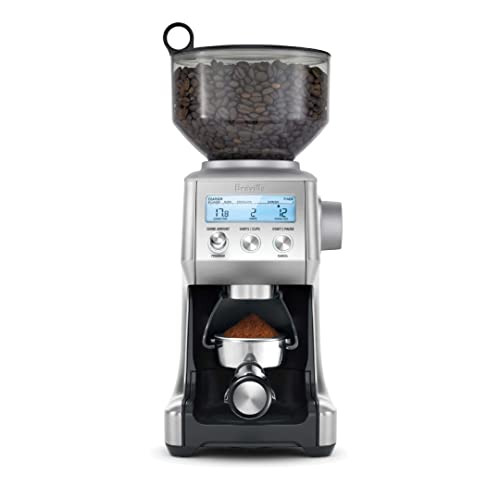
40 mm burrs · Conical Burr The Breville Smart Grinder Pro is the long-selling $200 conical with 60 settings and Dosing iQ timed dosing — a breadth-first grinder whose record is carried by usability and value rather than by outright grind performance.
$199.00Live Amazon price · as of 09/25/2026 12:33 AM
Conical Burr 1Zpresso publishes 8 microns per click, a 35–40 g capacity and a 670 g body, and positions it for espresso. It does not give a burr diameter on the page we take these from, so we do not quote one. Its 8-micron increment is designed for fine control at espresso settings; adjustment resolution alone does not establish grind quality, and we have not measured any of it.
$399.95Live Amazon price · as of 09/25/2026 12:33 AM
64 mm burrs · Flat Burr The definitive brew-only grinder: 64mm flat burrs, quiet operation and beautiful design for pour-over and drip. It cannot grind espresso, so it is a poor buy for espresso drinkers — and endgame for brew-only purists.
$389.00Live Amazon price · as of 09/25/2026 12:32 AM
64 mm burrs · Flat Burr The flat-burr value king: 64mm burrs, stepless single-dose workflow and SSP upgrade potential at roughly $389. Exceptional price-to-performance; expect minor out-of-box tuning and a less premium finish.
What is the difference between flat and conical burrs?
How the two grinding surfaces are arranged. Flat burrs are two rings lying flat on each other with the coffee thrown outward between them. Conical burrs have a cone sitting inside a ring, with the coffee falling down through the gap. That geometry then changes the particle distribution each one produces.
Are flat burrs better than conical burrs?
No, and the makers who sell both say so. Flat burrs give a more uniform particle distribution, which reads as clarity and lower astringency. Conical burrs give a bimodal distribution with more fines, which reads as body and sweetness. They suit different coffees and different preferences.
What does bimodal particle distribution mean?
That the grind contains two distinct populations of particle size rather than one: a main group near the size you set, plus a separate group of very small particles called fines. Conical burrs tend to produce this; flat burrs tend toward a single peak.
Are fines bad?
No. Fines extract very fast and give up body and sweetness first, which is why a grind containing some of them makes a rounder, heavier cup. Too many fines make the cup astringent and drying as well, which is the trade-off rather than a fault.
Which burr type is better for espresso?
Conical burrs have the longer association with espresso, because the extra fines add the body and sweetness most people associate with a traditional shot. Flat burrs suit espresso well too, particularly with lighter roasts where clarity is the point.
Does burr size matter?
Larger burrs grind faster, which is the reliable benefit, and tend to run cooler for a given dose. They do not change the character of the geometry: a large conical still produces more fines than a flat set. Size mostly buys speed.
Why do people talk about burr alignment?
Because misaligned burrs grind unevenly, which defeats the point of a burr grinder. Flat burrs need only to be parallel; conical burrs must be both parallel and concentric, which is a harder standard to hold in manufacture.
Are conical grinders quieter?
Generally yes. Conical designs rely on gravity to move coffee down through the burrs rather than throwing it outward, which usually makes them both quieter and slightly lower-retention than comparable flat grinders.
How do I tell if my grinder has flat or conical burrs?
Check the specification first, since makers state it. Otherwise take the hopper off and look: a cone pointing up inside a ring is conical, and a flat toothed ring like a washer is flat. Hand grinders are almost always conical, because a cone is much easier to turn by hand.
Are ceramic burrs better than steel?
They are a separate question from geometry. Steel burrs are sharper and wear faster; ceramic burrs are more brittle but hold an edge longer and conduct less heat. Neither material changes whether the grind comes out unimodal or bimodal, which is set by the burr shape.
Sources for this page:
That burrs grind with pressure rather than chopping and so produce fewer fines than a blade grinder, that flat burrs are two rings lying flat on each other with angled teeth while conical burrs grind vertically with one burr inside another, and a technician's account of why flat burrs are easier to manufacture to tolerance because only parallelism matters while conical burrs need both parallelism and concentricity: Perfect Daily Grind's conical versus flat burr article, read 2026-09-24 · That flat burrs lead to a uniform particle size while conical burrs produce a bimodal distribution of both smaller and larger particles, that flat burrs produce greater flavour separation while conical burrs give a more traditional body with blended flavours, and the maker's own conclusion that neither is definitively better: Niche Coffee's published conical versus flat comparison, read 2026-09-24 · That conical burrs produce more fines while flat burrs produce a more even distribution, that the extra fines tend to make more full-bodied cups well suited to espresso, and that the uniform grind of a flat burr generally results in lower astringency: Counter Culture Coffee's deep dive on grinder burrs, read 2026-09-24 · That burr grinders grind with two burrs, either flat or conical, set closer or farther apart to control particle size, that they deliver a consistent particle distribution leading to more uniform extraction, and that conical burrs can produce a slightly varied distribution with more fines than flat burrs, lending body and sweetness to the cup: Mahlkoenig's published guide to coffee grinders, read 2026-09-24 · Burr type and burr diameter for every grinder named are each maker's own published figures as recorded in our grinder catalog, with the listing read date on every card; scores, where shown, are our own published review verdicts We have not lab-tested brewers; where a figure is a manufacturer's, the page names the manufacturer, and machine capabilities come from our own published review records.