Single-Dose Coffee Grinders: What Single Dosing Actually Solves
Single dosing means weighing each dose and grinding it, instead of filling a hopper. What it fixes, what retention really means, who should bother and which grinders in our catalog do it.
8 facts, each with a source below8 questions answered6 verified products
Single dosing means weighing out exactly the coffee you are about to brew, dropping it in, and grinding until the grinder is empty — instead of filling a hopper with a week of beans and dosing from the top. A single-dose grinder is one built for that: no hopper to speak of, and a grind path designed so almost nothing stays behind. What stays behind is called retention, and it is the whole argument. Coffee left in the chamber goes stale and joins your next brew, and it means the dose you weighed is not the dose you get. Single dosing fixes both, and lets you switch between coffees without purging. It costs you thirty to forty-five seconds per brew, and no grinder retains literally nothing.
What it isWeighing each dose and grinding it, rather than dosing from a full hopper
RetentionCoffee left inside the grinder after grinding, which joins the next dose
Why botherFreshness, an accurate dose, and switching coffees without purging
Published exampleA Eureka Mignon quoted below 0.8 g total retention and below 0.3 g exchange
Zero retentionDoes not exist — every grinder keeps and swaps a little
The costRoughly 30–45 seconds per brew, and a scale you actually use
Who needs itEspresso drinkers, people with several bags open, anyone dialling in
Who does notOne bag, one brewer, same dose daily — a hopper is fine
Left: a hopper holds days of beans above the burrs and doses from the top. Right: single dosing weighs one dose, grinds it, and leaves the chamber empty. What is left behind is retention.
What single dosing is
The traditional grinder has a hopper: a hopper holds several days of beans above the burrs, and you dose from it as needed. It is fast and it is hands-off, and cafes use it because it has to be.
Single dosing replaces that with a weighing step. You put whole beans on a scale — commonly around 18 to 20 g for espresso — tip them into the grinder, grind until nothing more comes out, and brew. The grinder sits empty between uses. Many people give the grinder a puff of air or a tap at the end to push out the last of it.
A single-dose grinder is a machine designed around that habit rather than merely tolerating it: a small funnel where the hopper would be, steeply angled internals so grounds fall out rather than settle, and often a bellows to clear the path. You can single dose on a normal grinder — nothing stops you — but you will leave more behind.
Retention, and why it is the whole argument
Retention is coffee that stays inside the grinder after you have finished grinding. It sits in the chamber, on the burrs and in the chute. It causes two separate problems, and it is worth keeping them apart because people tend to blur them.
The first is staleness. Ground coffee goes stale fast — far faster than whole beans, because grinding multiplies the surface exposed to air. Coffee held in the chamber overnight is noticeably flat by morning, and it comes out mixed into your fresh dose. Makers of single-dose grinders put this bluntly: trapped grounds go stale and compromise the brews that follow until the grinder is cleaned.
The second is dose accuracy. If a gram stays behind and a gram of yesterday's coffee comes out in its place, your carefully weighed 18 g in gives you 18 g out by weight but not by content — and if the amounts do not balance, not even by weight. This is why the trade distinguishes total retention (how much is in there) from exchange retention (how much of it actually swaps out per dose). One published figure for a Eureka Mignon puts total retention below 0.8 g and exchange below 0.3 g, which gives you a sense of what good looks like on a conventional grinder.
The honest caveat, which the specialty trade states plainly: there is no such thing as zero retention. Even the best single-dose grinder retains and exchanges small amounts. The claim is less, not none.
Who should single dose, and who should not
This is a workflow choice, not an upgrade everyone needs. Be honest about which of these you are.
Single dosing is worth it if:
You drink espresso. Espresso grinds are fine and sticky, retention is highest there, and the dose matters most — a gram either way visibly changes a shot.
You have more than one bag open. This is the strongest practical reason. With a hopper, switching coffees means emptying it and purging the burrs, which wastes good coffee. Single dosing lets you brew a different coffee every cup with no waste at all.
You are dialling in. When you are moving the grind setting to chase a shot, low retention means the next dose actually reflects the new setting rather than half the old one.
You buy small bags of good coffee and would rather they stayed sealed until the moment you brew.
A hopper is genuinely fine if: you drink the same coffee every day, brew filter rather than espresso, use the same dose each time, and value the ten seconds you save. That is a large share of home coffee drinkers, and there is nothing wrong with it.
The workflow, step by step
Weigh the beans. Whole beans, on a scale, straight into a small cup. Around 18 g is a common espresso starting dose; filter brewing follows your ratio.
Tip them into the grinder. A spritz of water on the beans first — a drop or two, stirred — dramatically reduces static and the mess it causes. This is worth doing.
Grind until it stops. Wait for the sound to change and the output to cease.
Clear the path. A puff of the bellows, or a few taps. Three seconds.
Brew. And if you want to know what came out versus what went in, weigh the grounds; the difference is your retention.
That is the whole ceremony, and it is the reason the trade quotes roughly thirty to forty-five seconds of added time per brew. Whether that is a cost or a pleasant ritual is a matter of temperament, and worth being honest with yourself about before spending.
What to look for when buying
Beyond low retention itself, four things separate single-dose grinders in practice.
A bellows or a clear grind path. The mechanism that pushes the last grounds out. Its absence is the difference between a grinder that single doses and one that merely permits it.
Stepless or fine-stepped adjustment. If you are single dosing you are probably chasing precision, and a grinder with coarse steps will frustrate that.
Burr type. Flat burrs tend toward a uniform particle size; conical burrs produce a bimodal distribution, meaning both smaller and larger particles together. Makers who sell both are candid that neither is better — flat burrs tend to separate flavours more distinctly, conical burrs to give a more traditional body. This is preference, not ranking.
Static management. Fine grounds carry a charge and cling. Grinders vary a lot here, and the water trick above levels most of the difference.
One note on our catalog: the archetypal single-dose grinder, the Niche Zero, is sold direct by its maker rather than through the retailer we link to, so it does not appear as a card below. It holds our 2026 award standing for burr grinders, and its page explains why.
The grinders below are the ones in our catalog that suit a single-dose workflow — the hand grinders inherently, since they have no hopper worth the name, and the electrics by design.
Verified products for this page
ℹ️Affiliate disclosure: CoffeeLabAdvisor is an Amazon Associate and may earn a commission from these links, at no extra cost to you. Commissions play no part in what appears here — every product traces to a verified catalog entry or a published review.
Grinders in our catalog that suit single dosing — three hand grinders, which have no hopper to fill, and three electrics built around the workflow. Reviewed models link to their review; the hand grinders are documented from published specifications and carry no score. The Niche Zero is sold direct by its maker and so has no card here.
Documented specs
TIMEMORE
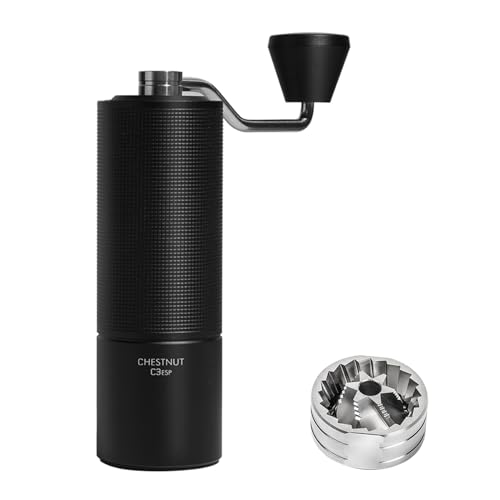
TIMEMORE Chestnut C3 ESP
$68.00Live Amazon price · as of 09/25/2026 12:33 AM
Conical Burr The lowest-priced of the four here, and a burr grinder rather than a blade. Its retail listing describes a stainless steel conical burr set of TIMEMORE's S2C design — S2C names the burr family rather than the material, and this is a listing claim we have not verified against a manufacturer datasheet. At this price the meaningful comparison is often against a blade grinder, and moving to a burr grinder is the more consequential change in grinding method.
$199.00Live Amazon price · as of 09/25/2026 12:33 AM
Conical Burr 1Zpresso publishes 8 microns per click, a 35–40 g capacity and a 670 g body, and positions it for espresso. It does not give a burr diameter on the page we take these from, so we do not quote one. Its 8-micron increment is designed for fine control at espresso settings; adjustment resolution alone does not establish grind quality, and we have not measured any of it.
$266.71Live Amazon price · as of 09/25/2026 12:33 AM
Conical Burr Comandante's own page describes a Nitro Blade burr made from its Nitro Rex steel, a jar holding 40 grams, and manufacture in Germany. It does not publish a burr diameter, so we do not quote one. It is the highest-priced of the four here, and Comandante's own material emphasises durable construction and long-term ownership.
$389.00Live Amazon price · as of 09/25/2026 12:32 AM
64 mm burrs · Flat Burr The flat-burr value king: 64mm burrs, stepless single-dose workflow and SSP upgrade potential at roughly $389. Exceptional price-to-performance; expect minor out-of-box tuning and a less premium finish.
$399.95Live Amazon price · as of 09/25/2026 12:33 AM
64 mm burrs · Flat Burr The definitive brew-only grinder: 64mm flat burrs, quiet operation and beautiful design for pour-over and drip. It cannot grind espresso, so it is a poor buy for espresso drinkers — and endgame for brew-only purists.
Weighing out exactly the beans for one brew, grinding them, and leaving the grinder empty, rather than filling a hopper and dosing from it. A single-dose grinder is one designed for that, with almost no hopper and a grind path built so little stays behind.
What is grinder retention?
Coffee that remains inside the grinder after grinding, in the chamber, on the burrs and in the chute. It goes stale and joins the next dose, and it means the weight you put in is not the weight that comes out.
Is zero retention possible?
No. The specialty trade is clear that there is no such thing as zero retention: even the best single-dose grinder retains and exchanges small amounts of coffee. Low retention is the realistic claim.
Is single dosing worth it?
It is worth it if you drink espresso, keep more than one coffee open, or are dialling in a new bag, because it protects freshness and dose accuracy and lets you switch coffees without purging. If you drink the same coffee at the same dose every day, a hopper is fine.
How much time does single dosing add?
Roughly thirty to forty-five seconds per brew, once weighing and clearing the grinder are counted.
Can I single dose with a normal hopper grinder?
Yes, nothing prevents it, but you will leave more coffee behind because the grind path was not designed to clear itself. Many people run a few beans through as a purge, which is exactly the waste single dosing sets out to avoid.
Why do people spray beans with water before grinding?
A drop or two of water stirred through the beans reduces the static charge that makes fine grounds cling to the grinder and scatter when they come out. It is a well-established habit among people who single dose, and it costs nothing.
Flat or conical burrs for single dosing?
Either. Flat burrs tend to produce a more uniform particle size and separate flavours more distinctly; conical burrs produce a mix of finer and coarser particles and a more traditional body. Makers who sell both say neither is definitively better.
Sources for this page:
The definition of single dosing as pre-weighing individual amounts of whole beans, grind retention as coffee left in the grinding chamber, a published retention figure for the Eureka Mignon below 0.8 g total and below 0.3 g exchange, the freshness and precision reasons for the workflow, and the statement that there is no such thing as zero retention: Perfect Daily Grind's single-dose grinding article, read 2026-09-24 · A single-dose maker's own position that single dosing eliminates waste and keeps coffee as fresh as possible, that retention both ruins measurement and adds cleaning effort, and that flat burrs give a uniform particle size while conical burrs give a bimodal distribution: Niche Coffee's published burr comparison, read 2026-09-24 · Grinder specifications, burr type and burr diameter are each maker's own published figures as recorded in our grinder catalog, with the listing read date on every card; scores, where shown, are our own published review verdicts We have not lab-tested brewers; where a figure is a manufacturer's, the page names the manufacturer, and machine capabilities come from our own published review records.