The grind for espresso is fine: finer than table salt, close to the texture of flour that still has a little grit, and finer than every other brew method except Turkish. The reason is pressure and time. The Italian standard for a certified espresso puts 7 g of coffee under water at 9 bar for about 25 seconds and expects 25 ml in the cup; only a fine grind packs tightly enough to resist that pressure for that long. The right setting is not a number you can copy, because it changes with the beans, the roast, the machine and the day, so the working method is to dial in: fix the dose, aim for roughly twice its weight in the cup in 25 to 30 seconds, and grind finer if the shot runs fast or coarser if it chokes. The exception is a pressurised (dual-wall) basket, which makes its own resistance and is built for pre-ground coffee.
TextureFiner than table salt; flour with a little grit
The standard7 g, 9 bar, about 25 s, 25 ml in the cup (Italian Espresso National Institute)
Home dose18-22 g in a double basket, as Breville's guide starts
RatioAbout 1:2 - twice the dose in the cup
Time25-30 seconds from the pump starting
Runs fastGrind finer, or add a gram
ChokesGrind coarser, or take a gram out
Dual-wall basketCoarser works; built for pre-ground
How fine is espresso grind, and why
Put a pinch of espresso grind between your fingers and it feels like flour with a little grit in it; table salt is coarser, and the medium grind of a drip machine feels like sand next to it. Our grind size chart places espresso at the fine end of its bands, one step finer than the moka pot and two finer than pour-over, with only Turkish coffee ground finer. The reason is mechanical. In every other brewer, water sits on or drips through the coffee under gravity and the grind sets how fast it drains and how much it extracts. Espresso pushes water through the bed under pressure - the Italian Espresso National Institute's standard for a certified espresso specifies 9 bar of entry pressure, water leaving the machine at 88 C, a 25-second percolation and 25 ml in the cup from 7 g of coffee - and the only thing resisting that pressure is the coffee itself. A fine grind packs into a puck dense enough to slow the water; a coarse one lets it through in a few seconds as a thin, sour stream.
Fine also means consistent. A grinder that makes some particles fine and some coarse gives the water an easy path around the coarse ones, so the shot runs fast through part of the bed and over-extracts the rest. That is why an espresso grinder is a separate purchase from a brew grinder, and why the grinders that can do it are the ones with fine steps between settings; our espresso grinder guide goes through which of the grinders we have evaluated can hold a fine setting and step through it in small increments. A note on microns: makers such as 1Zpresso publish figures like 8 or 25 microns per click, but as our grind chart explains, those describe how far the adjustment moves per click, not the size of the grounds, so they are not a grind setting you can copy from one grinder to another.
Dialling in: dose, yield, time, and which way to turn the dial
Because no two coffees or grinders agree on a setting, espresso is dialled in rather than set. Breville's own guide for its machines lays out the method that every home barista uses. Fix the dose first: Breville calls 18 to 22 g in a double basket a safe start, and the Dual Boiler's listing states 19 to 22 g for its 58 mm basket. Aim for a ratio: Breville names 1:2, one part coffee to two parts liquid in the cup, as the standard for a great espresso, so 18 g in should give about 36 g out. Time it: Breville's target is 25 to 30 seconds from the moment the pump starts, which is the same window the Italian standard describes as 25 seconds plus or minus 5. Then read the result. If the shot reaches its weight in well under 25 seconds it ran fast and under-extracted, and it will taste thin and sour; Breville's instruction is to choose a finer grind or add a gram or two to the dose. If it takes far longer than 30 seconds, or drips and stalls, the puck is too tight; grind coarser or take a gram out.
Change one thing at a time, and change the grind before the dose. A scale under the cup and a timer (or the shot clock most modern machines show) turn the process from guesswork into two numbers; the coffee scale guide covers the 0.1 g scales that fit on a drip tray. Two more things move the target. Fresh beans release more gas and run slower than beans a month past roast, so the same setting drifts coarser over a bag; and a darker roast is more brittle and grinds finer at the same setting than a light roast. Pre-infusion, which many machines on this site offer, wets the puck at low pressure first and makes a slightly finer grind workable. When the shot lands in the window and tastes balanced - sweet, a little acidity, no harsh bitterness - write the setting down with the bean and the date. That number is worth more than any chart.
Grinders that can grind for espresso, and settings from the makers
The grinders on this page's cards are the espresso-capable grinders we have evaluated (the Niche Zero, also evaluated, is sold direct and so appears here only by name), and the makers' own guidance gives a starting point on each. Baratza sets its Encore ESP so that settings 1 to 20 are the espresso range with smaller steps, and 21 to 40 cover filter, French press and cold brew. Breville's Smart Grinder Pro has 60 settings that run from espresso to French press, with the fine end for espresso. The Eureka Mignon Specialita and Libra, the Niche Zero and the DF64 Gen 2 are stepless or near-stepless, so there is no numbered espresso setting to quote; you find it by dialling in, and the fine steps are the point. Each card links to the full evaluation, where the burr size, adjustment type and our verdict are recorded. A grinder that reaches an espresso-fine setting but jumps between settings in big steps will make the dial-in frustrating, which is the practical reason cheaper blade and entry burr grinders are not on this list.
Hand grinders can do it too. The hand grinders in our catalog that are built for espresso use fine-threaded adjustment for exactly this reason, and our hand grinder guide covers which ones. Whatever the grinder, keep it clean: fine grinds and coffee oils pack into the burr chamber faster than coarse ones, and a grinder that has not been cleaned drifts finer on its own, which shows up as shots that slowly choke at a setting that used to work. Grinder cleaning tablets, and the makers' guidance on using them, are covered on our espresso machine cleaner guide.
Pre-ground espresso: when it works and when it cannot
Pre-ground espresso coffee is ground fine at the roastery and sold in cans, bricks and bags, and it works well in three places: the moka pot, the pressurised basket of a home espresso machine, and the capsule-style and pod machines that take loose coffee. What it cannot do is dial in. The grind is fixed, so if it runs fast in a standard basket on your machine there is no finer setting to turn to, and pre-ground coffee also loses its gas and aroma quickly once opened, which is why the cans are small and vacuum-sealed. Roasters know this, and most of the espresso-labelled cans say so on the listing: Lavazza's Caffe Espresso is described as best used with an espresso machine or moka pot, and its Super Crema and Crema e Gusto grinds list drip, moka and French press alongside espresso.
The pressurised, dual-wall basket is the bridge. Breville's instruction books, quoted in full on our pressurised vs non-pressurised baskets guide, state that the dual-wall basket regulates pressure regardless of grind, dose, tamp pressure or freshness, and that it is for pre-ground coffee; the single-wall basket is for fresh beans you grind yourself. With a dual-wall basket, a pre-ground can produces a shot with crema - made mechanically by the basket's outlet rather than by extraction, as that guide explains - and a coarser-than-espresso grind still works. Breville's stated doses for its dual-wall baskets are approximately 8 to 11 g for the single and 16 to 19 g for the double. If you have a machine and no grinder yet, this is the honest route: a pre-ground espresso can in the dual-wall basket now, and the grinder when the budget allows. Our medium grind guide covers the pre-ground bags meant for drip, which are too coarse for either basket.
Which setup, by where you are
You have a machine with a single-wall basket and no grinder: the grinder is the next purchase, not another bag of coffee; start with the Encore ESP or the Smart Grinder Pro and dial in with the method above. You have a Breville with the dual-wall baskets and want coffee today: a pre-ground espresso can - illy Classico, Lavazza Caffe Espresso, Cafe Bustelo - in the dual-wall basket, at Breville's stated dose. You are chasing better shots on a grinder that steps coarsely: the Specialita, the Niche Zero or the DF64 Gen 2 are the stepless upgrades. Your shots suddenly choke at the old setting: clean the grinder before you change anything else, then check the beans' roast date. You brew moka pot most days and espresso occasionally: a pre-ground espresso brick is fine for the moka pot, and our moka pot guide covers its own, slightly coarser, grind.
Verified products for this page
ℹ️
Affiliate disclosure: CoffeeLabAdvisor is an Amazon Associate and may earn a commission from these links, at no extra cost to you. Commissions play no part in what appears here — every product traces to a verified catalog entry or a published review.
Five espresso-capable grinders we have evaluated and that carry a listing (the Niche Zero, also evaluated, is sold direct and has none), then five pre-ground espresso cans and bricks. Grinder cards link to the full evaluation; each pre-ground claim is the listing's own statement, read on the date shown on the card, and live prices come from Amazon rather than being retyped here.

Reviewed$199.95Live Amazon price · as of 09/22/2026 4:24 AM
40 mm burrs · Conical Burr The best espresso grinder under $200: a repairable 40mm conical with 40 steps that pairs well with entry-level machines. Reliable and consistent, if not the clearest or most premium-feeling option.
Check price on Amazon → 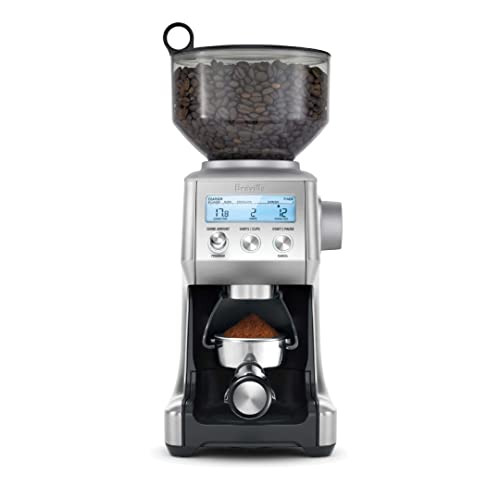
Reviewed$199.95Live Amazon price · as of 09/22/2026 4:30 AM
40 mm burrs · Conical Burr The Breville Smart Grinder Pro is the long-selling $200 conical with 60 settings and Dosing iQ timed dosing — a breadth-first grinder whose record is carried by usability and value rather than by outright grind performance.
Check price on Amazon → 
⭐ Honorable mention$549.00Live Amazon price · as of 09/22/2026 4:24 AM
55 mm burrs · Flat Burr The value champion of flat-burr espresso grinding: 55mm hardened steel burrs, stepless adjustment and all-metal build at roughly $549. Superb clarity and consistency; timed dosing is the main workflow caveat.
Check price on Amazon → 
⭐ Honorable mention$389.00Live Amazon price · as of 09/22/2026 4:24 AM
64 mm burrs · Flat Burr The flat-burr value king: 64mm burrs, stepless single-dose workflow and SSP upgrade potential at roughly $389. Exceptional price-to-performance; expect minor out-of-box tuning and a less premium finish.
Check price on Amazon → 
⭐ Honorable mention$799.00Live Amazon price · as of 09/22/2026 4:24 AM
55 mm burrs · Flat Burr The grind-by-weight contender, and the documented case for it is strong: an integrated scale dosing within ±0.2 g straight into the portafilter, on the Mignon line's proven 55mm flat burrs. Assessed in our 2026 evaluation — grind performance and consistency among its strongest dimensions, value its weakest — and recognised with an Honorable Mention for the weight-based workflow. Buy it for the bench it clears; skip it if you single-dose.
Check price on Amazon → 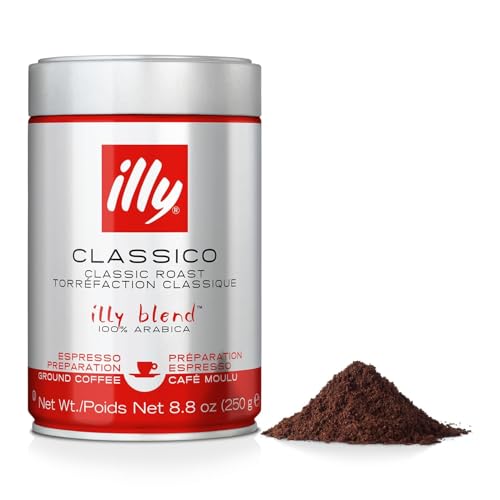
Espresso grind, pre-groundilly
Classico Ground Espresso
$13.99Live Amazon price · as of 09/22/2026 5:05 AM
The Italian benchmark pre-ground for espresso - the same Classico blend as the whole bean, ground for a machine. Listing states a medium roast of 100 percent sustainably grown arabica, ground for espresso, in an 8.8 oz can.
Check price on Amazon → 
Espresso grind, pre-groundLavazza
Caffe Espresso Ground, 8.8 oz can
$9.49Live Amazon price · as of 09/22/2026 5:05 AM
Lavazza's 100 percent arabica espresso grind in the small can. Listing states an 8.8 oz can of non-GMO 100 percent arabica ground coffee, blended and roasted in Italy, best used with an espresso machine or moka pot and also suited to drip and French press.
Check price on Amazon → 
Espresso grind, pre-groundLavazza
Super Crema Ground, 32 oz
$24.70Live Amazon price · as of 09/22/2026 5:05 AM
The robusta-blend crema favourite, pre-ground in the big bag. Listing states a 32 oz bag of full-bodied medium roast arabica and robusta ground coffee from 15 growing countries, described as ideal for espresso or drip, moka pot, Chemex and pour-over, with a brewing guide of 0.5 oz of coffee per 8 oz of water.
Check price on Amazon → 
Espresso grind, pre-groundCafe Bustelo
Espresso Style Dark Roast Ground, 10 oz can
$7.14Live Amazon price · as of 09/22/2026 5:05 AM
The Latin cafecito grind - dark, fine, and the cheapest way to try a pressurised basket. Listing states a 10 oz can of espresso-style dark roast ground coffee, made since 1928, described as standing up to milk and sugar and suited to hot or cold brewing by any method.
Check price on Amazon → 
Espresso grind, pre-groundLavazza
Crema e Gusto Ground, 8.8 oz brick (4-pack)
$27.78Live Amazon price · as of 09/22/2026 5:05 AM
The vacuum brick: four 8.8 oz packs of the 7-out-of-10 intensity blend. Listing states four 8.8 oz bricks of medium roast arabica and robusta ground coffee at 7 out of 10 intensity, sourced from South America and Southeast Asia, described as ideal for espresso and drip preparation and, in its preparation line, for drip machines, moka pot or French press.
Check price on Amazon →
Frequently asked questions
What grind size is best for espresso?
Fine - finer than table salt, close to flour with a little grit, and finer than any other method except Turkish. The exact setting is found by dialling in: about a 1:2 ratio in 25 to 30 seconds, finer if the shot runs fast, coarser if it chokes.
Why does espresso need such a fine grind?
Pressure. The Italian standard puts 7 g of coffee under 9 bar for about 25 seconds to yield 25 ml. Only a fine, evenly ground puck resists that pressure long enough; a coarse grind lets the water through in seconds as a thin, sour shot.
How many seconds should an espresso shot take?
25 to 30 seconds from the pump starting, per Breville's guide; the Italian Espresso National Institute standard gives 25 seconds plus or minus 5. Much faster means grind finer or add a gram; much slower means grind coarser or take one out.
How much coffee goes in an espresso shot?
The Italian standard is 7 g for a single. Home double baskets take more: Breville's guide starts at 18 to 22 g, and the Dual Boiler's listing states 19 to 22 g for its 58 mm basket. Aim for about twice the dose in the cup.
Can I use pre-ground coffee for espresso?
In a pressurised (dual-wall) basket, yes - Breville's instruction books say that basket is for pre-ground coffee and regulates pressure regardless of grind. In a standard single-wall basket, pre-ground usually runs fast and cannot be adjusted, so a grinder is the answer.
What grind setting for espresso on a Baratza Encore ESP?
Baratza sets settings 1 to 20 as the espresso range on the Encore ESP, with smaller steps there, and 21 to 40 for filter and French press. Start in the low teens and dial in; the exact number depends on the beans.
Is espresso grind the same as Turkish grind?
No. Turkish coffee is ground finer still, to a powder, because the grounds stay in the cup. Espresso grind keeps a little grit so the puck holds together and the water passes through it under pressure.
Why do my shots suddenly run slower at the same setting?
Usually one of three things: the beans are fresher (more gas, slower flow), the roast is darker (grinds finer at the same setting), or the grinder needs cleaning (packed fines make it grind finer). Clean first, then adjust coarser.
Sources for this page:
Certified Italian espresso parameters (7 g plus or minus 0.5 g; entry pressure 9 plus or minus 1 bar; water exit temperature 88 plus or minus 2 C; percolation 25 plus or minus 5 s; 25 plus or minus 2.5 ml in the cup) and the 25-30 second description: Wikipedia, Espresso, citing the Italian Espresso National Institute, read 2026-09-16 · Dial-in method (25-30 seconds from activating the brew cycle; 18-22 g as a safe starting dose; the 1:2 ratio; finer grind or a gram more when the shot runs fast, coarser or a gram less when it runs slow): Breville's guide to dialling in espresso, breville.com, read 2026-09-16 · The Dual Boiler's 19-22 g dose in a 58 mm portafilter: the machine's own Amazon listing, read 2026-09-16 · Dual-wall basket behaviour (regulates pressure regardless of grind, dose, tamp pressure or freshness; for pre-ground coffee; single wall for fresh beans; 1-cup approximately 8-11 g, 2-cup approximately 16-19 g): Breville's instruction book for the Barista Express as quoted on our pressurised vs non-pressurised baskets guide · Grind bands and the microns note: our grind size chart and the maker pages it cites (Baratza Encore ESP settings, Breville Smart Grinder Pro 60 settings, 1Zpresso adjustment figures), read for that chart on 30 August 2026 · Pre-ground can facts (roast, blend, size, stated brewing methods): each product's own Amazon listing, read 2026-09-16; every card links to the listing it was read from · Grinder specifications and verdicts: our published evaluation of each grinder, linked from its card We have not lab-tested brewers; where a figure is a manufacturer's, the page names the manufacturer, and machine capabilities come from our own published review records.
Keep going