Gigawatt Coffee Roasters: Five Air-Roasted Coffees, Compared
A family-run roaster in Bensenville, Illinois that roasts on a fluid-bed air roaster and sells online and at Chicagoland farmers markets. Here are 5 of its coffees, from a light Costa Rican to a dark water-processed decaf, with what each bag actually tells you.
ℹ️Disclosure: Gigawatt sent us samples of these five coffees in November 2026, and we brewed and tasted all of them. We liked every one, and in our tasting each matched the tasting notes Gigawatt gives for it. That is one bag of each, so it cannot tell you how consistent Gigawatt is from batch to batch. The tasting notes on this page are Gigawatt’s own and are labelled as Gigawatt’s; the rest comes from Gigawatt’s published pages and the independent sources listed at the end. Links to Gigawatt’s store are not affiliate links and earn us nothing. Our sample policy.
Gigawatt’s whole pitch is one machine. Most roasters tumble beans in a heated drum; Gigawatt suspends them on a column of hot air, and it builds its brand on what it says that does to the cup. This page sets out what the bags say, what independent sources say about air roasting, and where the published details disagree with each other.
Which Gigawatt coffee should you start with?
Start with how you brew; a question or two follows. The range explorer below opens on your pick.
Choose one and the questions for that way of brewing appear here.
Not sure? Gigawatt’s sample pack is five 3 oz bags across its range, each enough for one pot.
Explore the Gigawatt Coffee Roasters range
Each coffee with Gigawatt’s own photos, the facts Gigawatt publishes for it, and the store price we read on 9 November 2026.
ℹ️Not affiliate links: the buttons below go to Gigawatt’s own store and earn us nothing. Gigawatt sent us samples of these coffees; see the disclosure at the top of the page.
Photos: Gigawatt Coffee Roasters
Light · Bright and fruity
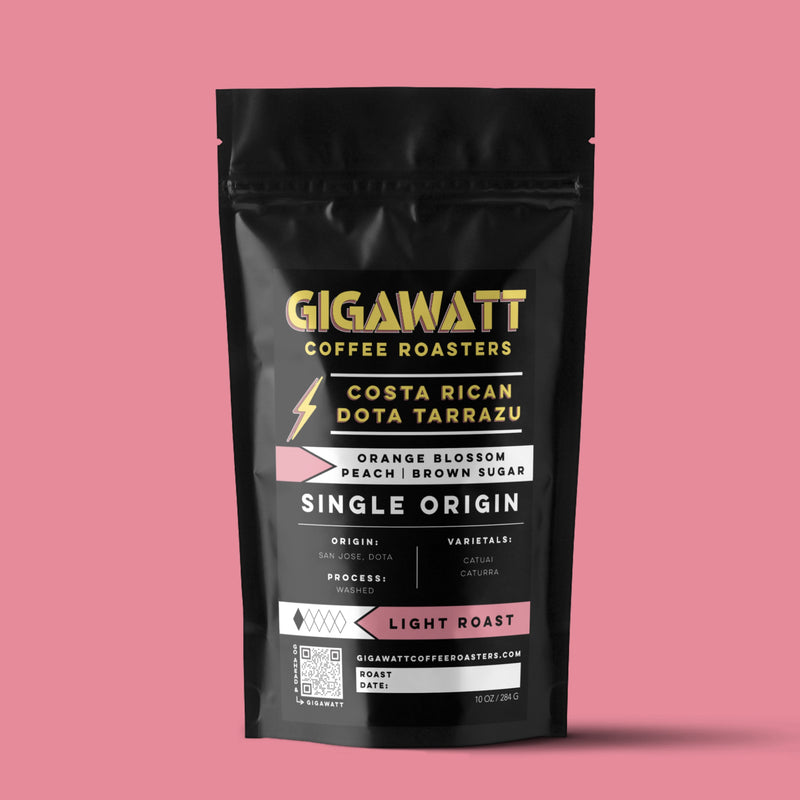
Costa Rican Tarrazu
Choose it for pour-over and a bright, fruity cup.
Roast
Light
Origin
Dota, Costa Rica
Process
Eco-pulped
Notes
Peach, orange blossom
What Gigawatt publishes
Origin: Dota, Tarrazu, Costa Rica. Producer: La Cooperativa de Caficultores de Dota
Process: Eco-pulped and sun-dried
Gigawatt’s tasting notes: Peach, orange blossom, brown sugar
The lightest coffee Gigawatt sells and the most fully documented: region, cooperative, varieties (Catuai and Caturra) and an altitude of 1,550–1,950 meters are all on the page. Light roasts keep more of a coffee’s acidity, so expect the brightest cup of the five.
$13.99Gigawatt’s store price for 10 oz, read 9 Nov 2026
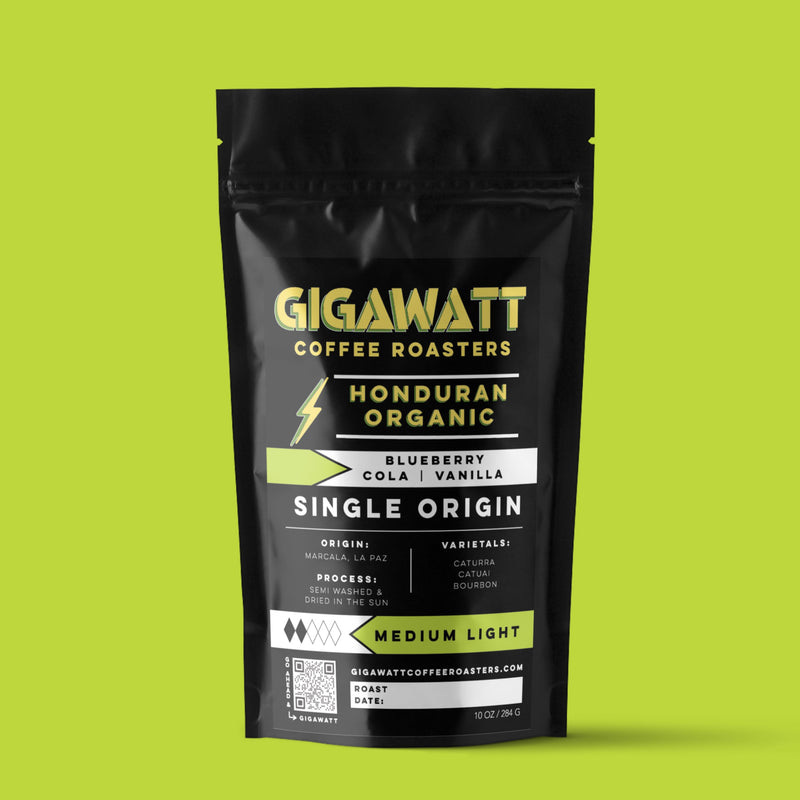
Gigawatt calls it its blueberry coffee. The page names the COMSA cooperative, three varieties (Bourbon, Catuai, Caturra) and 1,300–1,700 meters, and labels the coffee organic and Fair Trade, but it names no certifying body. An earlier version of the page, archived in 2025, described it as fully washed and sun-dried, so the process may differ by lot.
$13.99Gigawatt’s store price for 10 oz, read 9 Nov 2026
Choose it as one everyday coffee for drip or French press, black or with milk.
Roast
Medium-dark
Origin
4-country blend
Process
Washed
Notes
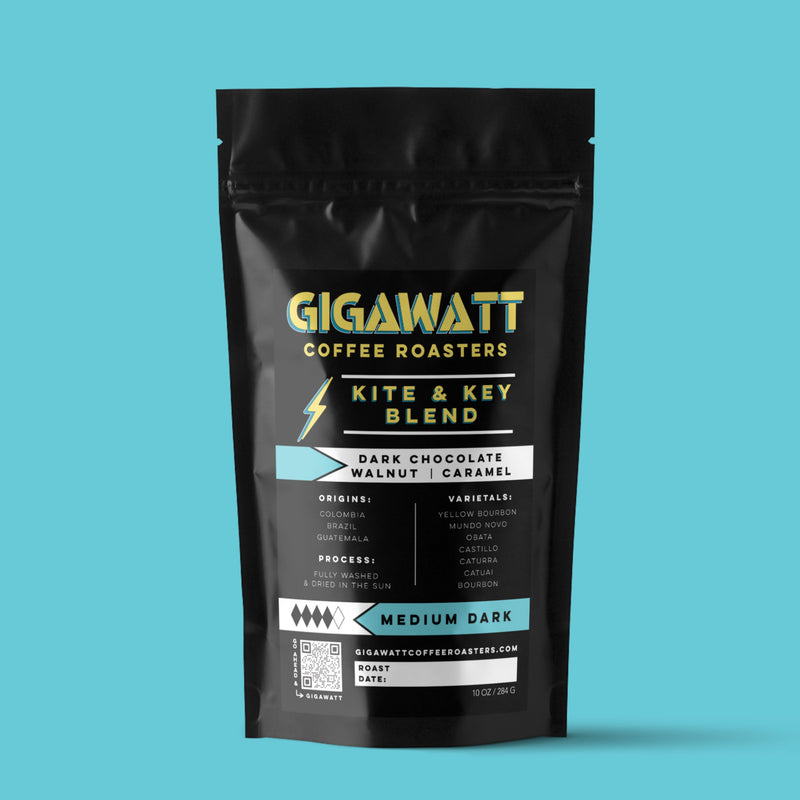
Chocolate, walnut
What Gigawatt publishes
Origin: Blend of Colombia, Brazil, Guatemala and Costa Rica
Process: Washed
Gigawatt’s tasting notes: Dark chocolate, walnut, caramel
Gigawatt’s best seller: its About page counts more than 39,000 bags sold, and it was one of the three coffees Gigawatt took to its first markets. Its product page labels it medium dark in the heading and medium in the details; Gigawatt’s FAQ calls it medium-dark, which is what we use.
$13.99Gigawatt’s store price for 10 oz, read 9 Nov 2026
Choose it for espresso at home, and for milk drinks built on espresso.
Roast
Dark
Origin
4-country blend
Includes
Monsoon Malabar
Use
Espresso
What Gigawatt publishes
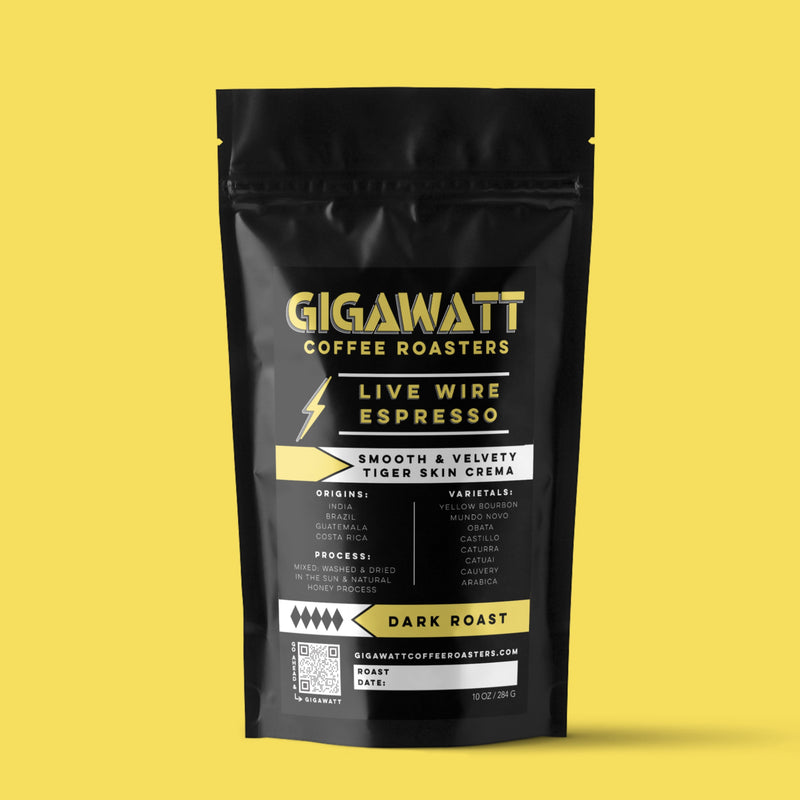
Origin: Blend of Guatemala, Brazil, Costa Rica and India, including Monsoon Malabar AA
Process: Not stated
Gigawatt’s tasting notes: None named; Gigawatt describes it as smooth and velvety
The espresso blend. Monsooned Malabar is an Indian coffee exposed to monsoon winds after harvest, a step known for heavy body and low acidity, which suits a dark espresso blend. The page names its four countries but no regions, farms or process.
$13.99Gigawatt’s store price for 10 oz, read 9 Nov 2026
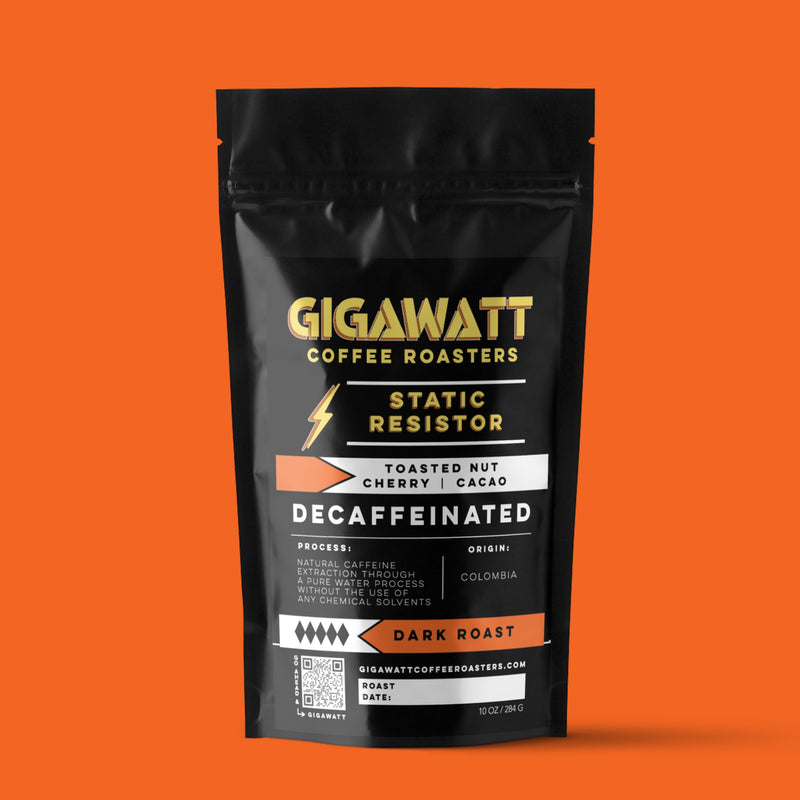
A dark decaf for drip, French press or espresso. Gigawatt names the method but not the origin: the bean is a seasonal selection, so it can change through the year. Water-processed decaf removes caffeine with water and filtration rather than solvents such as methylene chloride.
$13.99Gigawatt’s store price for 10 oz, read 9 Nov 2026
Prices: Gigawatt’s FAQ, read 9 November 2026, gives $13.99 for a 10 oz bag bought once and $12.59 on a subscription, with $5 flat-rate shipping per order in the continental US. All five come in 10 oz and 5 lb bags, whole bean or ground. Product photos: Gigawatt Coffee Roasters, shown from its store.
The 5 coffees at a glance
The five coffees run from light to dark. The roast labels are the ones Gigawatt’s own FAQ uses to sort its range.
Roast labels from Gigawatt’s FAQ (read 9 November 2026), which sorts its coffees into light, medium-light, medium, medium-dark and dark. Gigawatt says it also prints a five-diamond roast scale on every bag; the scale itself was not on any product page we could capture.
Water-processed decaf: no chemical solvents and at least 97% of the caffeine removed, per Gigawatt
Toasted nut, cherry, cacao
Every entry is Gigawatt’s own, from its product pages: Static Resistor read live on 9 November 2026 and the Organic Honduran’s process read live on 10 November 2026; everything else from archived copies of the same pages dated July 2025 to March 2026, because the store limited our requests. Tasting notes describe how Gigawatt says each coffee tastes; Gigawatt says it adds no flavorings.
Who Gigawatt is
Gigawatt Coffee Roasters is run by Eli and Jen Coleman, a husband-and-wife team, from a two-unit roastery in Bensenville, Illinois, near O’Hare. By its own account it began with home roasting in 2019, launched in February 2020, and moved to farmers markets when the pandemic closed the café and office plans it had started with. It now roasts five days a week, has a staff of seven, and roasts on fluid-bed air roasters, including a Coffee Crafters Valenta 18.
You meet it mostly at markets. It is on the Elmhurst Farmers Market’s 2026 vendor list and the La Grange farmers market vendor page, and Google reviewers mention buying at the Frankfort and Schaumburg markets. Online it sells nationwide. Gigawatt says it writes the roast date on every bag by hand, and a roast date is the single most useful freshness signal a bag can carry.
On Google, Gigawatt holds a 5.0 rating from 469 reviews (9 November 2026). Reviewers mostly mention the Kite & Key blend, freshness and the handwritten notes that come with orders.
Air roasting: what it is, and what it does not settle
A drum roaster tumbles beans in a rotating drum, heated partly by contact with the hot metal and partly by hot air. A fluid-bed roaster blows hot air up through the beans hard enough to lift and stir them, so nearly all of the heat arrives by convection. Coffee roasting texts, including Barista Hustle and Perfect Daily Grind, describe the difference in those terms. The same airflow lifts away chaff, the papery skin that comes off the bean as it roasts, and carries it to a collector; roaster patents describe that design.
Gigawatt goes further. It says that because nothing scorches against a hot drum wall and the chaff is blown away, its coffee is never bitter, and that only about 1% of roasters work this way. Those are Gigawatt’s claims, not findings. We found no independent source that measured the 1% figure. Perfect Daily Grind’s comparison of the two methods says the type of roaster does not by itself decide the flavor, and a roaster quoted in its guide to fluid-bed roasters says you still have to raise the heat gently on one to avoid scorching. Baratza describes chaff as flavor-neutral. Bitterness depends at least as much on how dark the coffee is roasted and how it is brewed.
So the fair reading is this. Air roasting is a real and distinct method, and it rules out one cause of harsh flavor, beans scorching on hot metal. Whether a given bag tastes better than a drum-roasted one is a question for the cup, not the machine.
What the published details leave open
Gigawatt documents its single origins well: region, producer, varieties and altitude. Its blends and its decaf say much less. A few points do not line up, and they are worth knowing before you buy:
Organic Honduran: labelled organic and Fair Trade with no certifying body named on the page, and described as natural process on Gigawatt’s current product page, while a 2025 version of the same page said fully washed, so the process may differ by lot.
Kite & Key: medium dark in the product heading, medium in the details, and three origins in one paragraph against four in another.
Static Resistor: the origin is a seasonal selection, so the coffee in your bag can change through the year.
Cup scores: we found no Coffee Review score or competition result for Gigawatt. One independent blog scored the Organic Honduran 8.8 in 2021, from a sample Gigawatt supplied.
Gigawatt Coffee Roasters FAQ
Where is Gigawatt Coffee Roasters located?
In Bensenville, Illinois, a village in Chicago’s western suburbs near O’Hare. Gigawatt roasts there and sells online nationwide and at farmers markets around Chicagoland.
What is air-roasted coffee?
Coffee roasted on a fluid-bed roaster, which suspends the beans on a stream of hot air instead of tumbling them in a heated drum. The heat arrives almost entirely by convection, and the airflow carries away the chaff that comes off the beans as they roast.
Is Gigawatt coffee bitter?
Gigawatt says it is never bitter, and its guarantee promises never bitter, never burnt. That is the roaster’s claim. Independent sources agree that air roasting avoids beans scorching on hot metal, but how bitter a cup tastes also depends on how dark it is roasted and how it is brewed.
How much does Gigawatt coffee cost?
$13.99 for a 10 oz bag bought once, or $12.59 on a subscription delivered every 2, 4 or 6 weeks, with $5 flat-rate shipping per order in the continental US (Gigawatt’s FAQ, read 9 November 2026).
Which Gigawatt coffee is best for espresso?
Live Wire Espresso Blend, a dark blend of Guatemalan, Brazilian, Costa Rican and Indian coffees. Gigawatt also says its Static Resistor decaf works as a decaf espresso.
Is Gigawatt’s decaf chemical-free?
Gigawatt says Static Resistor is water-processed, with no chemical solvents, and that at least 97% of the caffeine is removed. It is decaf, not caffeine-free.
Is Gigawatt’s Honduran coffee certified organic?
Gigawatt labels it organic and Fair Trade and says its COMSA producers use certified organic methods. The product page we read does not name the certifying body, so ask Gigawatt if certification matters to you.
Does Gigawatt write the roast date on the bag?
Yes. Gigawatt says it writes the roast date on every bag by hand, and it ships orders within 1–3 days.
Sources for this page: Gigawatt Coffee Roasters’ About, FAQ and Static Resistor pages, read 9 November 2026, and its Organic Honduran listing, read 10 November 2026; archived copies of its Live Wire (March 2026), Kite & Key (March 2026), Organic Honduran (October 2025), Costa Rican Tarrazu (July 2025) and sample-pack (October 2025) pages; Roast Local’s Gigawatt listing (October 2026); the Elmhurst Farmers Market 2026 vendor list and the La Grange Business Association vendor page; Barista Hustle and Perfect Daily Grind on fluid-bed and drum roasting; Baratza on chaff; US patent 5,292,005 on fluid-bed chaff separation; Pull & Pour Coffee’s 2021 Organic Honduran review; Google reviews, read 9 November 2026.