
Specifications verified 2026-10-02
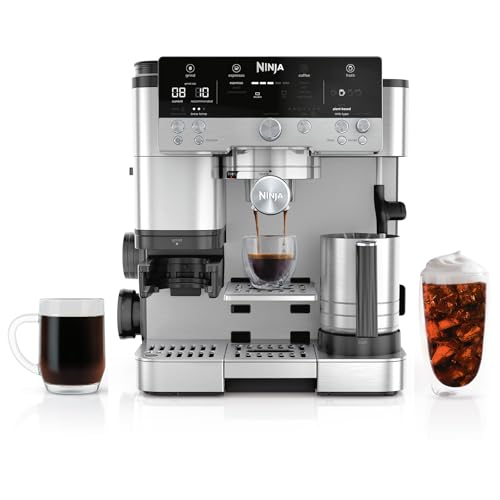
Ninja Luxe Café Premier (ES601)
$599.00Live Amazon price · as of 10/26/2026 8:04 PM
The 3-in-1: espresso, drip and rapid cold brew, with the Dual Froth System doing the milk.
Check price on Amazon →Home › Espresso Machines › Ninja Luxe Café Premier vs Pro
⚖️ Head-to-Head · 2026Pro or Premier? The ES701 adds a hot water system, five espresso styles and a lever tamper to the ES601. Compared on Ninja's own specifications.
The Ninja Luxe Café Premier (ES601) is a 3-in-1 machine: espresso, drip coffee and cold brew. The Ninja Luxe Café Pro (ES701) is a 4-in-1: the same three plus an independent hot water system for americanos, tea and hot chocolate. The Pro also adds 5 espresso styles instead of 2 (single, double, quad, ristretto and lungo against double and quad), a 5th froth preset, an insulated steam wand with an XL milk jug, an integrated lever tamper, and grind-size recommendations that adapt from your previous brew. Both share the same 25-setting conical burr grinder, weight-based dosing and Barista Assist Technology. The Pro carries a premium over the Premier; both are discounted often enough that the live prices on the cards below are the only ones worth comparing.
The 3-in-1: espresso, drip and rapid cold brew, with the Dual Froth System doing the milk.
Check price on Amazon →
The 4-in-1: adds an independent hot water system, five espresso styles and a lever tamper.
Check price on Amazon →Every entry is Ninja's own stated specification for that model, taken from its copy on the verified listings. Price is deliberately not in this table: both machines are discounted often, and the live figure is on the cards further down.
| Luxe Café Premier (ES601) | Luxe Café Pro (ES701) | |
|---|---|---|
| Machines in one | 3-in-1 | 4-in-1 |
| Espresso styles | 2: double shot, quad shot | 5: single, double, quad, ristretto, lungo |
| Drip coffee styles | 3: classic, rich, over ice | 3: classic, rich, over ice |
| Cold brew styles | 2: cold pressed espresso, cold brew coffee | 2: cold pressed espresso, cold brew coffee |
| Hot water system | Not stated | Independent hot water system: americanos, tea, hot chocolate |
| Milk system | Dual Froth System: spinning whisk plus automatic steamer, 4 presets | Dual Froth System Pro: insulated steam wand, XL milk jug, 5 presets, froth for two drinks |
| Froth presets | Steamed milk, thin froth, thick froth, cold foam | Those four plus extra-thick froth |
| Tamping | Assisted tamping | Integrated lever tamper |
| Grinder | Conical burr, 25 settings | Conical burr, 25 settings |
| Dosing | Weight-based | Weight-based, on a built-in scale |
| Grind guidance | Automatic precision grinding | Grind-size recommendations that adapt from the previous brew |
| Drink sizes (drip and cold brew) | 6, 8, 10, 12, 14, 16, 18 oz | 6, 8, 10, 12, 14, 16, 18 oz |
| Our score | None | None |
CoffeeLabAdvisor publishes a score only for CoffeeLab Award winners. That is an editorial choice, not a gap: the awards exist to name what is excellent, and a published number attached to everything else would turn a celebration into a league table. Machines we have not given an award are documented here instead — specifications from the maker's own materials, what those materials do not state, and honest context against machines that did win.
So this page carries no score, and none is pending. What it carries is checkable: every figure below is attributed, and where the maker publishes nothing we say so rather than filling the gap. Our editorial standards set out where the evidence stops.
For this comparison that costs nothing. Both machines come from one maker and share a grinder, a dosing system and a brewing approach; what separates them is a list of features Ninja publishes explicitly. Choosing between two siblings is a specification question, and specifications are exactly what can be verified and set side by side.
The whole 3-in-1 versus 4-in-1 distinction comes down to one thing: the Pro's independent hot water system, which Ninja lists for americanos, tea and hot chocolate. The word doing the work is independent. Plenty of espresso machines produce hot water by running the pump without coffee; a dedicated system means hot water without disturbing the espresso side, and it means tea drinkers in the house are served by the same appliance.
Whether that is worth money depends entirely on the household. If nobody drinks tea and americanos are not a habit, the fourth function is a line on a box. If the machine is replacing a kettle as well as a coffee maker, it is most of the reason to buy the Pro. Our americano guide covers what that drink actually is, and it is worth knowing that an americano is espresso plus hot water, so this feature is not a nicety for anyone who drinks them daily.
This is the difference that gets least attention and deserves more. The Premier lists two espresso styles, double shot and quad shot. The Pro lists five, adding single shot, ristretto and lungo.
A single shot matters more than it sounds: on the Premier, the smallest espresso the machine makes is a double. Ristretto and lungo are the short and long extractions of the same dose, and they are the two levers that let you adjust a coffee that tastes thin or harsh without changing the grind. Our lungo guide and shot sizes guide explain what each one changes.
So the honest framing is that the Pro is not just a Premier with a kettle attached. It gives you more control over the shot itself, which is the part of the machine you use every single morning.
Both machines automate milk, and both do it with the same basic idea: pour milk in, choose a style, walk away. The Premier's Dual Froth System pairs a spinning whisk with an automatic steamer and offers four presets, including cold foam. The Pro's Dual Froth System Pro adds a fifth preset, extra-thick froth, and Ninja describes it as an insulated, easy-to-clean steam wand with an XL milk jug that can froth for two drinks at once.
The two-drink capacity is the practical difference rather than the extra preset. A household making two lattes back to back is doing two milk cycles on the Premier and one on the Pro. If your mornings involve one drink, this section does not decide anything.
Buy the Premier (ES601) if you drink espresso, milk drinks, drip coffee and cold brew, and you do not need hot water on tap. It has the same grinder, the same weight-based dosing and the same Barista Assist guidance as the Pro. Nothing about the espresso itself is cut.
Buy the Pro (ES701) if any of three things matter: an independent hot water system for americanos and tea, the wider range of espresso styles including ristretto and lungo, or the integrated lever tamper and insulated steam wand. Those are the whole difference.
Neither machine carries a score from us, and both sit in a price band where a Bambino Plus holds our 2026 Best Overall Espresso Machine standing on a rubric these have not been evaluated against. If espresso alone is what you are buying, that comparison is worth making before either of these. If you want espresso plus drip plus cold brew from one machine, neither the Bambino Plus nor anything else in our reviewed catalog does that.
Both machines take a 53.3 mm portafilter, which is the size to know when buying baskets, puck screens or a bottomless portafilter. Both use a water filter in the tank, and both need descaling on a schedule. The questions owners actually ask, cleaning, descaling, resetting, water hardness and the leak that worries people most, are collected on our Ninja Luxe Café cleaning and troubleshooting guide, built the same way as this page from Ninja's own materials.
Both machines with their live prices, and the three things owners of either buy first. Both take a 53.3 mm portafilter and share the same water filter fitting, per the listings.
The cheaper Luxe Cafe, and the one most cross-shopped against a Barista Express. Listing states a 3-in-1 machine covering 2 espresso styles of double shot or quad shot, 3 drip coffee styles of classic, rich or over ice, and 2 cold brew styles, a built-in conical burr grinder with 25 settings, a Dual Froth System combining a spinning whisk with an automatic steamer, and Barista Assist Technology.
Check price on Amazon →The Luxe Cafe with a real steam wand and an integrated tamper. Listing states a 4-in-1 machine covering espresso, drip coffee, rapid cold brew and an independent hot water system, 5 espresso styles, an integrated tamper operated by a lever, a conical burr grinder with 25 settings and built-in weight-based dosing, and a Dual Froth System Pro with an insulated steam wand and XL milk jug.
Check price on Amazon →
The answer to the size question: 53.3 mm, which is what a 54 mm-class portafilter actually takes. Listing states a 0.2 mm thick 316 stainless steel puck screen measuring 53.3 mm, supplied in a 3-pack, and lists compatibility with the Ninja ES601 and Ninja Luxe Café as well as the Breville Barista Express, Barista Express Impress, Barista Touch, Bambino and Bambino Plus, and most 54 mm portafilter machines. It notes it is not recommended where the shower head has protruding screws.
Check price on Amazon →
Filtered water slows scale, which is the cause behind most of the questions on this page. Listing states 5 replacement water filters and 1 filter holder, compatibility with the Ninja Luxe Café, Ninja ES601 and Ninja Luxe Café Pro ES701, food-grade BPA-free material, and installation by removing the bottom cover, fitting the filter and placing it in the water tank.
Check price on Amazon →
The liquid option: pre-measured per session, for owners who would rather pour than weigh. Listing states a universal descaling solution, two 8 oz bottles for four sessions at 4 oz each, with a recommended cleaning every 3 to 4 months, compatible with drip, pod, espresso and super-automatic machines and kettles.
Check price on Amazon →The Premier (ES601) is 3-in-1: espresso, drip coffee and cold brew. The Pro (ES701) is 4-in-1, adding an independent hot water system for americanos, tea and hot chocolate. The Pro also offers 5 espresso styles against the Premier's 2, a fifth froth preset, an insulated steam wand with an XL milk jug, an integrated lever tamper, and grind-size recommendations that adapt from the previous brew.
It is worth it if somebody in the house drinks americanos or tea, if you want ristretto and lungo as button options, or if an integrated tamper and a real steam wand matter to you. If none of those apply, the Premier makes the same espresso from the same grinder and the premium buys nothing you will use.
3-in-1: espresso, drip coffee and cold brew. The 4-in-1 is the Pro (ES701), whose fourth function is an independent hot water system. This is the distinction behind the 3-in-1 versus 4-in-1 question people search for.
The Premier lists two, double shot and quad shot, so its smallest espresso is a double. The Pro lists five: single, double, quad, ristretto and lungo. Ristretto and lungo are the short and long extractions of the same dose.
Yes. Both list a conical burr grinder with 25 grind settings and weight-based dosing. The Pro adds grind-size recommendations that adapt based on your previous brew, and states a built-in scale; the Premier lists automatic precision grinding with weight-based dosing.
53.3 mm on both the ES601 and ES701, which is the size to buy baskets, puck screens and bottomless portafilters for. Accessories sold as 54 mm generally fit this class of machine.
No. We publish scores for CoffeeLab Award winners only, so neither the Premier nor the Pro carries a public score and none is pending. This page compares the two on the specifications Ninja publishes, which is a specification question rather than a quality judgement.
Sources for this page: All Ninja Luxe Café Premier (ES601) specifications: Ninja's own copy on the verified listing B0D45PK5V4 from its Amazon listing, read 2026-09-08 · All Ninja Luxe Café Pro (ES701) specifications: Ninja's own copy on the verified listing B0F5JFTR1Q from its Amazon listing, read 2026-09-08 · Portafilter diameter of 53.3 mm: the compatibility statements on the verified puck screen and portafilter listings for the ES601 and ES701, read 2026-09-08 · Comparison figures for the Breville Bambino Plus: our published review record and the 2026 awards register We have not lab-tested brewers; where a figure is a manufacturer's, the page names the manufacturer, and machine capabilities come from our own published review records.
Feedback on this page: Ninja Luxe Café Pro or Premier? ES701 vs ES601 (2026)
Thank you. Your note is filed against this page and will be read.