6 facts, each with a source below7 questions answered4 verified products
Turkish coffee is flour-fine coffee heated slowly from cold in a cezve and poured unfiltered, grounds and all, into a small cup. Kurukahveci Mehmet Efendi, the Istanbul house that has been selling this coffee since 1871, gives the method in five moves: measure the water with the cup you will drink from, add one teaspoon of coffee per cup and sugar if you want it, heat slowly while stirring until the coffee foams, spoon a little of that foam into each cup, then bring it up once more and fill the cups gently. The whole thing takes about two minutes. What makes it hard is not the method, it is the grind: no home grinder reaches it.
The potA cezve (also ibrik or briki), narrow-necked so the foam concentrates
The grindFiner than espresso, closer to flour; buy it pre-ground
The ratioOne teaspoon (about 6 g) per demitasse cup of water
The waterCold to start, measured in the cup you will serve in
The heatLow and slow; it must never reach a rolling boil
The foamKöpük. Spoon it into the cups before the final rise
Cafes in Turkey brew over hot sand because it heats the pot evenly and slowly from every side. A low gas flame is the home equivalent. Photo: Timothy Dachraoui / UnsplashThe shape is the design: wide base for heat, narrow neck to concentrate the foam, long handle to lift it off quickly. Photo: Dex Ezekiel / Unsplash
What Turkish coffee actually is
Turkish coffee is the oldest brewing method still in daily use, and the only one on this site that never separates the coffee from the water. There is no filter, no plunger and no basket. Flour-fine coffee goes into the pot with cold water, the whole thing is heated slowly until it foams, and it is poured into the cup with the grounds still in it. The grounds settle over the next minute or two, and you drink the clear coffee above them and stop before you reach the sludge at the bottom. That is the entire method, and it is unchanged in centuries.
The name describes a preparation rather than an origin. The same method is Greek coffee, Armenian coffee, Arabic coffee and Bosnian coffee depending on where you are standing, and the pot is a cezve in Turkish, an ibrik in some places and a briki in Greece. UNESCO inscribed Turkish coffee culture and tradition on its intangible cultural heritage list in 2013, which is a useful signal of how much of this is ritual rather than technique. The serving matters as much as the brewing: it comes in a small cup called a fincan, with a glass of water beside it, and it is drunk slowly.
Two things make it unlike anything else on our brewing methods page. It is unfiltered, so the cup carries body and sediment that a paper filter would remove. And it is the only method where sugar is added before brewing rather than after, because there is no point at which you could stir it in without disturbing the grounds.
The grind is the hard part
Turkish coffee needs the finest grind in coffee, finer than espresso and closer to powdered sugar or flour. This is not a preference, it is structural: the coffee is never filtered and only stays suspended long enough to brew if the particles are tiny, and the foam that defines a well-made cup depends on it. Grind it as coarse as espresso and you get a gritty cup with no foam.
Almost no home grinder reaches it. Electric burr grinders sold for espresso stop well short of Turkish fineness, and the manuals usually say so. A few hand grinders can be pushed there, and traditional brass Turkish mills are built for it and nothing else, but the practical answer for most kitchens is to buy the coffee already ground for cezve. That is not a compromise the way pre-ground drip coffee is, because the alternative is a grind your equipment cannot produce. The Mehmet Efendi tin carded below is the reference: its listing states 100% arabica ground extra fine for cezve preparation.
If you do grind at home, grind immediately before brewing and expect it to take a while; you are asking the burrs to do far more work than usual. Our grind size chart puts Turkish at the extreme fine end of the scale, and the grinding guide explains why most equipment stops short of it.
Choosing a cezve
The cezve's shape does three jobs. The wide base sits in the heat; the body tapers inward to a narrow neck, which concentrates the rising foam into a smaller area so it builds rather than spreads; and the long handle lets you lift it clear the instant it threatens to overflow, which is the whole skill of the method. Size matters more than it looks: a cezve should be filled between half and three-quarters, so a pot sized for three cups makes three, not one. Buy the size you usually serve.
On materials, all three carded below work and the differences are practical. Copper is traditional and conducts heat fastest and most evenly, which gives the finest control; it is lined with tin on the inside for food contact, and that lining needs care and eventually re-tinning. The DEMMEX listing states 1 mm copper with a tin-lined interior, hand-made in Turkey, 9 fl oz for three servings. Stainless steel is the low-maintenance option, dishwasher safe, and slightly slower to respond; the Cuisinox is 18/10 steel at 12 oz. Induction is the one constraint worth checking before you buy, because copper will not heat on an induction hob at all; the Matiks listing states a double-layer base that works on induction, gas, electric and ceramic. If your kitchen is induction, that decides it.
The method, step by step
This follows Mehmet Efendi's own brew guide, with the details their sequence assumes. It takes about two minutes and the entire job is heat management.
Measure the water with the cup. Fill the demitasse you will drink from, and pour that into the cezve. One cup of water per cup of coffee. This is why the method needs no scale: the serving vessel is the measure.
Add the coffee and the sugar, cold. One heaped teaspoon, about 6 g, per cup. If you want sugar, it goes in now, because there is no later. The traditional levels are none, one lump, two, or three; ask guests before you brew, not after.
Stir, then stop stirring. Stir the coffee into the cold water until it is wetted and there are no dry clumps. Once it is on the heat and the foam starts to form, stirring breaks the foam, so stir early and leave it alone after.
Heat slowly. Low flame. The coffee should take a minute or two to come up, not seconds. Cafes in Turkey brew over hot sand because it heats the pot gently from every side; a low burner is the home equivalent. Rushing this is the most common mistake and it costs you the foam.
Watch for the foam. A ring of dark foam forms at the edge and works inward, then begins to climb the neck. The instant it rises, lift the cezve off the heat.
Share the foam. Spoon a little of the foam into each cup before pouring anything else. This is the step people skip and it is the one that decides whether the cup looks right, because the foam has to be divided evenly and cannot be after the coffee is poured.
Bring it up once more, then pour. Return the pot to the heat until it rises a second time, take it off, and fill the cups gently down the side so you do not knock the foam flat.
Let it settle. Wait a minute before drinking so the grounds fall. Serve with a glass of water alongside, which is the custom and also clears the palate.
The rule underneath all of it: never let it boil. A rolling boil collapses the foam and over-extracts the very fine grounds. Two rises off a low heat is the method; a boil is the failure.
What goes wrong, and why
No foam. Almost always heat that was too high, or a grind that is too coarse. It can also be stirring after the foam started to form, or a cezve filled too full for the foam to build in the neck. It boiled over. You were not watching, and the neck concentrates foam quickly by design; stay at the stove for the whole two minutes, because there is no part of this method where you can walk away. Gritty in the mouth. The grounds had not settled, so wait a minute after pouring, or the grind is too coarse to settle quickly. Bitter. Usually a boil, sometimes too much coffee for the water; the ratio is one teaspoon per small cup, not per mug. Weak and thin. A mug-sized serving. This is a 2 to 3 oz drink, and scaling it up to a mug does not work, because the ratio and the pot geometry both assume the small cup.
Serving, and how it is drunk
Turkish coffee is served in a fincan, a small handled cup of about 2 to 3 oz, on a saucer, with a glass of water beside it and often something sweet. The water comes first, to clear the palate. The coffee is drunk slowly and in small sips, and you stop when you reach the grounds, which is roughly the last quarter of the cup. Do not stir it at the table; that puts the sediment back into suspension.
The ritual around it is not decoration. It is served to guests as a matter of hospitality, it is part of the traditional Turkish engagement ceremony, and the empty cup is sometimes inverted onto the saucer for fortune-telling from the pattern the grounds leave. None of that changes the brewing, but it explains why the method has survived unchanged while every other brewer on this site has been redesigned repeatedly. If you want the strong, small, unfiltered cup without the ritual, a moka pot is the nearest relative, and our moka versus espresso guide places it.
Cleaning a cezve
Rinse it in warm water as soon as it has cooled, and do not soak it. A copper cezve's tin lining is soft: no abrasive pads, no dishwasher, no long soaks, and dry it properly rather than leaving it wet, because standing water dulls copper quickly. Outside, copper tarnishes on its own and a proper copper polish brings it back if you care; many people do not, and a darkened cezve brews exactly as well. Stainless is easier and both of the steel pots carded below state that they are dishwasher safe, though a rinse takes ten seconds and is kinder to the finish. The same care rules apply as on our cleaning guide: no detergent needed for a pot that only ever holds coffee and water.
Verified products for this page
ℹ️
Affiliate disclosure: CoffeeLabAdvisor is an Amazon Associate and may earn a commission from these links, at no extra cost to you. Commissions play no part in what appears here — every product traces to a verified catalog entry or a published review.
Three verified cezves, in copper, stainless and an induction-capable steel, plus the pre-ground Turkish coffee from the Istanbul house whose brew guide this page follows. Every product fact is the listing's own statement.
Cezve
DEMMEX
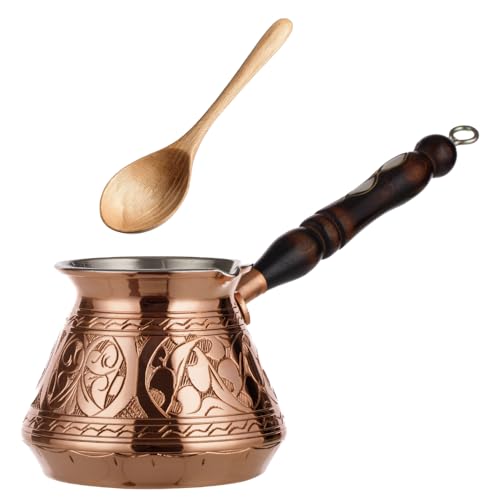
Copper Cezve, 3 servings
$43.99Live Amazon price · as of 10/26/2026 10:34 PM
The traditional pot: copper for fast, even heat, tin-lined inside, and sized so the foam has room to climb. Listing states 1 mm thick copper with a wooden handle and a food-safe tin-lined interior, handmade and hand-engraved in Turkey, 9 fl oz for 3 Turkish coffee servings at 2 oz per cup, for gas and electric stovetops.
$14.90Live Amazon price · as of 10/26/2026 11:34 PM
The low-maintenance cezve: steel rather than copper, dishwasher safe, and the cheapest way into the method. Listing states a mirror-polished 18/10 stainless steel Turkish coffee pot, 3.3 inches high by 3 inches wide with a 12 oz (355 ml) capacity, a wide lip to avoid spills, and dishwasher safe.
$29.99Live Amazon price · as of 10/26/2026 11:34 PM
The induction answer, since copper will not heat on a modern induction hob. Listing states 1 mm food-grade stainless steel with a double-layer base, heating on induction, gas, electric and ceramic cooktops, a stay-cool handle with dual pour spouts, dishwasher safe, 15 oz (450 ml) brewing 3 to 4 cups, supplied with a measuring scoop.
$14.95Live Amazon price · as of 10/27/2026 1:14 AM
The Istanbul house whose own brew guide this page follows, ground far finer than any home grinder reaches. Listing states a medium roast for cezve, 100% arabica, ground extra fine for authentic Turkish coffee preparation, in an 8.8 oz tin, from a house trading since 1871.
Measure cold water with the cup you will serve in, add one heaped teaspoon (about 6 g) of flour-fine coffee per cup and any sugar, stir, then heat slowly in a cezve without stirring again. When the foam rises, take it off, spoon foam into each cup, bring it up a second time and pour gently. Never let it boil.
What grind do I need for Turkish coffee?
The finest in coffee, finer than espresso and closer to flour. Most home grinders cannot reach it, including electric burr grinders sold for espresso. Traditional brass Turkish mills are built for it, and a few hand grinders can be pushed there. For most kitchens, buying coffee ground for cezve is the practical answer.
What is a cezve?
The small, long-handled pot Turkish coffee is brewed in, also called an ibrik or a briki. Its wide base takes the heat, its narrow neck concentrates the rising foam, and the long handle lets you lift it off the moment the foam climbs. Copper is traditional; steel is easier to look after and works on induction.
How much coffee per cup of Turkish coffee?
One heaped teaspoon, about 6 g, per demitasse cup of water, which is roughly 2 to 3 oz. Measure the water with the cup itself and the ratio takes care of itself. It is a small, concentrated drink and does not scale up to a mug.
Why does my Turkish coffee have no foam?
Usually the heat was too high, so the coffee came up too fast for the foam to build. The other causes are a grind that is too coarse, stirring after the foam started forming, or a cezve filled too full for the foam to gather in the neck. Low heat and patience fix most cases.
Do you boil Turkish coffee?
No. It is brought up to the point of foaming twice and taken off the heat each time before it boils. A rolling boil collapses the foam and over-extracts the very fine grounds, which is the difference between a good cup and a bitter one.
Do you drink the grounds in Turkish coffee?
No. The coffee is poured unfiltered, but the grounds settle in the bottom of the cup over a minute or two. You drink the clear coffee above them and stop at roughly the last quarter. Do not stir the cup at the table, which puts the sediment back into suspension.
Sources for this page:
The brewing sequence (measure water with the cup, one teaspoon of coffee per cup, add sugar before brewing, heat slowly while stirring until it foams, spoon foam into the cups, bring to a second rise, fill gently, serve with a glass of water): Kurukahveci Mehmet Efendi's own cezve brew guide at mehmetefendi.com, read 2026-09-08 · Grind fineness (finer than espresso, closer to flour) and the two-rise foam method: corroborated across Mehmet Efendi's guide and our grind size chart's Turkish band, read 2026-09-08 · UNESCO inscription of Turkish coffee culture and tradition on the Representative List of the Intangible Cultural Heritage of Humanity, 2013 · Product facts (copper thickness and tin lining, capacities, stainless grades, induction compatibility, extra-fine grind): each item's own Amazon listing, read 2026-09-08 We have not lab-tested brewers; where a figure is a manufacturer's, the page names the manufacturer, and machine capabilities come from our own published review records.