6 facts, each with a source below7 questions answered7 verified products
Medium grind coffee is ground to the texture of table salt or coarse sand: distinct grains you can feel between finger and thumb, finer than the sea-salt grit of a French press grind and coarser than the powdery grind of espresso. It is the default for automatic drip machines and siphons, the coarser starting point for pour-over cones and the AeroPress, and the grind that pre-ground supermarket coffee is sold at. This page describes it by texture and by the brewers that use it rather than in microns, because a universal micron figure is only meaningful with the grinder and burrs it was measured on, and we have measured none.
TextureTable salt or coarse sand: grains you can feel, no powder, no chunks
Uses it as the defaultAutomatic drip, siphon
Uses it at the coarser edgePour-over (V60, Kalita), AeroPress; both span medium and medium-fine
One band coarserChemex (medium-coarse); French press and cold brew (coarse)
One band finerMoka pot (medium-fine to fine); espresso is finer still
Pre-ground bagsSold as ground or drip grind; the medium band is what most of them mean
The seven grind bands in order, medium highlighted. The bands are drawn at equal size on purpose: this shows order and texture, not particle sizes, and it is drawn from the same method mapping as our grind size chart.
Medium grind up close: distinct grains, roughly the size of table salt, with no fine powder and no large chunks. Photo: Yohan Marion / Unsplash
What medium grind looks and feels like
Pinch a little between finger and thumb. Medium grind feels granular, like table salt or coarse sand: each grain is distinct, the pinch does not clump or hold its shape when you release it, and there is no dusting of powder on your fingers afterwards. Coarser than that and it starts to feel like sea salt or breadcrumbs, the French press band. Finer and it begins to cling and feel powdery, the medium-fine and fine bands where the moka pot and then espresso live. Texture is the honest way to describe it, and it is the way every grind chart worth reading uses, because the alternative, a range in microns, depends on the grinder and burr set it was measured on and on whether the number describes an average or the whole spread.
That spread matters as much as the size. A good medium grind is uniform: most grains close to the same size, few fines and few boulders. A blade grinder produces a medium average from a mix of dust and chunks, and the dust over-extracts while the chunks under-extract, which is why the same average grind from a burr grinder and a blade grinder makes two different cups. Our grind size chart sets out all seven bands with the same texture descriptions used here; this page goes deep on the one band that most home brewing starts from.
Which brewers use a medium grind
Grind size is a way of controlling how fast water extracts coffee: finer grounds expose more surface and extract faster, coarser grounds extract slower. A brewer's contact time therefore decides its grind. Methods where water passes through the bed in a few minutes want medium; methods where coffee steeps for four minutes or more want coarser; methods where water is forced through in under a minute want finer. Here is where medium sits, from the same method mapping our grind chart publishes:
Brewer
Grind band
Why
Automatic drip
Medium
A flat or cone basket with a three-to-six-minute brew; the default medium grind is designed for exactly this
Siphon
Medium
A short immersion under vapour pressure with a cloth or paper filter
Pour-over (V60, Kalita)
Medium-fine to medium
Manual pour with a three-minute drain; medium is the coarser, more forgiving starting point
AeroPress
Medium-fine to medium
Recipes vary widely; the maker's own recipe uses a medium-fine grind and a two-minute brew
Chemex
Medium-coarse
Thick bonded filters drain slowly, so the grind goes one band coarser
French press, cold brew
Coarse
Long immersion; medium grind would over-extract and slip through the mesh
Moka pot
Fine to medium-fine
Steam pressure needs a finer, tightly packed bed; medium runs weak
Notice that medium is a starting point for pour-over and the AeroPress rather than the answer: both span two bands, and a recipe, a coffee or a filter can move them. The pour-over guide and the AeroPress guide give each method's own recipe.
Grinder settings for a medium grind
No two grinders share a scale, so the only number that means anything is the one the manufacturer publishes for its own machine. Our grind chart records the guidance we could verify on the makers' own pages, and for the medium band it comes to this: the Baratza Encore ESP's manufacturer puts settings 21 to 40 in the filter, French press and cold brew range, so medium for drip sits in the lower part of that span; the Breville Smart Grinder Pro publishes 60 settings from espresso to French press, with medium in the middle third; the Fellow Ode Gen 2 is designed for brewed-coffee methods only, so its whole 11-setting dial with 31 steps is the filter range and medium sits around its centre. For hand grinders, the 1Zpresso J publishes 30 clicks per rotation, and drip grinds land in the upper rotations. The chart page reproduces each maker's own words and the date we read them.
Use the manufacturer's range to find the neighbourhood, then use the pinch test and the cup to find the setting. A grinder's number is a starting point that drifts with the coffee: a dense light roast wants a step finer than a dark roast at the same setting, and burrs wear over years toward coarser. Dial in once per bag, one step at a time, and write the setting on the bag.
Too fine or too coarse: reading the cup
The cup tells you which way to move. A brew that tastes sour, thin or weak, or that drains through a pour-over too fast, is under-extracted: the grind is too coarse for the brewer, and one step finer fixes it. A brew that tastes bitter, harsh or muddy, drains slowly, or leaves a thick sludge in the bottom of the cup is over-extracted or clogged: the grind is too fine, and one step coarser fixes it. Change the grind before you change the dose or the water, because grind is the variable with the largest effect and the easiest to reverse.
Two medium-grind failures are common enough to name. On automatic drip machines a grind that is too fine, often from a supermarket bag ground for espresso by mistake, overflows the basket as water backs up behind a clogged bed; the fix is a coarser bag, not more filters. On a pour-over, a medium grind from a blade grinder produces a drain that stalls halfway because the fines migrate to the filter and seal it; the fix is a burr grinder, not a different recipe. Our ratio calculator keeps the dose constant while you sort the grind out, which is the only way to know which variable you are actually tasting.
Pre-ground medium bags, honestly
Most pre-ground coffee is ground medium, because most of it is bought for automatic drip machines. The bags below say so on their own listings: one is positioned for drip or French press, one for the pot or the single cup, one is pre-ground at the roastery on a setting its maker says suits nearly any drip brewer, and one is a drip grind of an Italian espresso blend. All are verified catalog entries, and every fact on a card is the listing's statement rather than ours.
Two honest caveats. Pre-ground coffee goes stale far faster than whole bean, because grinding multiplies the surface exposed to air; buy the smallest bag that fits your consumption and use it within a couple of weeks of opening. And a pre-ground bag's medium is whatever its roaster decided medium meant, which will not match your neighbour's brand or your own grinder's medium exactly; if a bag brews weak in your machine, that bag is coarser than your machine likes, and the next bag may not be. For a drinker who brews a pot every morning in a drip machine, pre-ground medium is a perfectly sensible default. For anyone who has noticed the difference, the section below is the upgrade.
Whole bean and a grinder: the upgrade that changes the cup
Grinding just before brewing is the single largest improvement most drip and pour-over drinkers can make, ahead of a better brewer and ahead of more expensive coffee, because aroma that has already left a pre-ground bag cannot be put back. The grinder does not need to be an espresso grinder; medium grinds are easier to produce well than fine ones, and an entry burr grinder does it uniformly. Two from our reviewed catalog are carded below: the Baratza Encore ESP, whose filter range is documented above and which also reaches espresso, and the Fellow Ode Gen 2, a flat-burr grinder designed for brewed coffee only, which our review scores accordingly on an espresso-focused site but which is precisely the tool for a medium grind. The best coffee grinder guide sets out the whole decision, and the hand grinder guide covers the manual route for travel and small kitchens.
Verified products for this page
ℹ️
Affiliate disclosure: CoffeeLabAdvisor is an Amazon Associate and may earn a commission from these links, at no extra cost to you. Commissions play no part in what appears here — every product traces to a verified catalog entry or a published review.
Five pre-ground bags whose listings describe a medium or drip grind, and two reviewed grinders that produce a medium grind well. Product facts are each listing's own words; grinder scores are from our published reviews.
Medium grind, pre-ground
Lavazza
Classico Ground Coffee
$16.59Live Amazon price · as of 10/27/2026 1:13 AM
The pre-ground drip default from Italy: medium roast, ground for the filter basket. Listing states a medium roast Italian ground coffee blend, roasted in Italy, non-GMO, best used in a drip coffee maker or French press, in a 20 oz bag.
$14.99Live Amazon price · as of 10/27/2026 12:44 AM
A specialty organic blend pre-ground at the roastery on a setting the listing says suits nearly any drip brewer. Listing states an organic medium roast ground coffee, Direct Trade, 100% arabica, pre-ground at the roastery on a setting that works for just about any drip brewer, in a 12 oz bag.
$22.96Live Amazon price · as of 10/27/2026 1:13 AM
The supermarket medium: a large canister ground for the pot or the single cup. Listing states a medium roast ground coffee made with arabica beans, for brewing by the cup or pot, hot or iced, in a resealable 30 oz canister.
$20.31Live Amazon price · as of 10/27/2026 1:13 AM
The oldest recipe in the American supermarket aisle, ground medium. Listing states a medium roast ground coffee, 100% arabica, kosher certified, sweet, fruity and well-balanced in its own words, in an 18 oz bag.
$12.74Live Amazon price · as of 10/26/2026 9:52 PM
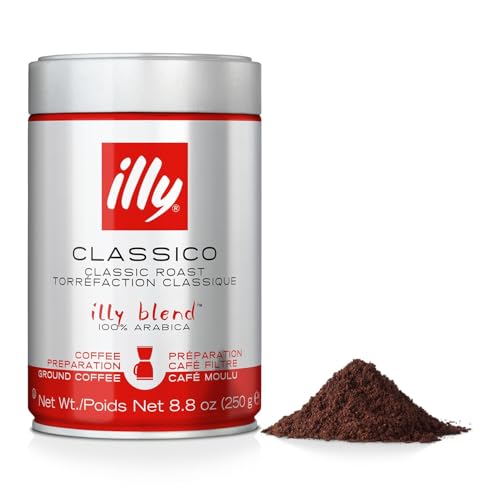
The same illy blend ground for drip, which is what a medium grind is for. Listing states a medium roast ground coffee for drip, with a lingering sweetness and notes of caramel, orange blossom and jasmine, in an 8.8 oz can.
$199.95Live Amazon price · as of 10/26/2026 8:03 PM
40 mm burrs · Conical Burr The best espresso grinder under $200: a repairable 40mm conical with 40 steps that pairs well with entry-level machines. Reliable and consistent, if not the clearest or most premium-feeling option.
$399.95Live Amazon price · as of 10/26/2026 8:26 PM
64 mm burrs · Flat Burr The definitive brew-only grinder: 64mm flat burrs, quiet operation and beautiful design for pour-over and drip. It cannot grind espresso, so it is a poor buy for espresso drinkers — and endgame for brew-only purists.
Coffee ground to the texture of table salt or coarse sand: distinct grains you can feel, with no powder and no chunks. It is finer than the sea-salt grind of a French press and coarser than the powdery grind of espresso, and it is the default grind for automatic drip machines and siphons and the coarser starting point for pour-over and the AeroPress.
What brewers use a medium grind?
Automatic drip and siphon use it as the default. Pour-over cones such as the V60 and Kalita, and the AeroPress, span medium and medium-fine. Chemex goes one band coarser, French press and cold brew coarser still, and the moka pot one band finer. Grind size tracks contact time: a few minutes of flow wants medium.
What number is medium grind on my grinder?
Whatever the manufacturer publishes for filter brewing on that model, then adjusted by taste. Our grind chart records each maker's own guidance: the Baratza Encore ESP places filter grinds at settings 21 to 40, the Breville Smart Grinder Pro spans 60 settings with medium in the middle third, and the Fellow Ode Gen 2's whole dial is the filter range. No two scales match.
Is medium grind the same as drip grind?
In practice yes. Drip grind is the label pre-ground bags use for the medium band, because most pre-ground coffee is sold for automatic drip machines. One roaster's medium will not match another's exactly, so treat a bag's grind as a starting point and adjust the dose or the brewer if it brews weak or slow.
Can I use medium grind coffee in a French press?
You can, but it is a compromise. A French press steeps for four minutes or more, and a medium grind over-extracts in that time and slips through the mesh into the cup. Coarse is the right band. If medium is all you have, shorten the steep and expect some sediment.
Can I use medium grind for espresso?
No. An espresso machine forces water through the puck in under thirty seconds, and a medium grind offers so little resistance that the shot gushes out fast, pale and sour. Espresso needs a fine, powdery grind, and a pressurised basket can only partly hide the difference. The moka pot, one band finer than medium, is the closest stovetop equivalent.
How do I know if my grind is too fine or too coarse?
Taste and time. Sour, thin, weak or fast-draining means too coarse; go one step finer. Bitter, harsh, muddy, slow-draining or sludgy means too fine; go one step coarser. Change the grind before the dose or the water, and change one step at a time.
Sources for this page:
Grind bands, texture descriptions and the method-to-band mapping: our grind size chart, whose mapping this page reproduces; the chart's own sources are listed there · Manufacturer grinder guidance (Baratza Encore ESP settings 21–40 for filter, French press and cold brew; Breville Smart Grinder Pro 60 settings from espresso to French press; Fellow Ode Gen 2 designed for brewed methods, 11 settings with 31 steps; 1Zpresso J 30 clicks per rotation): the makers' own product pages as read for the grind chart on 30 August 2026 and quoted there · AeroPress medium-fine grind and two-minute brew: the maker's own recipe as documented on our AeroPress guide · Pre-ground bag facts (drip or French press use, roastery grind setting, canister size): each bag's own Amazon listing, read 2026-09-07 We have not lab-tested brewers; where a figure is a manufacturer's, the page names the manufacturer, and machine capabilities come from our own published review records.