8 facts, each with a source below5 questions answered6 verified products
A French press does not need a fine grind, so it does not need an expensive espresso grinder. It needs something harder to buy: consistency at the coarse end. A press steeps for minutes and then strains through a metal mesh, so every particle smaller than that mesh goes into your cup and keeps extracting while you drink it. That is what sludge at the bottom actually is, and it is why the same beans taste clean from a pour-over and muddy from a press. A burr grinder producing a tight spread of coarse particles solves it; a blade grinder cannot, because it chops until you stop and makes both sizes at once. The good news is that this is a cheaper requirement than espresso, and a hand grinder does it comfortably.
What a press needsConsistency at coarse, not fineness
WhyMetal mesh, not paper
The failure modeSludge, and bitterness late in the cup
Blade grindersCannot do this, by design
Hand grindersWork well here; coarse is easy
Do not buyAn espresso grinder, for this alone
Not on this pageGrind charts, doses or any score
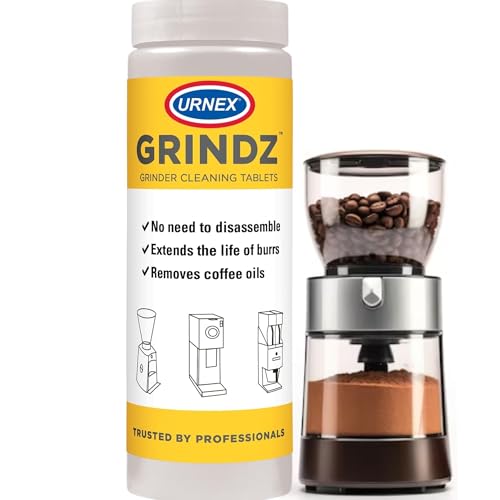
Also worth owningGrinder cleaning tablets
Both cups were ground coarse. The difference is the cloud of fines on the right, and a metal filter does not remove them.
What this page is for
This page answers one question: which grinder should you buy if you brew with a French press. It is a buying page, and it argues from what a press does to what that requires of a grinder.
Three related things live elsewhere on this site and are not repeated here:
Every other common brewer filters through paper, and paper catches the small stuff. A press filters through a metal screen with holes you can see, and it holds the coffee in contact with the water for several minutes before it does.
Two consequences follow, and they are the reason this page exists.
Fines pass straight through. Anything smaller than the mesh ends up in the cup. That is the silt at the bottom, and it is not inert — it carries on extracting in the mug, which is why the last third of a press tastes harsher than the first.
Long contact punishes inconsistency. Over four minutes, a small particle gives up far more than a large one. A grind made of two sizes brews as two different coffees at once: one under-extracted and sour, one over-extracted and bitter, served together.
So the specification you are shopping for is not how fine can it go. It is how uniform is it when set coarse, which is a different and less expensive thing.
Why a blade grinder cannot do this
This is a mechanical point rather than a brand one, and it applies to every blade grinder ever made.
A burr grinder sets a gap and passes beans through it, so particle size is determined by the machine. A blade grinder spins a knife and chops whatever is in reach for as long as you hold the button. Beans near the blade are pulverised while beans at the edge stay in chunks, and the longer you run it to break up the chunks, the more of the rest turns to dust.
For a press, that combination is the worst case: you get the coarse pieces you wanted and a load of fines, and the metal filter passes the fines to your cup. No technique fixes it, because it is the tool rather than the operator.
If a blade grinder is what you own today, that is fine and a press will still make coffee. But it is the first thing to change, and it is the reason this page recommends spending on a burr grinder before anything else.
What to look for, and what we card
Three specifications matter for coarse brewing, and none of them is the one espresso buyers chase.
Burrs, of any type. Conical or flat both do this well. The flat-versus-conical argument is an espresso argument; at coarse settings it matters far less than simply having burrs at all.
Enough range at the coarse end. Some grinders built around espresso run out of adjustment before they get properly coarse, which is the opposite of the usual worry. A grinder that is explicitly brew-oriented has its whole range where you need it.
Grounds that come out cleanly. Static and retention are ordinary annoyances at fine settings and much less of a problem coarse, which is one more reason this is an easier purchase than espresso.
The cards below are grinders from our catalog that suit this. One is brew-only by design, which sounds like a limitation and is an advantage here: every click of its range is in territory a press can use.
A hand grinder is a genuinely good answer here
Coarse grinding is the easiest work you can ask of a hand grinder. The burrs sit far apart, the beans offer little resistance, and a press dose takes well under a minute of unhurried cranking.
That changes the value calculation. The usual objection to hand grinders — that espresso makes them a chore — simply does not apply, and for one or two mugs a day a hand grinder gives you burr quality that an electric at the same price cannot.
Our hand grinder guide covers what separates them from each other. For a press specifically, prioritise catch cup capacity over fine adjustment: press doses are large, and a cup that holds less than your usual dose means grinding twice.
The mistake worth avoiding
The most common way to overspend here is to buy an espresso grinder because it is the most capable thing on the shelf.
Espresso grinders are expensive because holding a fine grind consistently under pressure is difficult and needs precise, tiny adjustments. A press uses none of that. You would be paying for engineering your brewer cannot exploit, and on some of those grinders you will also find the coarse end of the range is where they are weakest.
If you brew espresso as well, that is a different question and the answer changes — the espresso grinder guide is the page for it. If a press is what you own, buy the grinder that is good at coarse and spend the difference on better beans, which will do more for the cup than any grinder upgrade at this point.
Where this page stops
Nothing on this page is scored. Where a grinder here has been through our evaluation protocol, its card links to that review; where it has not, the card says the specifications are documented rather than tested, and no number is attached either way.
The particle-size argument above is a mechanical one about burrs, meshes and contact time, and we have stated it as reasoning rather than as measurement. We have not run a particle-size analysis on these grinders and we are not going to publish numbers we did not produce.
Verified products for this page
ℹ️Affiliate disclosure: CoffeeLabAdvisor is an Amazon Associate and may earn a commission from these links, at no extra cost to you. Commissions play no part in what appears here — every product traces to a verified catalog entry or a published review.
Grinders from our catalog that suit coarse brewing, plus the cleaning tablets any burr grinder eventually needs. Reviewed grinders link to their review; the hand grinders are documented from published specifications and carry no score.
$399.95Live Amazon price · as of 09/22/2026 4:30 AM
64 mm burrs · Flat Burr The definitive brew-only grinder: 64mm flat burrs, quiet operation and beautiful design for pour-over and drip. It cannot grind espresso, so it is a poor buy for espresso drinkers — and endgame for brew-only purists.
$199.95Live Amazon price · as of 09/22/2026 4:24 AM
40 mm burrs · Conical Burr The best espresso grinder under $200: a repairable 40mm conical with 40 steps that pairs well with entry-level machines. Reliable and consistent, if not the clearest or most premium-feeling option.
$199.95Live Amazon price · as of 09/22/2026 4:30 AM
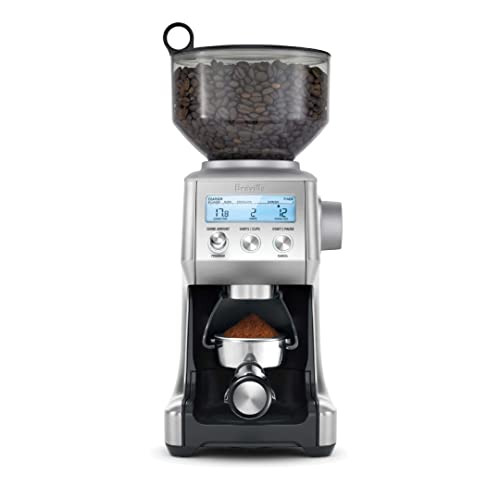
40 mm burrs · Conical Burr The Breville Smart Grinder Pro is the long-selling $200 conical with 60 settings and Dosing iQ timed dosing — a breadth-first grinder whose record is carried by usability and value rather than by outright grind performance.
$139.00Live Amazon price · as of 09/22/2026 4:54 AM
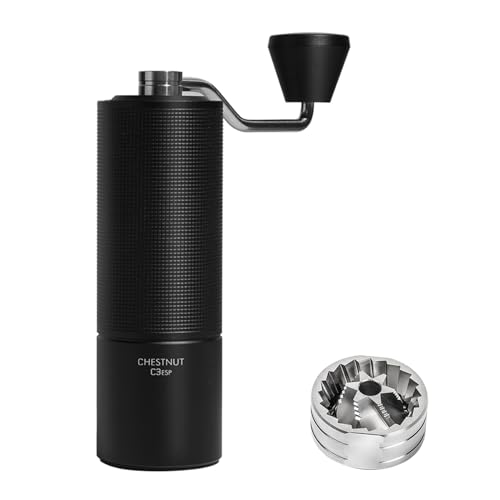
48 mm burrs · Conical Burr 1Zpresso publishes a 48 mm conical burr, a 30-click system per rotation, a 30–35 g capacity and a 705 g body. That burr diameter is part of what a manual grinder can offer at this price; what it is worth in the cup depends on geometry and alignment, which we do not measure.
$99.00Live Amazon price · as of 09/22/2026 4:54 AM
Conical Burr The lowest-priced of the four here, and a burr grinder rather than a blade. Its retail listing describes a stainless steel conical burr set of TIMEMORE's S2C design — S2C names the burr family rather than the material, and this is a listing claim we have not verified against a manufacturer datasheet. At this price the meaningful comparison is often against a blade grinder, and moving to a burr grinder is the more consequential change in grinding method.
Coarse, but the more useful answer is consistently coarse. A press strains through a metal mesh rather than paper, so any particle smaller than the mesh reaches your cup and carries on extracting while you drink. That is what sludge is. A burr grinder producing a tight spread of coarse particles is what you are shopping for; our how-to-grind guide covers the settings themselves.
Can I use a blade grinder for French press?
It will make coffee, but it is the worst pairing in common use. A blade chops rather than sizing: beans near the blade turn to dust while the rest stay chunky, so you get coarse pieces and a cloud of fines at the same time. A press then passes those fines straight into the cup. This is a limitation of the tool rather than of technique, and no grind time fixes it.
Do I need an expensive grinder for a French press?
No, and an espresso grinder is usually the wrong purchase. Espresso grinders cost what they do because holding a fine grind consistently demands precise, tiny adjustments, and a press uses none of that. What a press needs is uniformity at the coarse end, which is a cheaper requirement. Spend the difference on fresher beans.
Is a hand grinder good for French press?
It is one of the best pairings there is. Coarse grinding is the easiest work you can ask of a hand grinder, because the burrs sit far apart and the beans barely resist, so a press dose takes well under a minute. The usual objection to hand grinders is espresso, which does not apply here. Prioritise catch cup capacity, since press doses are large.
Why is there sludge at the bottom of my French press?
Fines passing the metal filter, almost always from the grinder. Anything smaller than the mesh goes through, and because it keeps extracting in the mug it also explains why the last of a press tastes harsher than the first. A burr grinder set coarse reduces it sharply. Pouring gently and leaving the last centimetre in the pot helps with what remains.
Sources for this page:
Grinder specifications are each maker's own published figures as recorded in our catalog records, with the listing read date on every card; product facts on the cards are the Amazon listing's own statements, read on 2026-09-11. We have not lab-tested brewers; where a figure is a manufacturer's, the page names the manufacturer, and machine capabilities come from our own published review records.