8 facts, each with a source below5 questions answered7 verified products
Buy in this order: coffee, grinder, brewer, scale, kettle, storage. It is almost exactly the reverse of how most people start, and that is the point. Fresh coffee with a roast date on the bag costs the least of anything here and changes the cup the most — nothing further down the list rescues stale beans. Then a burr grinder, which is the single biggest equipment upgrade available and where a hand grinder competes far above its price. The brewer can be cheap: a press or a dripper costs very little and is genuinely hard to beat for the money. A scale makes a good cup repeatable, which is a different thing from making it good. The whole kit together costs less than one entry-level espresso machine, which is not on this list on purpose.
Each step changes the cup more than the one below it. Most people start at the bottom, with the machine.
Who this page is for
Someone starting from nothing, or close to it, who wants a genuinely good cup at home without deciding which of forty machines to buy first.
Two adjacent pages cover different situations:
You already own an espresso machine and want to know what to add — espresso machine accessories, which has the buying order for that situation.
You are buying this for somebody else — coffee gifts, which is organised by budget rather than by sequence.
This page assumes you are building it for yourself and will actually use every item, which changes the answer quite a lot.
1. Coffee, with a roast date
The cheapest item on the list and the one that changes the most, which is why it comes first.
The thing to look for is a roast date rather than a best-before date. A best-before date tells you when a bag was packed to be legally sellable; a roast date tells you when the coffee was actually made. Bags carrying only the former are usually old, and no equipment recovers what has already gone.
Buy whole bean rather than pre-ground, because the grinder is the next item and pre-ground coffee makes it pointless. Buy a size you will finish in a few weeks rather than the biggest bag on the shelf.
Our bean guide covers what to actually buy, and storage covers keeping it once you have it.
2. A burr grinder
The biggest single equipment upgrade in home coffee, and the step most people skip.
The jump that matters is from a blade to burrs. A blade chops until you let go, producing dust and chunks at the same time; burrs set a gap and size the coffee. Everything about consistency in the cup follows from that, and the difference is not subtle.
Hand or electric is a lifestyle question rather than a quality one at the entry level. A hand grinder buys better burrs for the same money and asks for a minute of your morning. An electric one is faster and easier and spends more of the price on the motor and housing.
Whichever you choose, this is the item on the list worth stretching for, because it is the one you will notice every single day.
3. A brewer, and it can be inexpensive
Here is the good news that makes this whole list affordable: the brewer is not where the quality lives.
A French press is about as simple as brewing gets, needs no paper, and makes a heavy, full-bodied cup. It is forgiving of technique and unforgiving of a bad grinder, which is why it sits below the grinder on this list. It also doubles as a cold brewer.
A pour-over dripper costs similarly little, makes a cleaner and more articulate cup, and asks more of your pouring. It needs the right filters, which are cheap but specific to the dripper.
Either will out-perform a cheap drip machine with the same coffee, which is the part that surprises people. If you want a machine to do it while you shower, the drip guide is the page for that, and it is a legitimate choice rather than a compromise.
4. A scale
A scale does not make coffee better. It makes a good cup repeatable, which over a month is the same thing.
Scoops are the problem it solves. A scoop of light roast and a scoop of dark roast are different weights of coffee, and so are a scoop of coarse grounds and a scoop of fine. Weighing removes a variable you did not know you had, and it is the reason a cup you loved on Tuesday is hard to reproduce on Thursday.
A basic kitchen scale with a tare function and one-gram resolution is entirely sufficient for filter brewing. The 0.1 g precision and built-in timer of an espresso scale are real features that filter brewing does not need — that is an upgrade for later, and only if espresso arrives.
5 and 6. A kettle, then somewhere to keep the beans
Both are genuine improvements and both are smaller than everything above, which is why they are last rather than absent.
A gooseneck kettle gives you control of where the water goes, which matters for pour-over and not at all for a press. The temperature-controlled versions are a further step and a further cost; for most people a gooseneck spout without temperature control is the sensible middle, since water off the boil for thirty seconds lands close enough.
An airtight container protects what you bought in step one. Coffee goes stale through contact with air, so a container that actively reduces the air in it does more than a jar with a lid. Keep it out of sunlight and away from the cooker, and do not keep beans in the freezer in a bag you open repeatedly.
What is deliberately not on this list
An espresso machine. This is not an oversight and it is not snobbery about pods or push-button machines.
Espresso is a different hobby with a different budget. It needs a grinder capable of fine, precise adjustment — a much more expensive class than the one above — and a machine that holds pressure and temperature. Buying an entry machine without the grinder to feed it is the most common expensive disappointment in home coffee, and it is why this site keeps saying it.
If espresso is genuinely what you want, start at the beginner espresso guide and budget for the grinder at the same time. If what you want is a very good mug of coffee in the morning, the list above gets you there for a fraction of it.
Also not here: flavouring, milk frothers and anything for iced coffee. All fine things, none of them foundational, and each has its own page when you want it.
Where this page stops
The order above is an editorial judgement, and we would rather say so than dress it up as a finding. It rests on a simple claim: freshness and grind consistency affect the cup more than brewer choice does, and both cost less to fix.
Every product fact on the cards is its listing's own statement, read on the date shown. Nothing on this page is scored, and the grinders are deliberately not carded here — that decision deserves its own page rather than a card in a list of six things.
Verified products for this page
ℹ️Affiliate disclosure: CoffeeLabAdvisor is an Amazon Associate and may earn a commission from these links, at no extra cost to you. Commissions play no part in what appears here — every product traces to a verified catalog entry or a published review.
The kit itself, from our verified catalog. The grinders are on their own pages because that is the decision worth the most thought. Each product fact is its listing's own statement, read on the date shown on the card.
Scale
Amazon Basics
Digital Kitchen Scale with LCD
$9.89Live Amazon price · as of 09/22/2026 4:10 AM
A scale at all beats no scale; this is the cheapest honest one. Listing states a digital kitchen scale with an LCD display, a tare function and multiple units.
$39.97Live Amazon price · as of 09/22/2026 4:10 AM
A gooseneck spout, without the temperature control premium. Listing states a 27 oz gooseneck electric water kettle intended for pour over coffee and tea.
$44.00Live Amazon price · as of 09/22/2026 12:17 AM
The plunger lid removes the headspace instead of just sealing it, which is the whole problem with a jar. Listing states a patented inner lid that pushes the air out of the canister as it is pressed down, a medium size holding approximately 1 lb (500 g) of whole-bean coffee at 5 inches wide by 7 inches high, in stainless steel.
$19.99Live Amazon price · as of 09/22/2026 2:11 AM
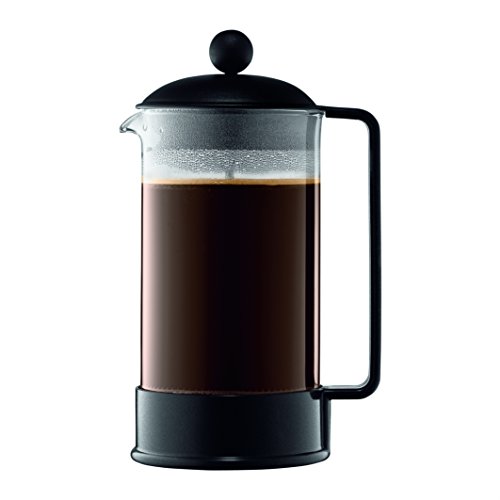
The $20 workhorse - same brewing as presses at three times the price. Listing states the Bodum 34 oz Brazil French press in high-heat borosilicate glass, made in Portugal.
What do I need to start making good coffee at home?
Six things, in this order: fresh coffee with a roast date, a burr grinder, a brewer, a scale, a kettle and an airtight container. The order matters more than the budget. Fresh coffee costs the least and changes the most, the grinder is the biggest equipment jump, and the brewer can be genuinely inexpensive. The whole kit costs less than one entry-level espresso machine.
Should I buy a grinder or a coffee maker first?
The grinder, if you are buying whole bean coffee. Going from a blade to burrs is the single biggest equipment improvement available, because burrs size the coffee while a blade chops it into dust and chunks at once. A cheap brewer with a good grinder beats an expensive brewer with a bad one, which is the opposite of how most people spend.
Do I really need a coffee scale?
You need it to repeat yourself. A scale does not improve a cup; it lets you make the same cup twice. Scoops vary with roast level and grind size, so a scoop is not a fixed amount of coffee. A basic scale with a tare function and one-gram resolution is plenty for filter brewing. The 0.1 g precision and timer of an espresso scale are for espresso.
Is a French press or a pour-over better for a beginner?
A press is more forgiving of technique and needs no paper, and it makes a heavier cup. A pour-over makes a cleaner one and asks more of your pouring. Both cost little and both out-perform a cheap drip machine with the same coffee. If your grinder is entry-level, the press is the kinder starting point because a pour-over shows grind inconsistency more clearly.
Why is an espresso machine not in a coffee starter kit?
Because it is a different hobby with a different budget. Espresso needs a grinder with fine, precise adjustment, which is a much more expensive class than a good filter grinder, plus a machine that holds pressure and temperature. Buying the machine without the grinder to feed it is the most common expensive disappointment in home coffee.
Sources for this page:
Every product fact on this page is its Amazon listing's own statement, read on 2026-09-11. Prices on the cards are fetched live and are not written into the text. We have not lab-tested brewers; where a figure is a manufacturer's, the page names the manufacturer, and machine capabilities come from our own published review records.